
When you review tools daily, you tend to get a lot of questions. One of those questions came from a reader responding to one of our topical interviews with another publication. Essentially, they wanted to know why hoverboard batteries exploded but power tools don’t. It’s actually a great question. After all, you’d think the high-current output of power tool battery packs would make them more susceptible to fires and spontaneous combustion than something under a child’s hoverboard.
Question from Duncan: Clint, I enjoyed the article on power tools and where they are likely to go in the future. It triggered a question about Lithium batteries and these hoverboards that burned up. What is the difference between the batteries used in those boards and the ones used in cordless power tools? Obviously, there is now a lengthy track record of success in the use of these batteries in portable tools, and certainly no one I know babies their tools. Do you think it is the battery design or the design and execution of the wiring and connections surrounding the power sources? Thanks, Duncan.
Why Hoverboard Batteries Exploded
In speaking with the engineers at companies like Milwaukee and Bosch in the past on the subject of how lithium-ion batteries work, we learned a great deal. Some of the issues surrounding batteries include what kind of cell and platform manufacturers use. Another really important consideration involves the kind of electronics and protection offered. After all, protection comes in electronic form as well as how the battery pack is physically designed).
With the hoverboard situation, quality control varies. Lack of control over the individual cells, pack, and/or the system itself can yield problems. Among them, you can run into any of the following conditions:
- Overcharging cells, making them rather dangerous and volatile
- Recharging cells and packs before they have sufficiently cooled down
- Using individual cells manufactured with sub-par components and quality control
- Use of cell packs constructed with little attention to heat dissipation and protection
- Designing the charger with low-cost components and no ability to cool the pack before charging
Cell Choice Matters More Than You Think
Lithium-ion cells vary—even from the same manufacturer. Some optimize high current discharge. Others optimize run-time. And, as you might guess, you can fall anywhere in between.
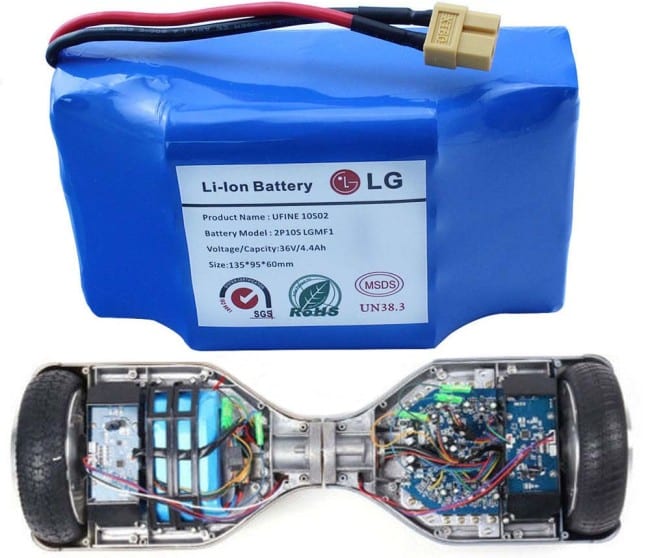
36V/4.4Ah or larger battery packs might contain as many as twenty 18650 cells. There might be a number of cells within that can either overheat, overcharge, and/or discharge at very high current. A lot of discussion has gone into the use of original Samsung cells (vs. cheaper knock-offs), but the problem of why hoverboard batteries exploded goes much deeper than that.
What Happened with Some Hoverboards
Some of the battery packs in these hoverboards overloaded and/or caught fire while charging. Others burst while being used (with the batteries discharging). Still others burst into flames while stored (after they had been used and/or charged).
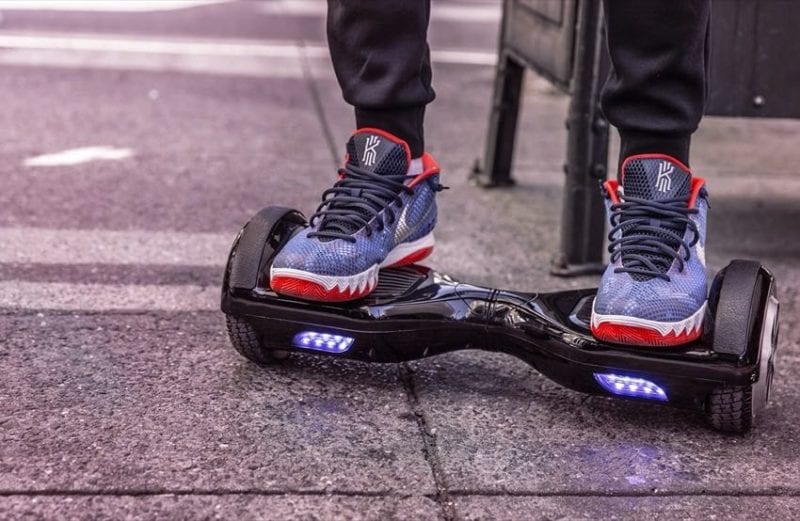
The use of stringent quality control processes keeps this from happening regularly with respect to power tools. You don’t have a ton of knock-off batteries and tools entering the US market. Contrast to what occurred with hoverboards. Everybody started knocking off both the batteries and the hoverboards themselves. Also, not many people worried about brand loyalty or quality. Let’s face it, as consumers we just expect things to work, regardless of where or who makes them. We certainly don’t expect our pants to catch on fire while riding on a toy!
Manufacturers like Milwaukee, Ridgid, Makita, DeWalt, and others incorporate a lot of technology in their tools, batteries, battery pack circuitry, and the intelligent chargers themselves. All of this is designed to keep the battery pack from discharging too quickly, running hot, being overcharged, charging while too hot, or any other potential issues. And if you notice, not too many quality power tools come with “wall-wart” style chargers. Most actually serve to cool the battery before it charges.
Wrapping It All Up
In conclusion, the reason why hoverboard batteries exploded involves a little bit of everything we mentioned. You have poor battery design. Little attention may have been paid to the electronics and connections. Finally, tool companies now have a decade or more of experience with lithium-ion cells and packs. They have proven track records on how to safely discharge 20 amps or more from a pack.
Maybe we should all be just a little bit more impressed the next time we grab a battery pack!
Hope that helps—have a great week!