
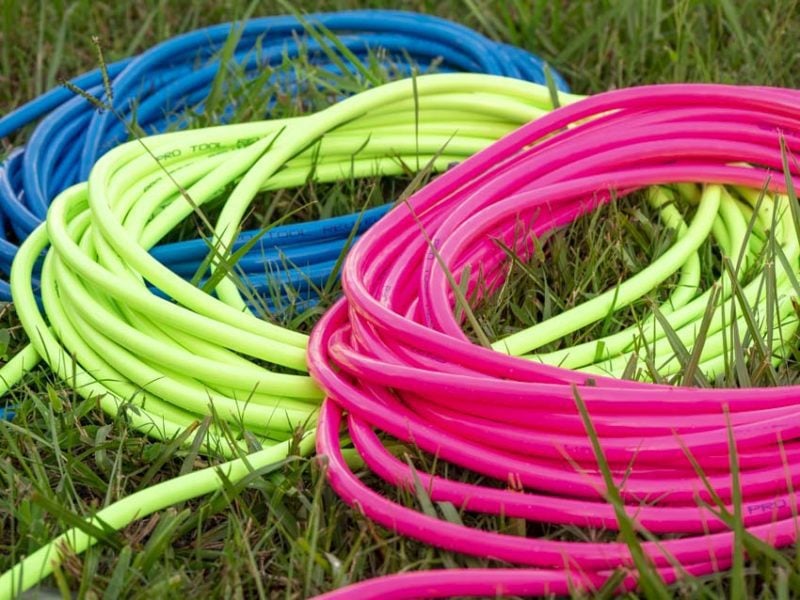
While the use of cordless tools is expanding, corded tools still have their place on construction and home renovation sites. That brings about the common question: What kind of extension cord do I need? The best rule of thumb is: The heavier the cord, the better.
You’ll find that extension cords are typically available in sizes ranging from 18 AWG (smaller wire gauge) to 10 AWG (larger wire gauge), with lengths that may vary from as short as 6 feet to over 100 feet. Just as choosing the best ladder for the job ensures you have the right equipment, using the right kind of extension cord ensures you have enough power, preventing overheating of the cable and damage to your tools. This comes in handy when you plug in a table saw from a temporary pole located on the back side of a jobsite.
Length Matters in What Kind of Extension Cord You Need
Lest you think that it’s all math (actually, it is) the one thing you need to keep in mind when figuring out what kind of extension cord you need is that power gets lost across an extension cord. That means that the longer it is, the less current you can safely deliver to the tool. It also requires a thicker wire gauge (AWG) in order to carry the required current. Remember, thicker AWG (wire gauge) is represented by a lower number.
Extension Cord Lengths and Current Chart
Here’s a “cheat sheet” on the recommended electrical extension gauge required per cord length, given various ampere (current) demands. The more current you need and the longer the cable, the thicker it needs to be:
| Current (Amps) | 25 ft | 50 ft | 75 ft | 100 ft | 150 ft | 200 ft |
|---|---|---|---|---|---|---|
| 0–5A | 16 | 16 | 16 | 14 | 12 | 12 |
| 5.1A–8A | 16 | 16 | 14 | 12 | 10 | — |
| 8.1A–12A | 14 | 14 | 12 | 10 | — | — |
| 12.1A–15A | 12 | 12 | 10 | 10 | — | — |
| 15.1A–20A | 10 | 10 | 10 | — | — | — |
Also, check out our Extension Cord Size Chart for even more information on how wire gauge and amps interact.
Cost in Relation to Size
Of course, the cost is a function of length and wire size, so the larger the wire size and the longer the cord, the more it will likely cost. The reason the heavier cord is a better choice is that it will allow you more flexibility in what you connect to the cord without damaging your power tool or burning up the extension cord (and whatever may be touching it).
What happens when a cord is undersized is that not enough electricity will flow through it due to resistance, which will cause the cord to heat up, sometimes to dangerous levels where the shielding on the cord melts and can cause a short circuit or even a fire. This is something to be avoided at all costs and is largely why nearly all power tools will include current ratings and recommended maximum extension cord lengths for power tools similar to the chart shown above.
Another thing that can happen when you have an undersized extension cord is that the power tool that you are using may require a certain number of volts and amps in order for the motor to function properly. Now, if the cord is undersized, the tool will have to work harder, and in some cases, this can damage the power tool. Understanding what kind of extension cord is needed to deliver the proper power to your tool will help you work more safely and effectively.