
The Ryobi Devour cordless sweeper has hit the scene with plenty of fanfare and also a little confusion. We’re here to break down what it is, what it isn’t, and how well it works. Of course, we’ll also see if it’s something that reaches into the Pro market.
So before we dive too deep into features, let’s go ahead and set the record straight on a couple of things. First of all, the Ryobi Devour is not a vacuum. The motor simply drives the brushes to act as a sweeper rather than a vac.
Check out our article on the latest Ryobi vacuum reviews and products.
Second, the design might look familiar if you’re a fan of Hoover products. The Hoover Spinsweep has a nearly identical look with a smaller sweeping swath and larger capacity. The major difference lies in that the SpinSweep is a push sweeper. It uses the movement of the unit to spin the brushes.
With that out of the way, we’ll move on to the sweeper itself.
Noteworthy Features
4.5-Gallon Capacity
The transparent container holds up to 4.5 gallons of various debris. Since you can see through it, it’s easy to determine when you need to empty the canister.
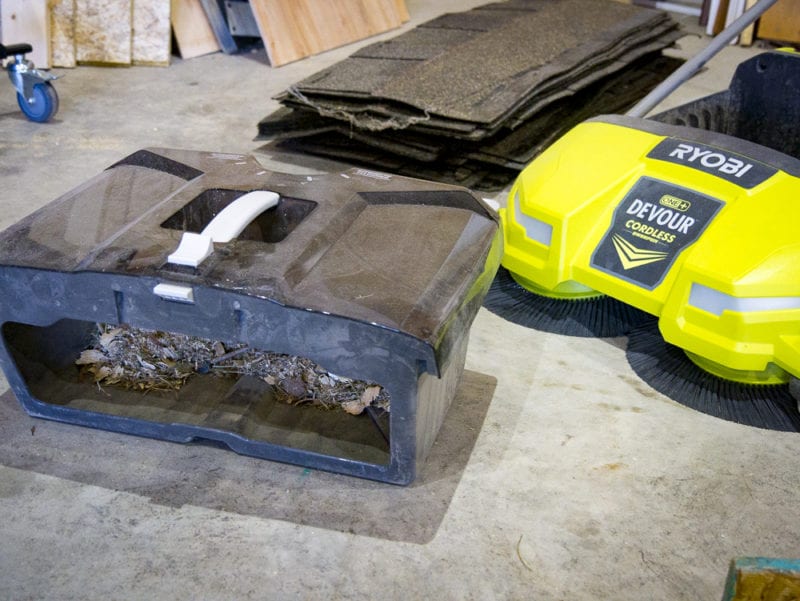
21-Inch Swath
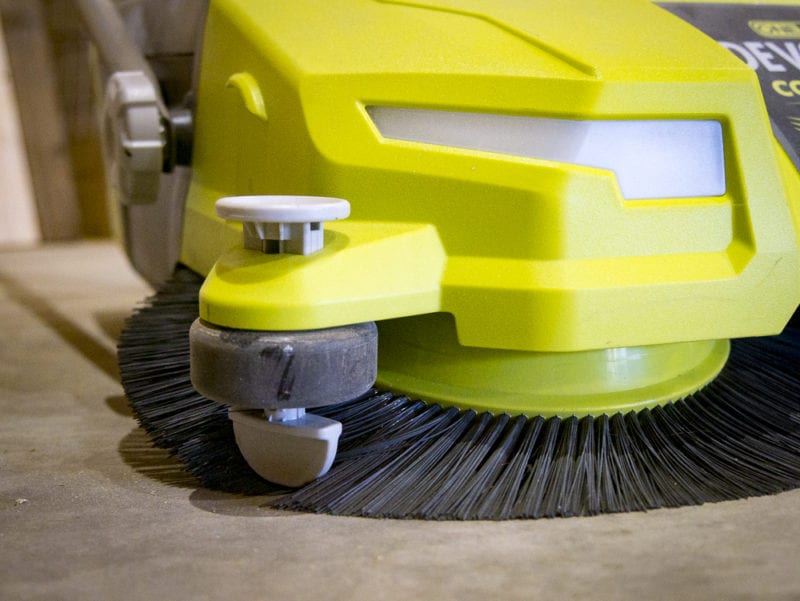
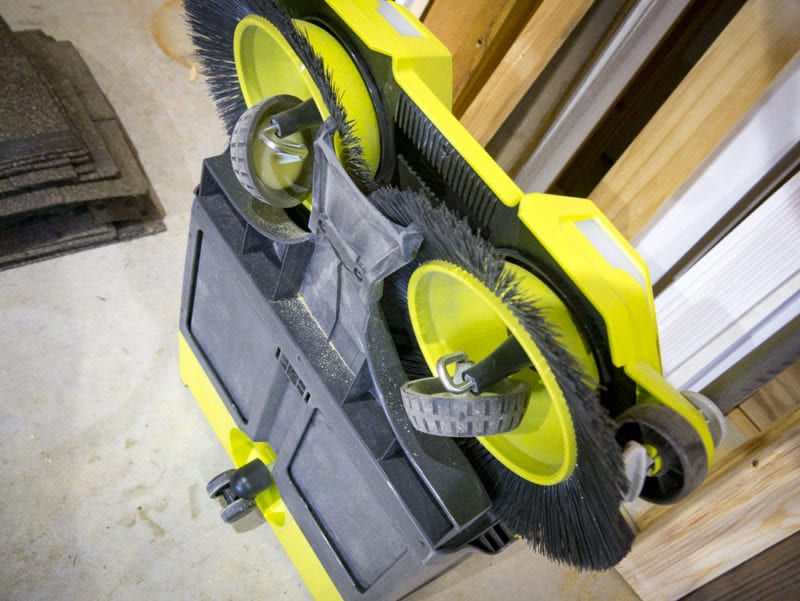
The total width of the brushless covers 21 inches – the same as a quality push or walk-behind lawn mower. The nice thing is that the brushes come out further than the side of the housing to effectively collect along walls and get slightly underneath shelves and workbenches. Bumpers on either side ensure that you don’t scratch or mar up the wall you’re next to.
Twin Counter-Rotating Brushes
Two brushes counter rotate to the inside, pulling debris in like the mighty Sarlacc in the deserts of Tatooine. Not a Star Wars fan? That’s okay. It’s kind of like a teenage boy shoveling food in as fast as he can as your grocery bill rockets higher along with his metabolism. That is to say, if it’s in reach of the brushes, it’s going to be pulled in.
LED Lights
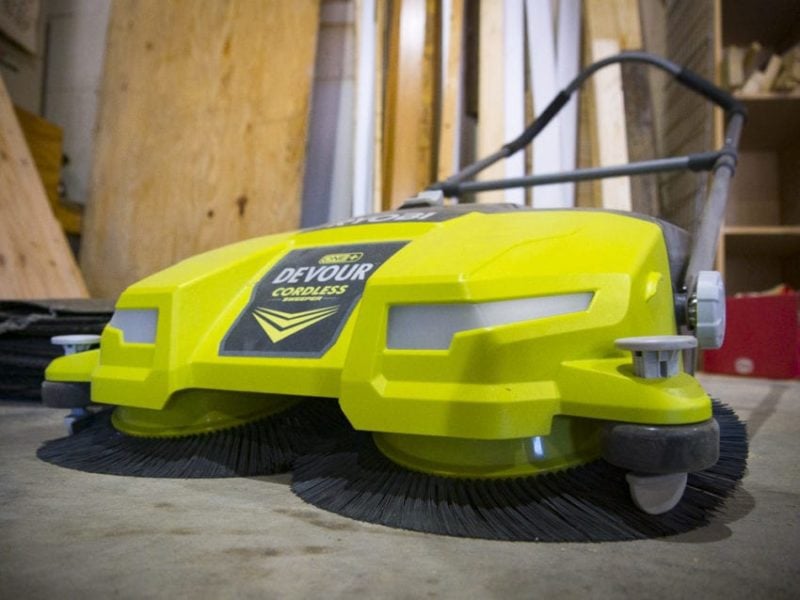
Two LED lights keep darker areas lit up so you can easily see whatever debris is in front of you.
Kickstarter
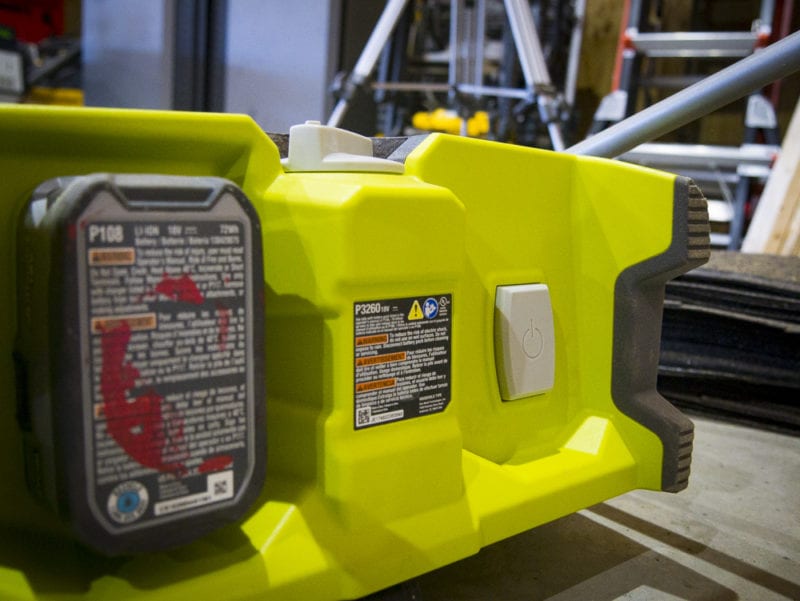
The power button is conveniently located on the right side of the unit and is large enough to give a gentle kick to start up the Ryobi Devour. Not having to bend over is a major plus when it’s cleanup time at the end of the day.
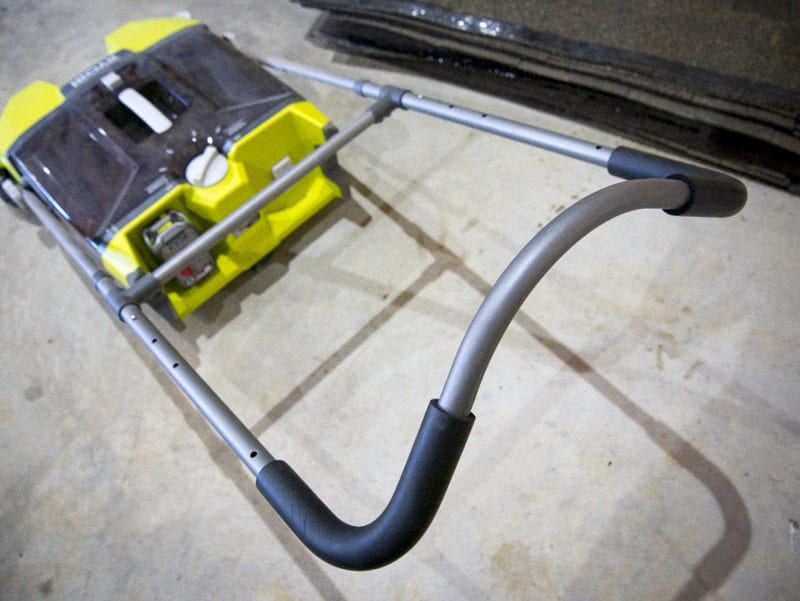
Pivoting Handle
The handle swings freely from front to back. While I was expecting something more like a mower style handle that locks in place, it’s pretty convenient once you get used to it. It adjusts to the height of the user with three pin detents to lock into. It also swings up to the front so you can store the Devour upright and out of the way.
Performance
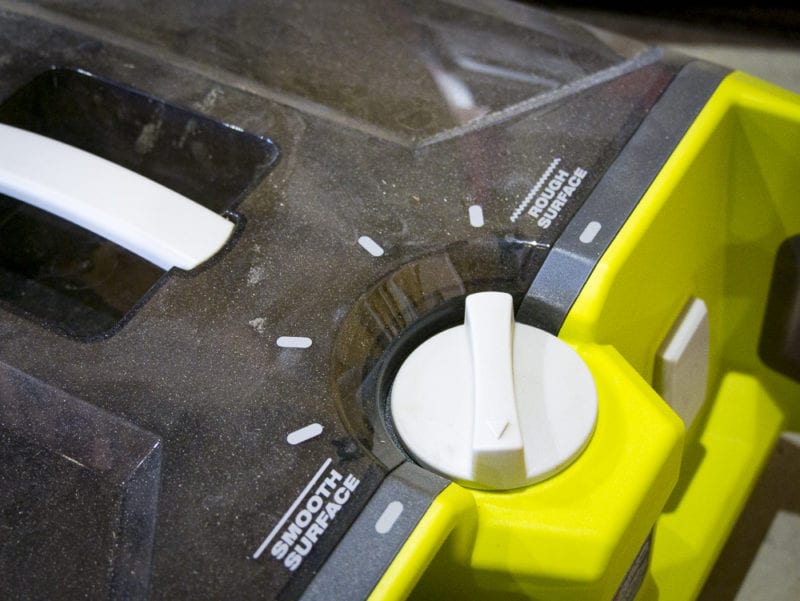
For starters, you’ll need to adjust the height depending on the kind of floor you’re sweeping. Turn it to the left for smooth surfaces and increasingly to the right the rougher the surface is. Hard surfaces like concrete and wood are going to be the best bet. Carpet isn’t really what you want to run the Devour on.
You’ll notice during cleanup that the Ryobi Devour does kick up some dust. Keep in mind that it’s a sweeper, not a vacuum, so the goal is to collect larger debris that a vacuum may rebel against pulling in. If you need a dust-free floor, you’ll want to follow up with a vacuum like the Ryobi cordless shop vacuum.
As far as what the Ryobi Devour can collect, there’s a lot on the menu. We collected nails, screws, sawdust, wood chips, drywall dust and chunks, chunks of wood, and even tape measures. It’s pretty impressive what you can collect. Of course, the larger the debris, the more often you’ll need to empty the canister.
Movement is easy thanks to three casters that all spin 360°. The two in the front angle and one in the back helps make those tight turns. While you can do a lot of spinning, your best pickup in moving straight forward. As you turn, the outside brush won’t be able to pull debris in as effectively.
Runtime
Since the Ryobi Devour isn’t a vacuum, runtime is much higher than a cordless vacuum or blower. Much longer. According to Ryobi, a 4.0 Ah battery will power the Devour better than two hours. In our testing, it ran for 2 hours and 50 minutes at the middle floor setting. That’s enough time to sweep the shop, all the tile in the house, and all the porches on a big house. Twice.
Price and Value
The Hoover SpinSweep still sells for over $100 at Home Depot. Karcher has a push sweeper that’s similar in design for a little under $140. So how much will you have to fork out for a cordless version? How does $139 sound?
If you’re already on the Ryobi battery platform, that’s a win. If you’re not, you’re looking at $119 for a 4.0 Ah battery and charger starter pack or $139 for a multi-port charger and 4.0/2.0 Ah two battery starter pack. Either way, it’s an extra chunk to add to your initial cost. On the other hand, it unlocks Ryobi’s 18V One+ platform that has a ton of great lifestyle products, even if you don’t need their power tools.
The Bottom Line
If you keep in mind from the outset that the Ryobi Devour is a cordless sweeper rather than a vacuum, you’re in for a treat when it comes to cleaning up the shop. It’s easy enough for a child to operate and maneuver, picks up a wide range of debris, and runs longer than most anyone will care to spend sweeping. Does it branch out into the Pro market?
Yes, but if what you’re looking for is a dust-free floor and not just one that’s picked up, you’ll need to follow behind the Devour with a vacuum.
Ryobi Devour Cordless Sweeper Specifications
- Model: Ryobi P3260
- Power Source: Ryobi One+ 18V battery
- Swath: 21″
- Weight: 17.5 lbs.
- Capacity: 4.5 gallons
- Warranty: 3 years
- Price: $139 (bare tool)