
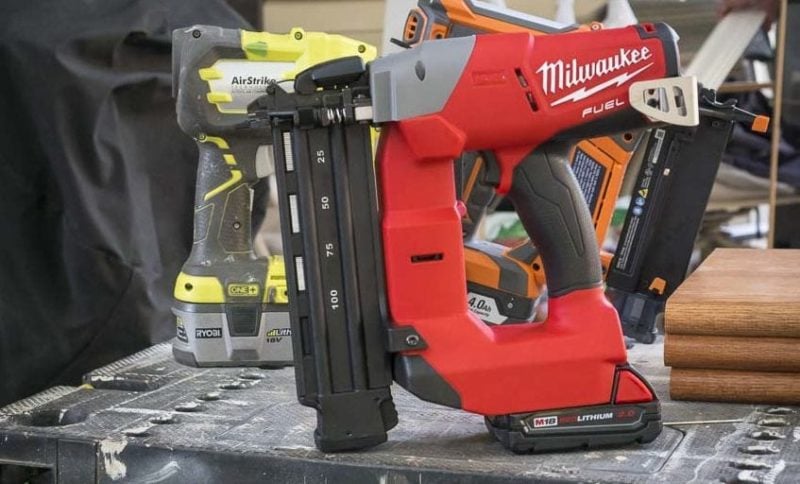
I run just about all my trim off an 18-gauge nailer. The head doesn’t leave a large divot, so you don’t have to double fill your nail holes. It’s perfect for case, base, chair rail, and crown molding—just about any type of trim in a residential environment. This is really my go-to tool. I’ve even hung pre-hung doors with an 18-gauge nailer…temporarily. When the Milwaukee M18 Fuel 18-gauge finish nailer showed up at my door I was well-equipped to bring it along on several trim jobs and give it a whirl.
I had plenty of projects lined up for this tool. It’s a good match for installing cove and shoe molding, and I had plenty to install over the next several weeks. First, however, I wanted to give this nailer a once-over. I could already see some differences from other nailers I’ve used. At first glance it looked well-made, and the feel of the tool was balanced and stable. I also couldn’t help by notice how thin the design was overall. Most battery-powered finish nailers are bulky. Having professionally used several pneumatic finish nailers—and having had my hands on both the Ryobi and Ridgid 18-gauge cordless models—I was all set to test the Milwaukee.
Before I delve too deep into its use, there are some distinctive features on this tool. Pros, and particularly trim carpenters will want to be aware of these when checking out this tool.
Milwaukee M18 FUEL 18-gauge Finish Nailer Features
Milwaukee has the widest capacity we’ve yet seen on a cordless 18-gauge nailer. It supports nail sizes from 5/8 to 2-1/8 inches in length. While you can find 2-1/8 inch brad nails, they aren’t all that commonly used. Most 18-gauge finish nailers stop at 2-inches. The Milwaukee 2740-20 finish nailer can also hold 110 nails in its magazine—room for two sticks.

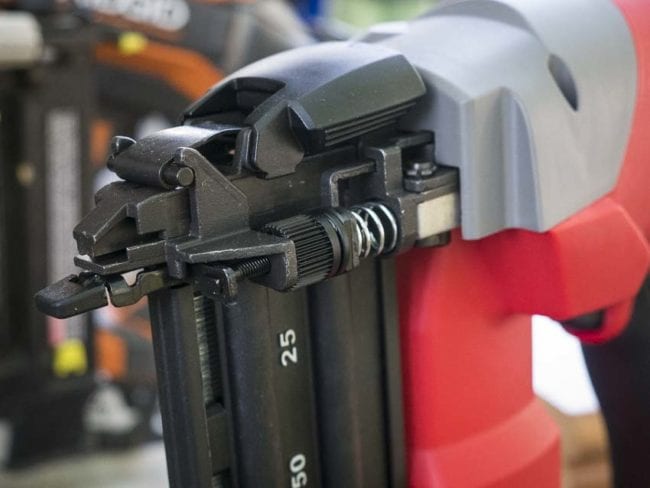
The profile of the driving tip of the Milwaukee M18 18-gauge nailer has a bit more steel than either the comparable Ryobi nailer or the Ridgid Hyperdrive 18-gauge finish nailer. It gives you a sense that it’s going to last longer—particularly since that metal interacts with sliding metal nails non-stop as the tool is used. The fastener on the M18 finish nailer exits the tool about the same distance from the tip as the Ryobi Airstrike 18-gauge nailer and at a similar distance on my pneumatic model. It’s not hard to learn how to get accurate nail placement, though the view is a bit more obscured than with most tools I’ve used.
We had three cordless 18-gauge nailers present for our testing, and if you look at the tips you can see some of the differences they have for both visibility and clearance. The real oddball is the Ridgid whose protective tip obscures your view from the side.
Care for a Magazine?
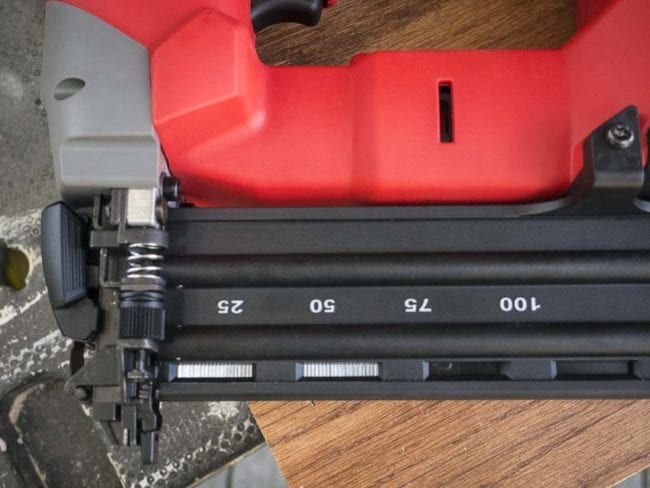
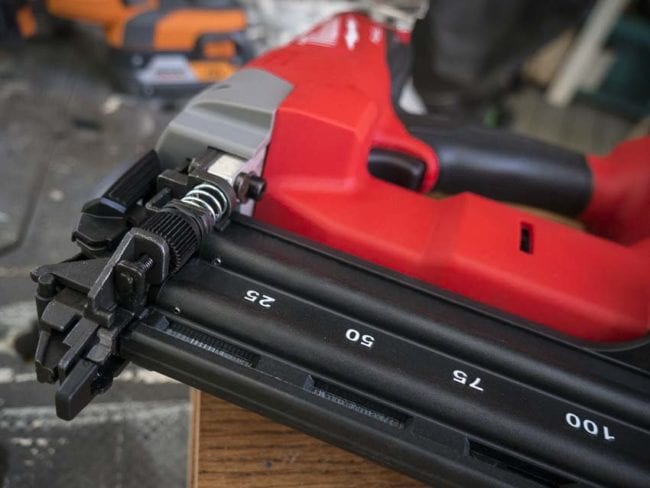
Another place visibility took center stage was with the window area on the magazines. The Milwaukee M18 Fuel 18-gauge finish nailer gives you more than just the small window near the top of the magazine. The whole mag is set with rectangular windows as well as markings for 100, 75, 50, and 25 nails. You’ll have some warning before you run out.
Milwaukee says you can drive up to 1200 18-gauge finish nails on a single compact M18 2.0Ah battery pack. We have no reason to doubt them, and we’re not about to blow through that many nails to verify a claim that large. Even if they’re off by half (and we’re certain they’re not), you can go for a whole day unless you’re David Foster.
Unlike the Milwaukee M18 15-gauge angled finish nailer, this model doesn’t have an LED light to illuminate your work piece during use. Looking at the tool, I can’t see where they would have placed it. That’s probably a good call to save space.
There are only two practical adjustments you can make on this tool. One is to manually set the depth of drive using the tiny dial located on the left side of the driving head. It’s a bit more difficult to use than some of the larger controls I’ve seen on competitive models, but I could still get it dialed in.
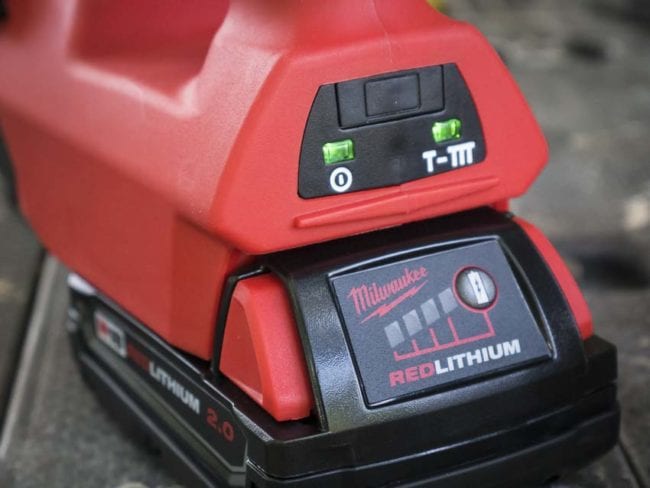
Another thing you can do is switch from the default sequential drive to “bump” mode (contact actuation). This is done by pressing and holding the button on the rear of the tool just above the battery. If the green light on the right is blinking, you’re in bump fire mode. This control is the same for all Milwaukee finish nailers. That button also activates the tool after you first insert the battery. If you press and hold it the tool will turn off as well. I would have preferred this to be a mode switch only, as I kept forgetting to turn the tool off when I was done.
Milwaukee M18 FUEL 18-gauge Finish Nailer Specs
- Model: 2740-21CT (also bare tool as 2740-20)
- Nail Sizes: 5/8 to 2-1/8 in.
- Magazine Capacity: 110 nails
- Runtime: 1200 nails per charge on a RedLithium 2.0 Ah compact battery
- Modes: Sequential and contact actuation (bump)
- Dry-fire lockout
- Adjustable belt hook
- LED work light
- Includes: Brushless 18ga finish nailer, M18 RedLithium 2.0 battery, charger, carrying case
Milwaukee 2740-21CT 18ga Finish Nailer Ergonomics
Ergonomics on the Milwaukee M18 Fuel 18-gauge finish nailer are comfortable and balanced. It’s similar to the Ryobi 18-gauge nailer I use regularly and much more comfortable to hold in the hand than the Ridgid (which I find to be a tad front-heavy). Milwaukee definitely paid attention to the ergonomics in the design like they did with the M18 Fuel 15-gauge angled nailer.
The belt clip is a nice feature. It’s present in other cordless nailers I’ve used, and the Milwaukee is oriented like the Ridgid. It tips the tool a bit forward, but it’s easy to grab the handle and lift (battery up is my personal preference).
Loading and unloading nails is a no-brainer. It works just as you’d expect, and it takes no time at all to swap out nail lengths. I like the way the magazine shuts with a solid “click” and about the only thing you need to remember is to open it up before you clear any jams (or you’ll launch the nails up and out of the tool)! As with all Milwaukee cordless tools I’ve used, the battery goes in and out easily, and the inclusion of a compact M18 2.0Ah pack was a good call as it keeps the tool on a SlimFast diet.
Using the Milwaukee M18 FUEL 18-gauge Finish Nailer
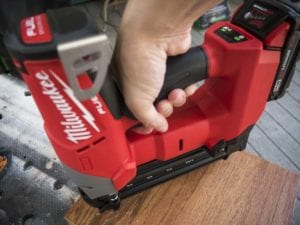
I took the Milwaukee M18 Fuel 18-gauge finish nailer on a job site to repair and rebuild some kitchen drawers in a rental home. It did a great job securing everything easily and quickly while it glued up. The tool fires fast, and there’s very little delay (almost none) from the time you pull the trigger to the time the nail enters the work piece. You also don’t hear that tell-tale wind-up sound.
For some additional in-house testing, we fired some 1-1/4″ brad nails into solid oak. For this test, we pushed the depth gauge to its maximum setting. While there’s almost no lag on the Milwaukee 18-gauge nailer, it initially placed the nails barely below or even flush to the surface of the wood. This was only an issue with the hardwoods we tested. That concerned us at first, so we did some additional testing. The solution was to apply a bit more pressure to the work piece when driving a nail into tough material. You don’t have to push hard—certainly not enough to overtax the firing mechanism. But that little bit of extra pressure suddenly brought this tool in line with the others on those harder materials.
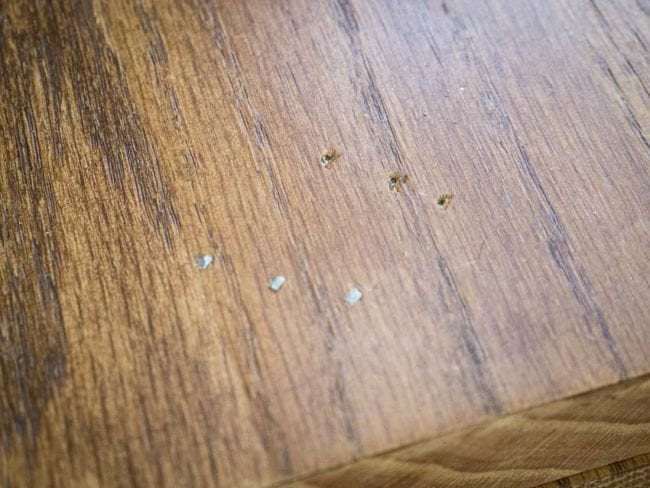
Our assessment was that the tool has about the same striking energy or driving power of both the Ryobi or Ridgid in oak, but there you also get a noticeable speed increase. That striking system, however, requires a bit more pressure on the tool in order to drive nails properly in some hardwoods. It seems a reasonable trade-off. Most people are dealing with soft woods, composite, MDF, or poplar, so it’s doubtful you’ll experience flush or proud nails in these materials. We didn’t in any of our testing provided the workpiece was rigid and stable.
Where the tool presented some problems for us was when installing corner round molding as part of a Pergo Outlast+ laminate flooring installation project. When you set the depth gauge to near-maximum, the tool can be difficult to engage. You have to depress the safety tip all the way in before the LED light comes on, and the tool is ready to fire. At the maximum depth setting, I almost had to “lean” the tool back to fire it properly. It’s something that you can work around, but most Pros don’t want to have to deal with that stuff on the jobsite. When the depth gauge isn’t at maximum it’s not as much of an issue.
Conclusion
If anything, the Milwaukee M18 Fuel 18-gauge finish nailer shows that you really can make a cordless tool that strikes almost as quickly as a pneumatic. By eliminating the bulk of the “wind up” delay when you pull the trigger, Milwaukee has released a tool that feels more confident. The push button on/off/mode safety feature will be a minor hit or miss with some—I’d rather that just be a mode button.
This is a tool that fits in well with anyone already on the Milwaukee M18 platform. For those looking to get into battery powered nailers for the first time, the real differentiator is going to be the time-to-fire and the ergonomics. Milwaukee is leading on both of those points. It’s a well thought-out tool overall. Visibility of the nail placement is one of the few dings aside from the need to apply a bit more pressure when firing into harder materials. The other is the sensitivity of the safety/activation tip.
We’re looking forward to seeing what else Milwaukee has in store for its nailers. We’d love to see a pinner come out—a tough challenge based on the rather small footprint of those tools. A framer is almost certainly on their radar as well.
Pick one up at Acme Tools: