
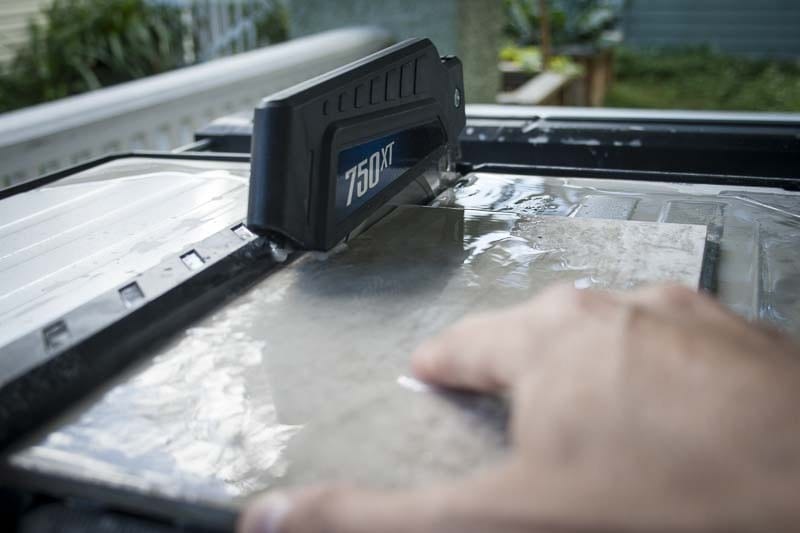
Having reviewed several full-size tile saws for larger undertakings (see our reviews of the Bosch TC10 tile saw and the Ridgid R4040S 8-inch tile saw), I wanted to see what it looked like to use a smaller tabletop 7-inch tile saw. These smaller tile saws can be great for accomplishing tasks that may not require as much setup or horsepower as a full-size 10-inch wet saw. They’re also easier to store, set up, and clean when you’re through. My goal in this review was to see if the $149 QEP 750XT tile saw could take care of a job like resurfacing a fireplace with tile, or doing a nice kitchen backsplash. For this review, I tackled a fireplace, covering old textured brick from the 1920’s with fresh new tile to give a nice, updated look to a classic craftsman style living room. The job involved cutting the 12×12 tile into 3.5” thick strips, easing the edges with a tile stone, and cross-cutting as needed to end up with the desired brick pattern.
The Challenge: Re-tile a 1920’s fireplace and hearth with roughly 16 sq ft of porcelain tile.
Build Quality
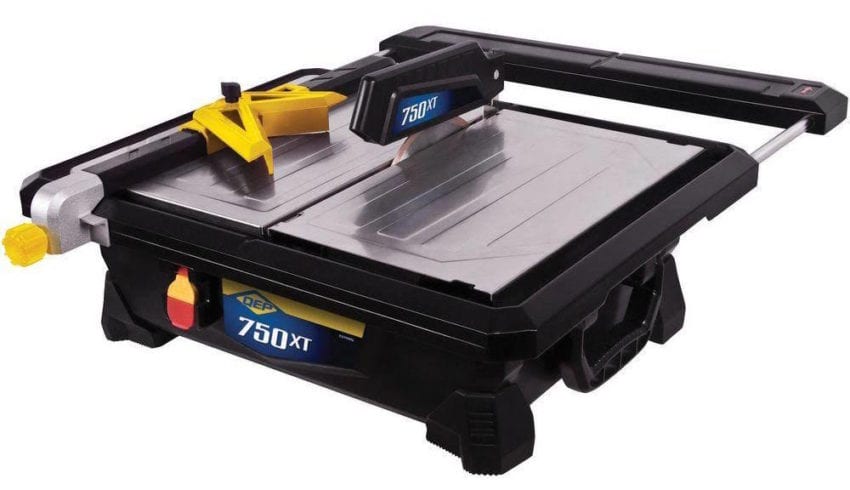
Unpacking the QEP 750XT tile saw (model# 22750Q), it was obvious from the weight, that the build quality of the saw was where some corners were cut to achieve the rather low cost of entry. With a street price of just $89, this may be one of the least expensive tile saws on the market. In examining the tool, you immediately notice the plastic casing, rip guide, miter guide, and guard. The platform is made of what looks to be thin stainless steel, and the 3/4 HP motor drives the included 7-inch diamond blade at 3600 rpm.
The water-cooled blade uses no pump. As with other 7-inch tile saws I’ve used, the blade picks up water from the reservoir and carries it around the diamond blade, the excess being directed downward by the plastic blade shroud. Convenient channels in the top surface of the saw table help funnel the overflow water back into the lower basin.
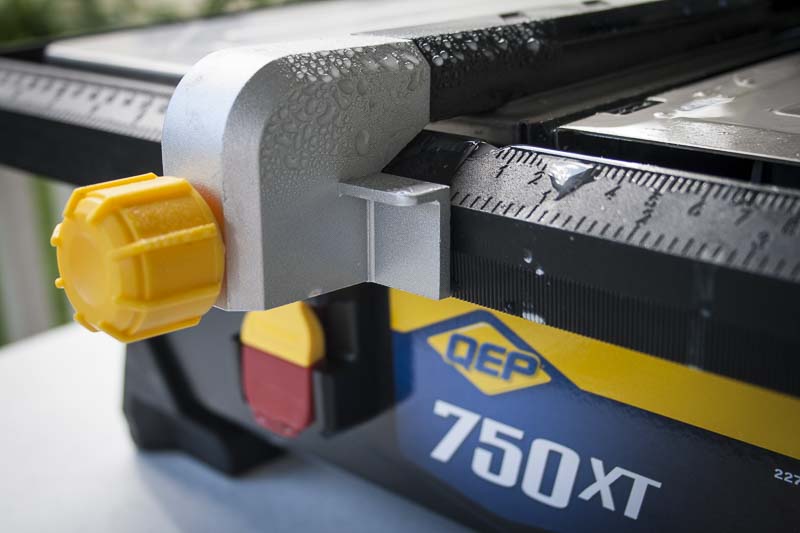
QEP 750XT Tile Saw Specs
- Item No: 22750Q
- Motor: 3/4-Peak HP / 120V, 60 Hz., 4.8 Amps
- Watts: 550
- RPM: 3600
- Blade Capacity: 7 in.
- Arbor: 5/8 in.
- Rip Cut: Unlimited
- Diagonal Cut: Unlimited
- Depth of Cut: 1-1/4 in.
- Size: 21 in. L x 22.2 in. W x 9.5in. H
- Weight: 21.4 lbs.
Using the QEP 750XT Tile Saw
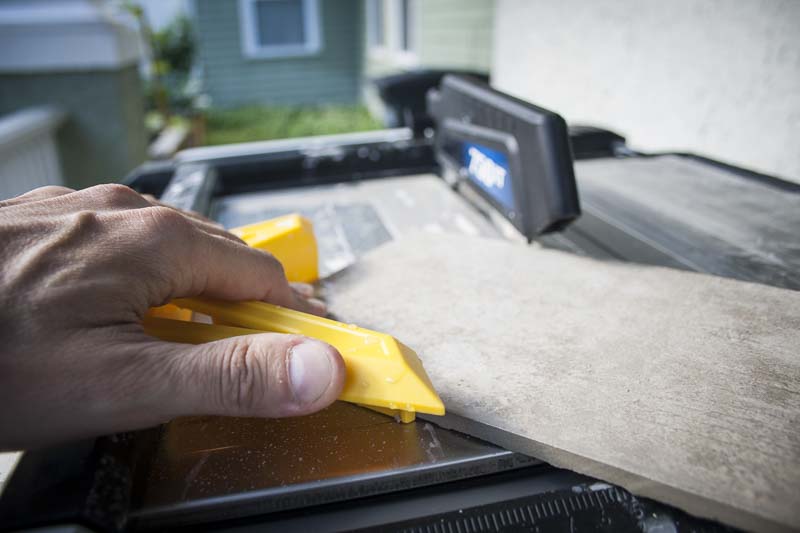
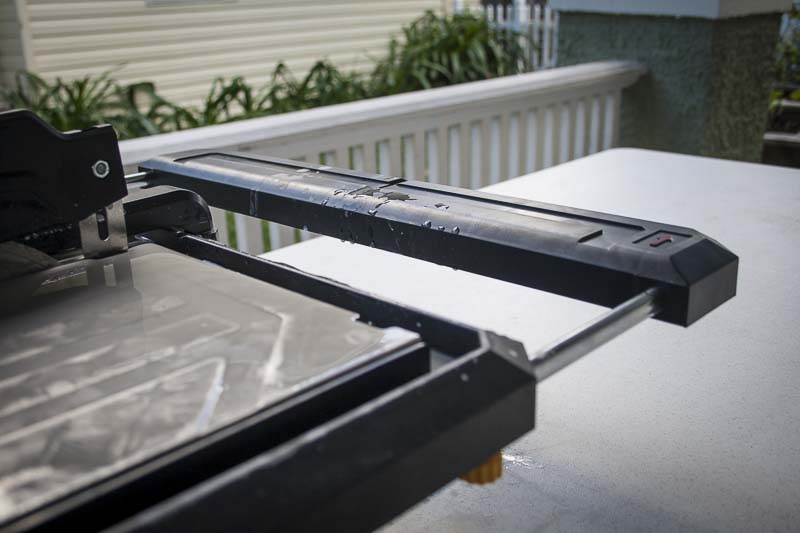
There are a couple of quick things to note when using the QEP 750XT. First, the plastic tile rip fence serves as an adequate guide, but it is difficult to adjust, and easy to lock down such that you’re out of square (skewed). You want to pay attention to the final setting before you begin to cut your tile. Also, you’re moving the tile forward on your own, sliding the tile against the plastic guide and table surface, so good technique here will result in a better cut. The plastic miter attachment slides overtop of this plastic guide, giving you a plastic-on-plastic siding system that, I felt, was very difficult to use with confidence. It is very easy for the miter mechanism to jerk while you ease the tile forward, causing irregularities in your cuts. In this way, I believe it to be a stop-gap solution rather than an expected way to use this saw for lots of diagonal cuts.
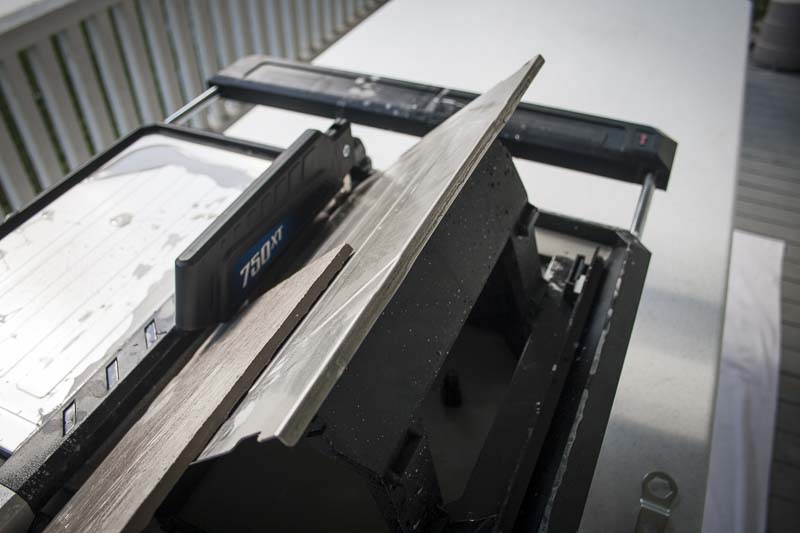
Bevel cuts are achieved by lifting and bracing the right side of the table at an angle and driving the tile forward. You can do this at 22.5 and 45 degrees. If you’re planning a lot of miter or bevel cuts you may want to consider a more expensive option with a sliding table—it will be more precise and superior for repetitive cuts.
The QEP 750XT cuts ceramic tile quite easily—like butta’ as they say—but porcelain tile was a bit tougher. On most cuts I could feel the motor bog down, and I felt the need to go very slowly so as to not tax the tool. I do not believe you’d want to use this tool on floor tile, or anything over 6×9. For smaller ceramic tile or for cross-cutting subway tile, as in a traditional bathroom or shower, this would be fantastic tool. In fact, for that smaller, easy-to-cut tile, it may be easier to pull this off a shelf than set up a full-size tile saw.
Water flow was adequate, and the 7-inch tile saw retained most of what I gave it, channeling the water back to the blade for re-use. Even after the project was done I found that I would have only just then wanted to add some more to the interior basin.
Conclusion
Overall, the QEP 750XT is easy to critique—but not to criticize. It’s a $149 tile saw, and so all of my negatives have to be taken into account. If you’re a pro, you won’t want this saw. You just won’t want to deal with the compromises. For someone who is only doing a job a year, however—and small jobs at that—this may be a great way to get the job done and lean more on your own skills to use a more simplistic and manual tool effectively. If you’re cutting mostly porcelain tile then I’d also recommend you steer clear as the harder tile will strain the motor, causing premature wear (and the slow speed of cuts may drag out your job).