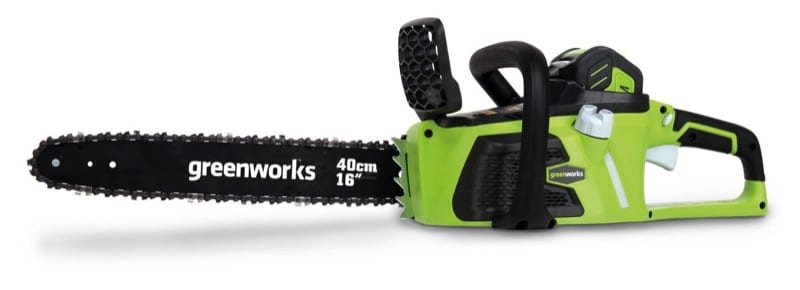
It’s not often that a cordless chainsaw gets more than a casual nod from professionals, but the GreenWorks 40V chainsaw literally raised eyebrows from several Pros we handed it to. The thought of going cordless in professional applications may be far from your mind, but consider a couple things we realized in the course of this review.
First, a cordless tool like the Greenworks DigiPro 16″ brushless chainsaw is much more convenient for up-in-the-air work. The second you let go of the trigger the saw stops and the noise of the engine ceases. If you’re trying to hear from your man on the ground, that’s a whole lot more convenient than having to stop a gas saw. And restarting? Pull-starting a gas saw while standing on a lift isn’t my idea of fun, so having a pushbutton start is a godsend when you’re twenty-five feet in the air. Lastly, the maintenance on this saw is greatly reduced, and the brushless motor and 4-year warranty is extremely compelling (though that warranty shrinks to 90-days for true commercial use). Let’s just say that, after using a saw like this, you may open up your horizons a bit on cordless technology.
Editor’s Note: Check out our best battery-powered chainsaw for our top picks.
GreenWorks 40V Chainsaw Features
GreenWorks claims it has enough power in the included 4.0 Ah 40V G-MAX battery to cut a cord of wood on a single charge. I’m not sure I’d go so far as to disagree with that claim based on our testing, but I would point out that some wood cuts easier and more quickly than others. To end up with run-time, you’re looking at a combination of load and cutting speed. The more load you put on the motor (cutting tougher material or larger diameter pieces) the less run-time you’ll have. Short, quick cuts in softer, dry wood will yield an almost ridiculous number of cuts on a battery-powered tool. This tool, like the Greenworks 40V Trimmer, seems to have a good amount of run-time for practical use.
One big deal about the GreenWorks 40V Chainsaw (model 20312) is that it uses a brushless motor. That means it’s an electronically commutated system that doesn’t lose efficiency due to the contact of brushes on the commutator (the rotating part) of the motor. Brushless motors run cooler as a result, and they’re typically quieter and produce fewer vibrations that can damage other electronic components over time. And, since there are no brushes, the motor has a longer life as well and virtually no maintenance needs over the lifetime of the tool. For a chainsaw, this is a big deal and represents a huge leap forward in technology we hadn’t seen until this model fell into our hands.
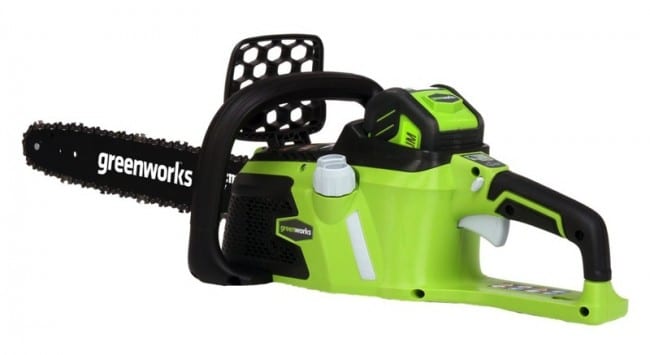
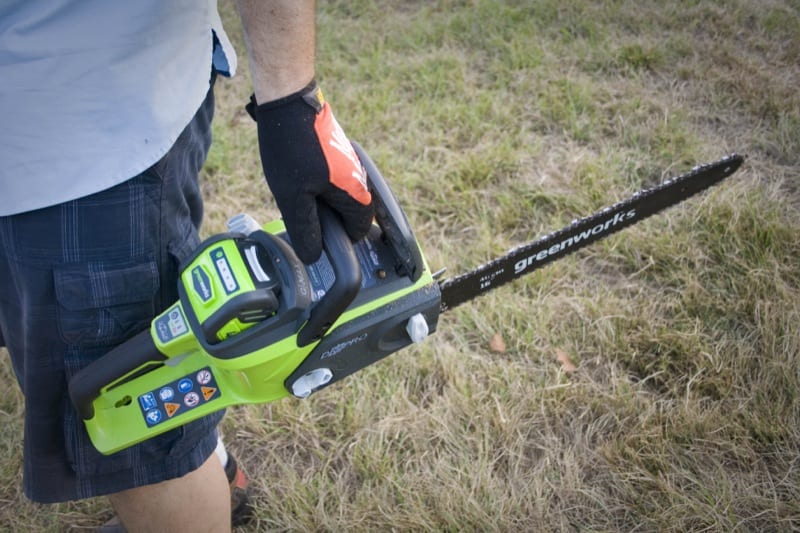
Another unique feature of the GreenWorks 40V G-MAX Chainsaw is that it uses a 16-inch steel Oregon bar and chain. Most cordless chainsaws I’ve used include a 14″ bar at best. Having a long bar is one thing, but being able to actually use it is another. In the end, what was most impressive is that we used every inch of the 16″ bar, and it held its own quite well during the testing phase of the review.
Like a traditional chainsaw, the GreenWorks 40V G-MAX includes lots of safety features, like a chain brake, hand guard and a trigger that can be released very quickly when needed. Plus, as I mentioned earlier, you can very quickly power down the saw completely by simply turning it off. The saw also automatically powers off after being inactive for a minute or so to prevent the battery from discharging.
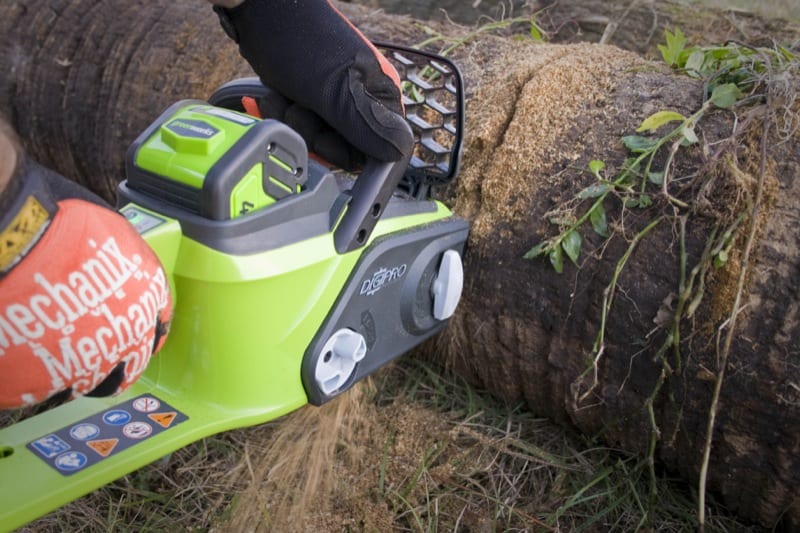
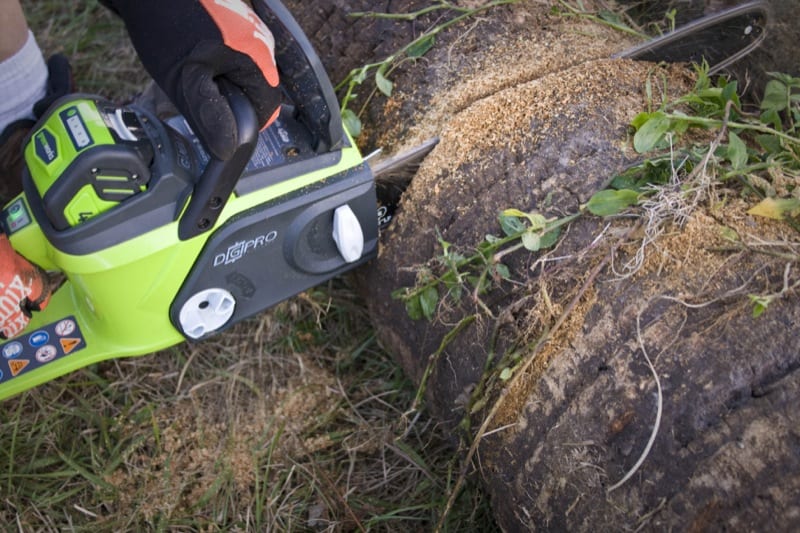
Oiling the saw is automatic (as expected) and facilitated by unscrewing the cap on the left side of the tool and filling it with chain oil (it also has a nice tether attached to the cap so you don’t lose it). Chain tensioning and removal are facilitated by two easy-to-use dials on the right side of the saw. The chain seemed to retain tension well and this was one of the easiest systems I’ve used.
GreenWorks 40V Chainsaw Specifications
- Model: 20322 (20312 with 4.0 Ah battery)
- Battery (20312): 4.0 Ah 40V G-MAX
- Charger: G-MAX model 29482
- Charge time: 120 minutes (4.0 Ah), 60 minutes (2.0 Ah)
- Motor: Brushless
- Bar: 16-inch Steel Oregon
- Safety features: On/off control (with auto power off), Chain brake, hand guard, quick-release trigger
- Includes (20322): Chainsaw, 16″ steel Oregon bar and chain, scabbard, travel bag, 40V 4.0 Ah G-MAX battery (29472), G-MAX 29482 charger
- Includes (20312): Chainsaw, 16″ steel Oregon bar and chain, scabbard, travel bag
- Compatible batteries: G-MAX 40V 29472 (4.0 Ah) and 29462 (2.0 Ah)
- Warranty: 4 years, consumer (90 days commercial)
- Price: $208.94 (kit w/4.0 Ah battery), $145.87 (chainsaw only)
In the Field
There’s not much of a learning curve to operate the GreenWorks 40V chainsaw except that it requires you to engage the handle-mounted electronics system with an On/Off button. This will also kill the motor at any time. The power button is actually a momentary switch, so the act of activating and deactivating the saw is really handled by the internal electronics—which also facilitates the automatic time-out when the saw is inactive. Since this is an electric battery-powered chainsaw, it only makes noise when you pull the trigger. Let off, and it’s as silent as a hand saw.
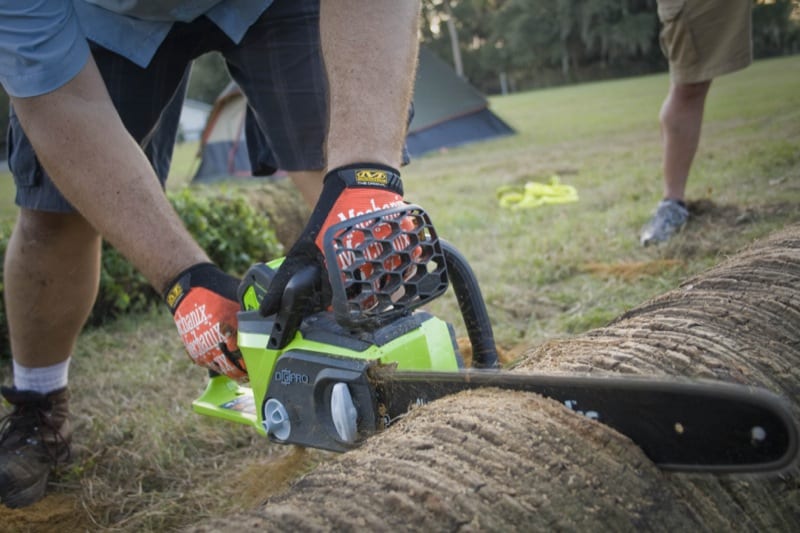
Cutting was actually fun. Like most battery-powered chainsaws, there’s a short learning curve, but it’s almost uncanny when you realize how quiet the saw is. A majority of the cutting noise is simply motor whine and the act of the blade ripping away material. The steel Oregon blade and chain on the G-MAX DigiPro are .043″ gauge. This is a narrow-kerf Micro-Lite system that, like a thin kerf miter saw blade, is designed to give you more cutting power with less strain on the motor. For a battery-powered saw, this is a great call. You may need to sharpen more often, but the trade-off is worth it in increased run-time. You’ll also find you can cut larger-diameter material with less hassle and fewer cases of getting bogged down.
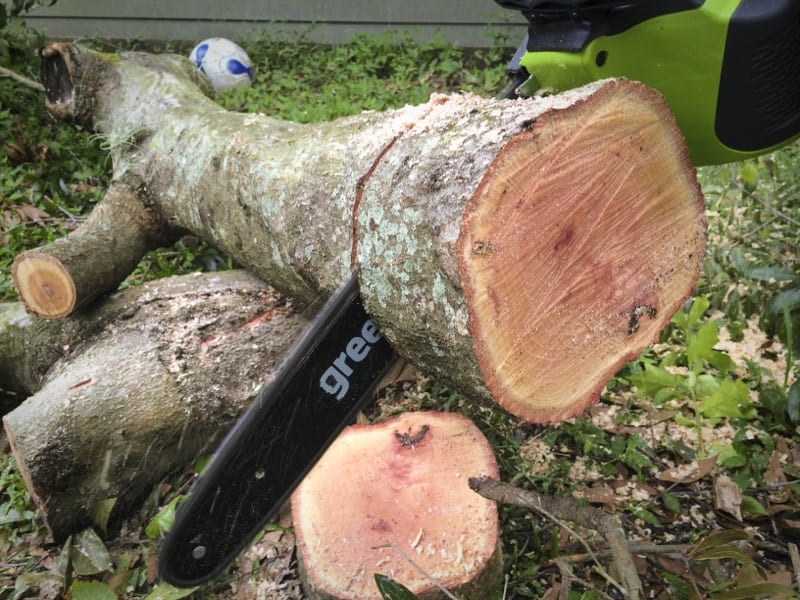
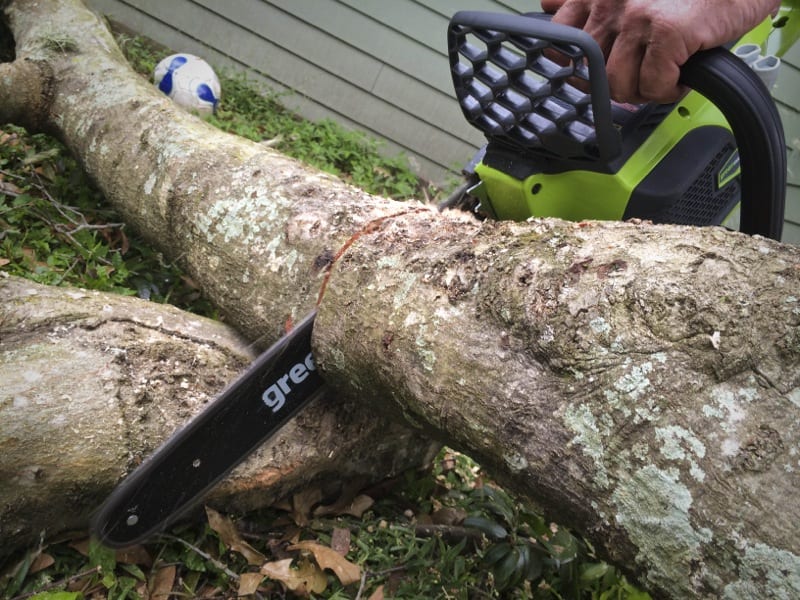
We cut a lot of material with this saw, but our first experience with it had us slicing through 10-inch and greater diameter pieces of water oak from a tree that had been felled that same day. This meant the tree was fresh and moist, and the expectations going in were modest to dubious. I put the saw into the hands of my friend Jason, a professional tree cutter with decades of experience. He was happy to give the saw a try, but really didn’t hold out much hope for it being a serious tool for the type of work he was doing. After slapping in a G-MAX 4.0 Ah battery I literally watched his eyebrows raise as he cut through piece after piece of 10-11″ fresh water oak. The saw sliced through the wood without bogging down in the least—and it did it both powerfully and quickly. After seven big cuts, the battery had only dropped one bar. I don’t think Jason was ready to trade in his gas powered Stihl models for the cordless, but another friend and colleague of mine, Michael Springer, who (dare I say) “dabbles” in quite a bit of wood-cutting (and who reviewed four other cordless chain saws for us last year) said he almost exclusively uses battery-powered saws when he’s in the air, simply for the convenience and safety they afford. Starting and stopping a battery-powered chainsaw while you’re on a lift is exponentially safer and easier than with a gas model.
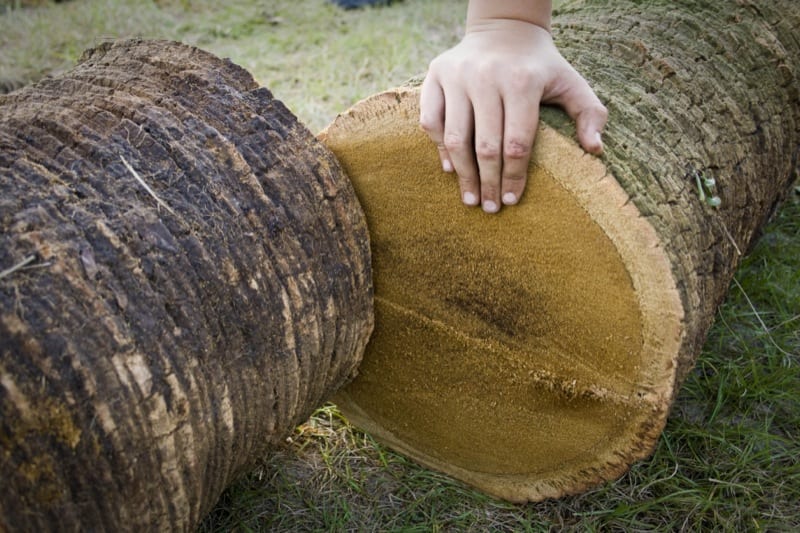
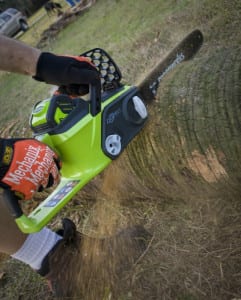
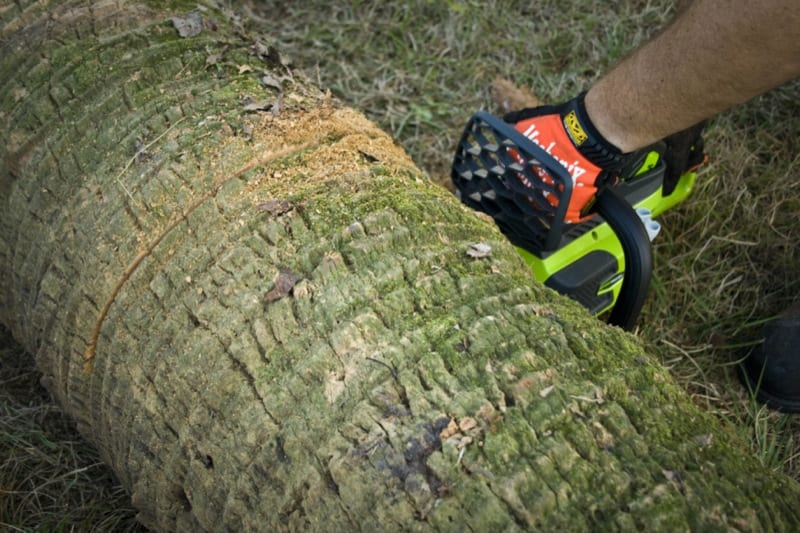
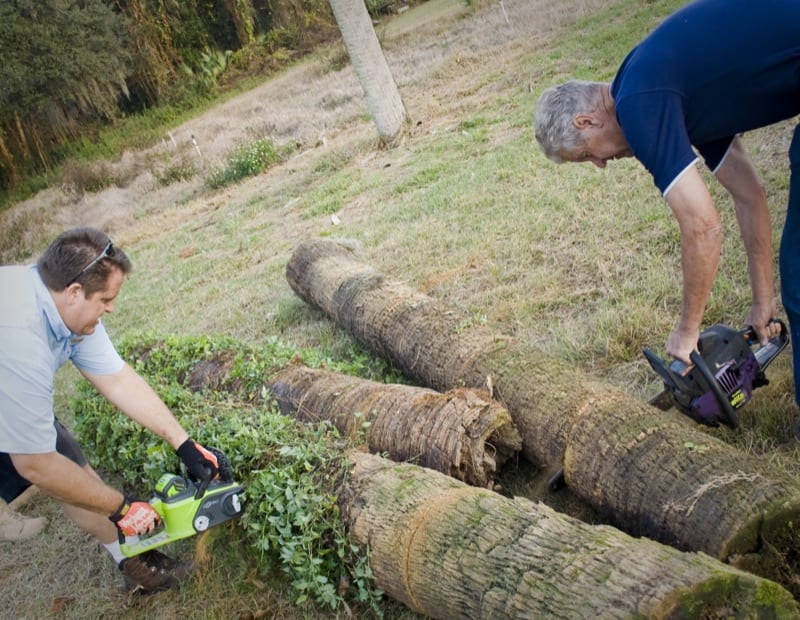
In between, there were plenty of cuts, but the next big test came when we took the saw onto five acres or property owned by my brother-in-law and took it to task slicing up pieces of old, wet, large-diameter palm trees. These were trees that were 24-inches in diameter and about as wet and pulpy as you can get. We had a gas-powered 18-inch Poulan “Wild Thing” chainsaw running in tandem as a baseline. This saw is approximately $100 cheaper than the base price of our battery-powered review model. Both saws had reasonably sharp blades and began cutting at the same time. The GreenWorks G-MAX chainsaw sliced through the material slightly faster—possibly due to its thinner kerf bar and chain. The Poulan had the advantage in length, but it seemed to us that it took a lot more effort to cut through the thick pieces of wood (or pulp—you can hardly call this stuff wood).
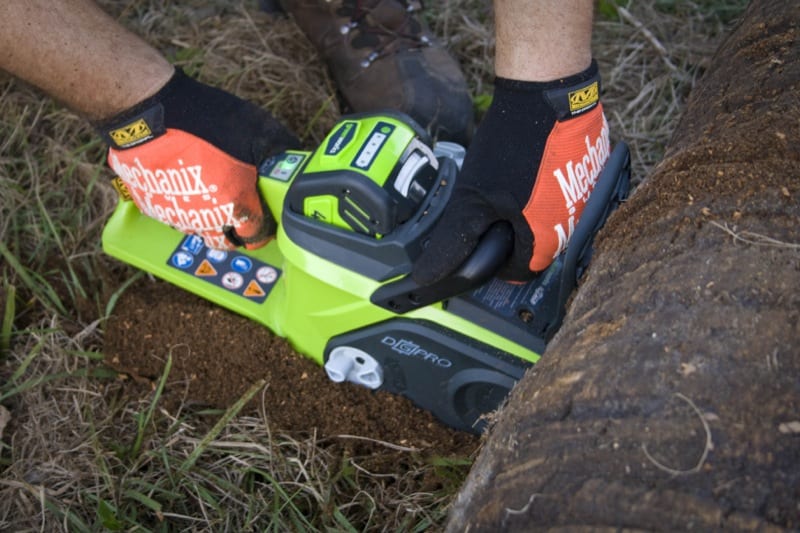
On a single 40V G-MAX battery, we managed over 14 complete cuts through the thick palm trees—and the battery still had some life. Cutting involved slicing as far through a side of the tree as possible, then rolling the palm trees over so we could continue on the other side and complete the cut. The fact that these trees were soaking wet, and the pulp absolutely thick and difficult to remove let me see first-hand that the sawdust ejection system on the GreenWorks chainsaw was extremely efficient. Even with the damp material, the saw pushed out the material into huge piles and kept on cutting. Now, it did bog down from time to time. The material was extremely dense, and when we pushed the saw too hard it would shut off. Since we really were overdriving the motor and I had done so many uninterrupted cuts in dry wood this didn’t bother me or surprise me in the least. Restarting the tool involved releasing the trigger, cycling the On/Off power button and starting again. It is a very quick process and one that seemed to work as intended—saving us from ruining the motor, or worse, from hurting ourselves.