
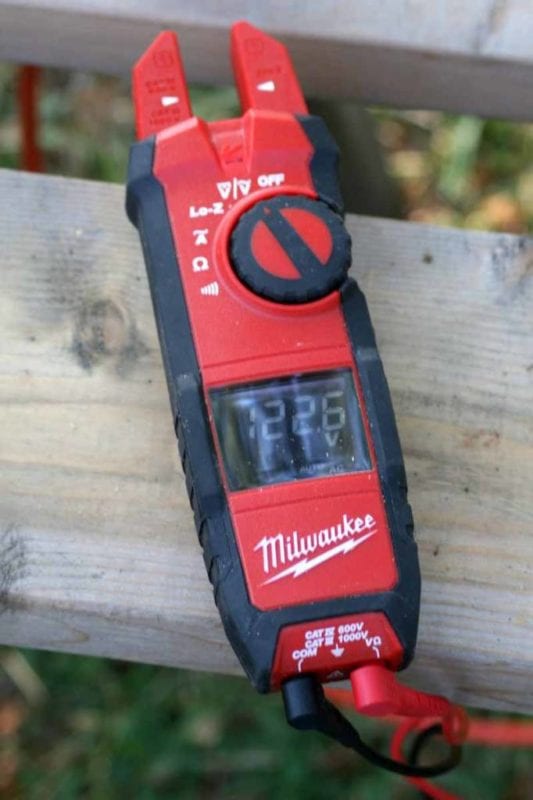
When we first set eyes on the Milwaukee True RMS Fork Meter 2205-20, we thought it was a quaint tool – but its compact size is in stark contrast to its impressive feature set. Turns out, this is a rugged compact CAT IV electrician’s tool that has lots of great features, not the least of which are an integrated LED work light and reverse white-on-black LCD display. After using it over the past few weeks, we’ve come to appreciate its convenience and size as well as the way it makes one-handed measurements both possible and practical.
Milwaukee True RMS Fork Meter 2205-20 Features
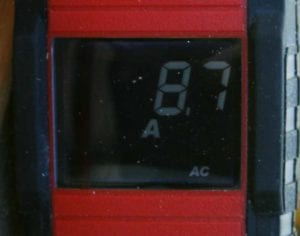
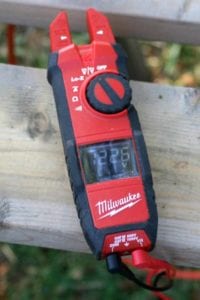
The Milwaukee True RMS Fork Meter 2205-20 is a compact one-handed device with many capabilities for its size and price. With a True RMS scale, CAT IV 600A rating, UL certification, LED work light, and more, it was easy to pass around and get others excited about. The most talked-about feature was the unusual inverted white-on-black high-contrast LCD screen.
This was a good call by Milwaukee and really just took someone walking outside a few times who realized that inverting the display would make it about 10x easier to read regardless of the time of day or lighting conditions. It’s both attractive and smart, and we wonder why more manufacturers don’t implement this on their tools – though we suspect, after this review and getting their hands on this tool in the marketplace, they might.
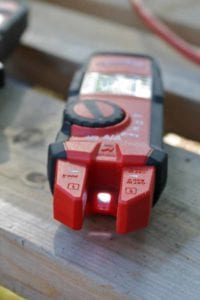
After this, people seemed to really enjoy the integrated LED light – and we’d have to agree. It’s nice that it doesn’t have to be activated all the time, but rather it goes on when you press the side-mounted button. That means that it won’t drain your battery like the lights on most cordless drills, and you have the option of ignoring the feature during the day. At night, however, or in darker environments, we found it to be a very nice convenience. According to the user manual, the tool can be used with all its lights on for 26 hours on its 2 x AA batteries. That’s a decent run considering most of us won’t have the LED running all the time, and 26 hours could translate into weeks of even the hardest use. When Milwaukee integrated a non-contact voltage detector, however, they really took this tool to the next level. You simply don’t see this feature on a lot of fork meters, and it’s a wonder because we used it all the time.
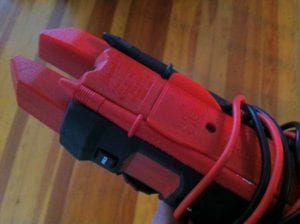
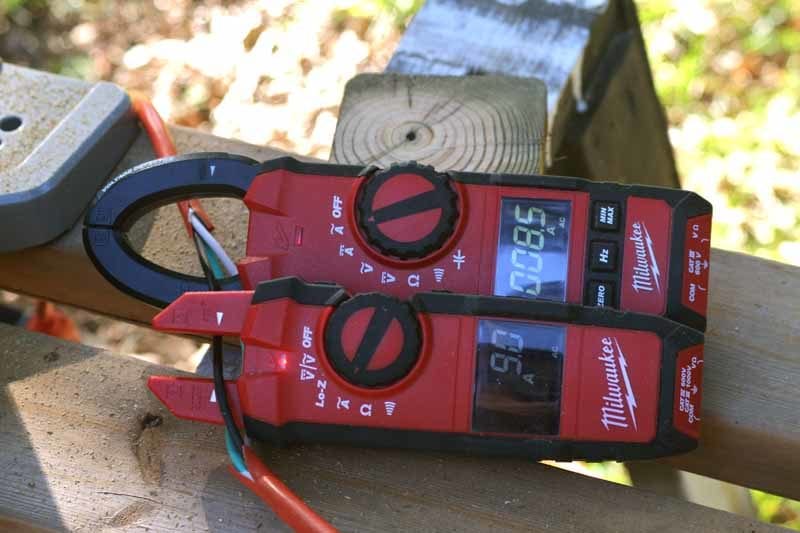
The Milwaukee True RMS Fork Meter 2205-20 was slightly more compact than the 2237-20 Clamp Meter we tested out previously. It had a lot of the same features, but one place in which it excelled was the presence of probe storage on the back of the tool. Instead of having to go rummage around and find the probes, you could simply wrap them and secure them to the back of the Fork Meter using the provided inserts which held them securely.
Editor’s Note: Please read our article on Test & Measurement Tool Category Classes
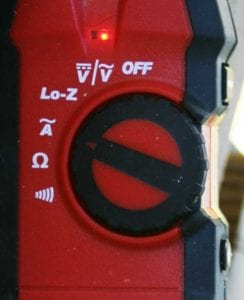
We loved the offset dial that granted access to all of the fork meter’s many functions. It’s “grippy” and has just the right amount of resistance when being flipped from mode to mode. It measures AC and DC Voltage, Low Input Impedance, AC Current, Resistance, and Continuity. The 2206-20 (about $20 more) also adds Temperature, Capacitance, and DC Current to its arsenal. The fact that this is a true RMS meter also means that those measuring voltage or current in variable speed motors (think HVAC systems) and other switching equipment will be able to get an accurate reading and not an “estimate” or purely calculated values based on perfect 60Hz sine wave loads.
Physically, the Milwaukee True RMS Fork Meter 2205-20 looks like a Milwaukee product, with red ABS plastic and a black rubber overmold protecting it and giving it the ability to withstand a 1-meter drop test. They even put overmold on the control dial, so you can use it with gloved or ungloved hands. Unlike the 2237-20 Clamp Meter we reviewed earlier, the Milwaukee 2205-20 Fork Meter doesn’t have a Zero function or a Min/Max button for recording high and low readings. It does have a “Hold” button, though, which will capture the current measurement so you can take your time recording it or showing it to a coworker (“Wow, I measured 19.998 amps drawing on that 20-amp breaker!”)
Milwaukee 2205-20 Testing and Usage
Our use of the Milwaukee 2205-20 Clamp Meter was varied and extensive. We grabbed the tool quite a bit, using it to measure both current and voltage while completely rewiring a 1920 colonial style home to bring it up to code and replace the outdated wiring with real 12/2 and grounded outlets. The job was extremely difficult, primarily because it took place on a two-story home with over 3000 square feet of living space. We also opted, insane as it sounds, to rewire the house in stages (it had already received an updated 300-amp AC panel box some years back), so there was a level of difficulty in planning out the new circuits while keeping old ones alive. Our use of the Milwaukee 2205-20 Fork Meter included:
- DMM (digital multimeter functions for checking voltage)
- Current load and inrush checking to determine the existing circuit loads
- Verification of correct voltage and wiring on new circuits
- Safety checks on the electrical box to ensure power was correctly disconnected
- Non-contact voltage checks on existing and new circuits
We enjoyed using the Fork Meter to check and verify maximum current draw on existing circuits when deciding on how best to lay out the new wiring of the house. It serves as an excellent verification tool that your expectations for a circuit and the end result are in line. While most of us can certainly plan out an electrical layout without measuring the current draw, this could be a way for people to be a little more conservative and perhaps reduce the number of breakers needed to adequately wire their home. In the course of rewiring this home, the tool also revealed several existing circuits which were simply overloaded such that a breaker would trip when a vacuum cleaner was plugged into the circuit while all the lights were on (we set upon those circuits and outlets first).
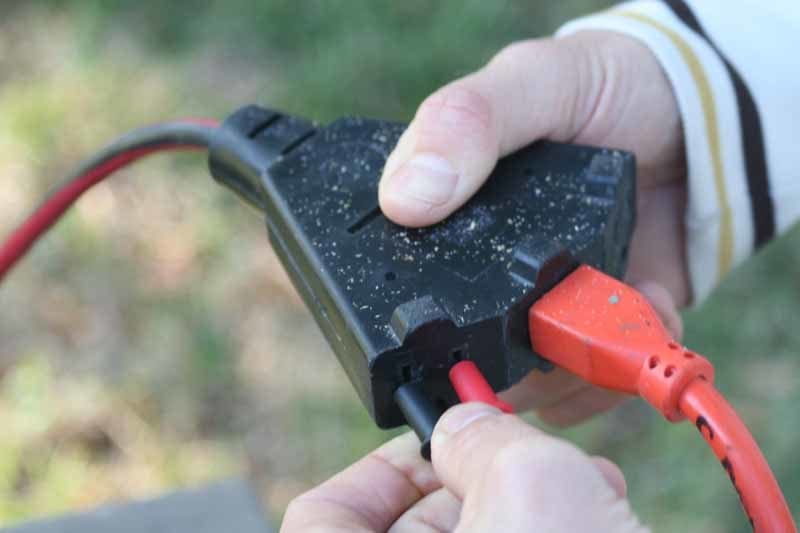
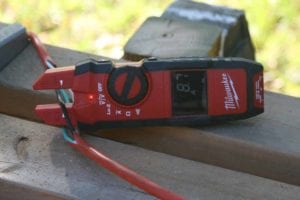
During this job we also had a desire to measure the current draw on a miter saw we were reviewing from a competing tool manufacturer. It was a brand new 12-inch compound miter saw and we found that it drew 8.7 amps unloaded, but picked up to 11.4 amps when cutting through a single pressure-treated piece of 4×4. Inrush current was measured at around 28 amps, but that number was a tad unpredictable since the tool had no way to capture the highest reading, nor did it come with an inrush current mode. This showed us that inrush measurements aren’t practical with this tool.
Conclusion
Milwaukee True RMS Fork Meter 2205-20 is a tool that we really enjoyed using. Its easy-to-read backlit LCD screen, LED worklight, and on-tool probe storage made it a really nice tool for all your basic electrical needs. For just $150, it’s a bit of a one-size-fits-all solution for journeymen and certainly DIY types that have serious electrical projects or repairs to do. Our Performance score earned an easy 9, and Value was a clear 9 as well. Why? There simply aren’t that many True RMS Fork Meters on the market, and none of them have the features of the Milwaukee. By definition, that’s market-leading – and that’s a good place to be.