
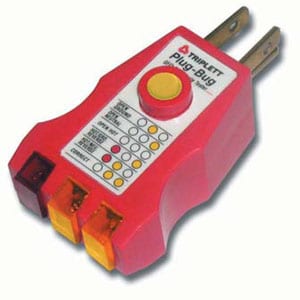
For use on 110~125VAC receptacles, the Triplett Plug-Bug 2 Receptacle Tester 9610 detects common wiring problems in standard and GFCI outlets. There’s not much to say about this product. To test, you simply plug it into any standard 110V-125V AC 15 or 20-amp receptacle and observe the light pattern. Once you rule out any wiring faults, you just push the yellow button to test proper operation of ground fault (GFCI) receptacles.
The Testing Procedure
- Test the Triplett PlugBug 2 on a known good receptacle before using it on other receptacles.
- Insert the Plug-Bug 2 into the receptacle to be tested and observe the lights. The included chart (and the tester itself) gives you the guide for what is possible in terms of detection.
- If testing a GFCI protected receptacle, insert Plug-Bug 2 into receptacle and observe lights. AC power must be present in order to test a GFCI. The receptacle must be wired correctly before proceeding (see Chart). If no lights come on, AC power is not present or the receptacle is improperly wired. If lights indicate proper wiring, press the Plug-Bug 2’s TEST button. If the GFCI is working, the Plug-Bug 2’s indicator lights will turn off. The TEST LED may flash briefly. If the indicator lights do not turn off, and the TEST LED remains lit, the GFCI is not working, or the circuit being tested is not GFCI protected. (Do not press the TEST button for more than 6 seconds). To re-apply power to the GFCI protected circuit, press the RESET button located on the receptacle or the GFCI circuit breaker.
The Triplett PlugBug 2 Detects
- Open Ground
- Open Neutral
- Open Hot
- Hot/Ground reversal
- Hot/Neutral reversal
- Correctly wired circuits
The Triplett PlugBug 2 9610 tester cannot determine if the neutral and ground conductors are reversed. In terms of usability, this is one of the easiest tools you’ll use, making it perfect for the homeowner or handyman. The fault chart is located on both sides of the tester – a great decision, since many legacy receptacles are often installed upside down or sideways. This product seems made to last and the one year warranty is impressive given its already low price.