
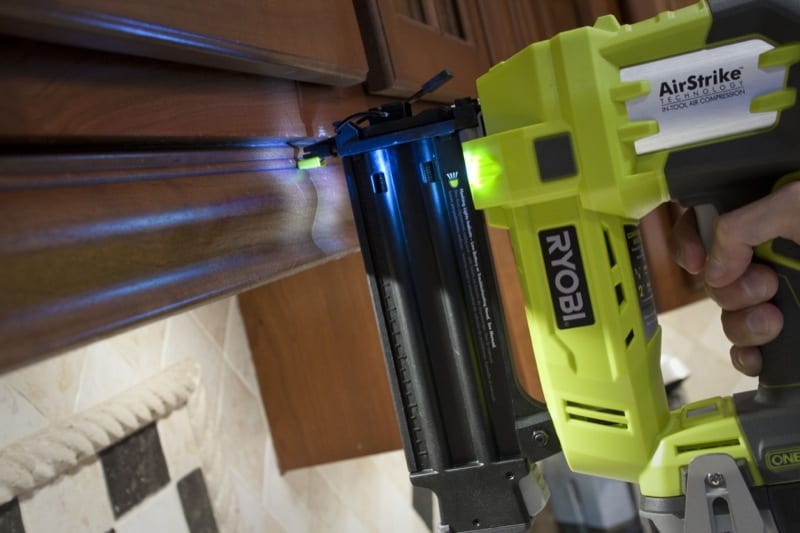
I’ve been wanting to get my hands on the new Ryobi P320 AirStrike 18V brad nailer since it came out. Who wouldn’t? It’s a $129 cordless brad nailer that works with my other Ryobi ONE+ tools like the Ryobi P360 18 gauge stapler. Normally, I’d go and just buy one, but for several months it seemed the local Home Depot carried precisely two of the tools in stock on any given week and promptly sold out the same day they were stocked. Eventually, there were more available, and I procured one to use on my finish carpentry projects.
To have a brad nailer totally self-contained means I don’t have to schlep around a compressor and 50-foot air hose just to nail up some trim molding or put together some custom built-ins. While some compressor kits are nice and portable, you still have to deal with kinking hoses or the other hassles of additional setup, tear down, and maintenance. A battery-powered tool eliminates all of that, and this tool thrives with the new Ryobi 1.5Ah and 4.0Ah batteries. For anyone who does a lot of finish or trim carpentry, this type of product is like a dream come true.
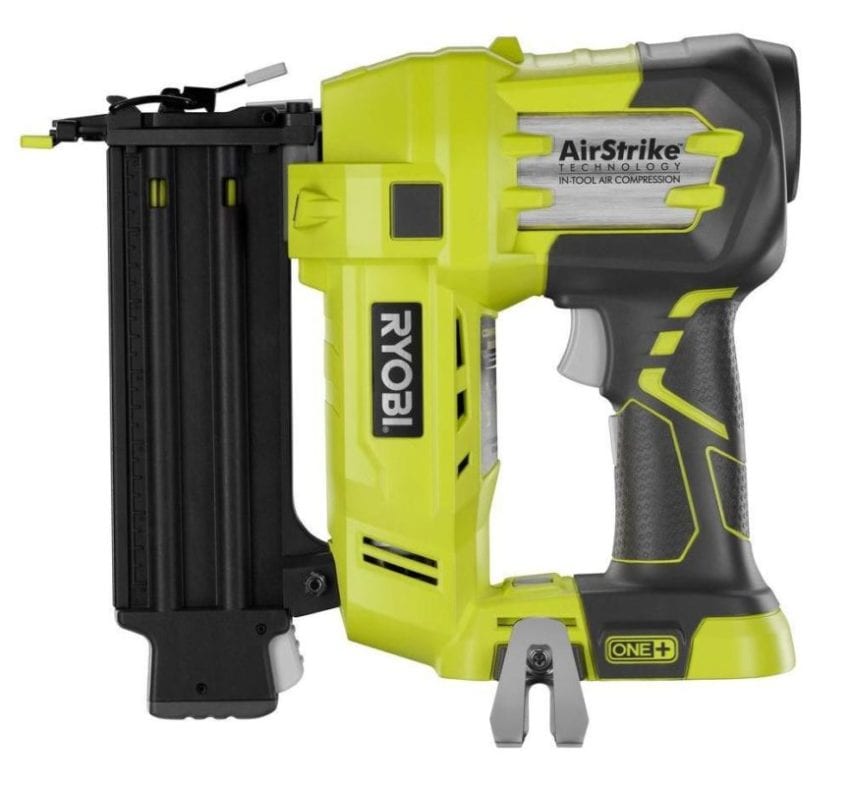
The Ryobi P320 Cordless Brad Nailer Compared
Picking up the Ryobi 18V brad nailer, the first thing I noticed was the weight. While I wouldn’t classify it as “heavy”, the tool does come in almost five pounds heavier than my pneumatic brad nailer. My scale put it at nearly 7.0 lbs with a 4.0 Ah 18V lithium-ion battery. Even with the added weight, I have to say the tool still has a balanced feel to it that works. Here’s how it compares to a few related models currently on the market:
| Model | Ryobi P320 AirStrike | Ridgid R213BN18B | DeWalt DC608B | Paslode 901000 |
|---|---|---|---|---|
| Dimensions | 11.7 x 10.2 x 3.5 in. | 12.8 x 9.9 x 4.3 in. | 11 x 11.5 x 3.5 in. | 11 x 11.5 x 3.5 in. |
| Weight | 7.0 lbs. | 5.6 lbs. | 7.4 lbs. | 4.9 lbs. |
| Battery Tech | 4.0 Ah Li-ion | 3.0 Ah Li-ion | 2.4 Ah XRP Li-ion | Fuel + Battery |
| Price | $129 (tool only) | $249 (tool only) | $199 (tool only) | $299 (w/batt) |
Since most of us career carpenters have pretty good hand strength, the weight isn’t a deal-breaker—particularly when you factor in the convenience of a cordless tool. Using it overhead all day long to hang crown might be another story, but for attaching small trim pieces or assembling projects I’ll take the weight in stride with the mere convenience of the tool.
Firing Delay
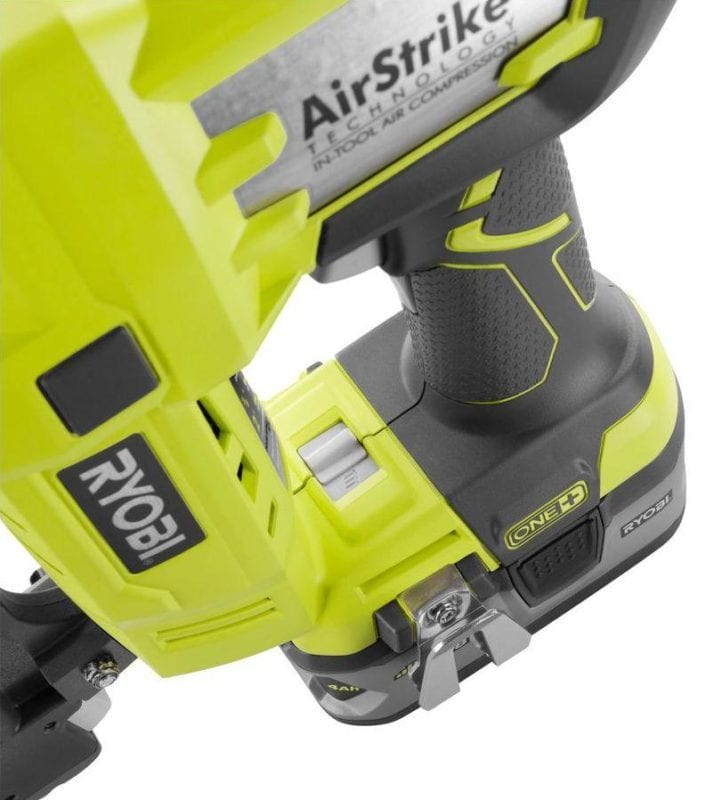
Another difference I’d point out when I talk about the AirStrike versus a pneumatic is the slight delay you experience pulling the trigger. While a pneumatic nailer will give you an instant fire, the Ryobi has to do a brief cycle before sending the nail home. The delay is actually pretty short (shorter than some gas-powered nailers I’ve used), and after the first 15-20 shots I got used to it. Switching the mode from single shot to contact actuation (accomplished by sliding a switch at the base of the handle), lessens the delay even further.
Stand-out Features of the Ryobi P320 AirStrike 18V Brad Nailer
There’s a lot to like about this 18V brad nailer, but here are a few of the features I really enjoyed that, in my opinion, set it apart as a great tool:
Dual LED lights
The twin LEDs are positioned on each side of the tool and are activated simply by grasping the hex grip handle. The light shines directly onto the work surface—right where you’re nailing. And since they come from either side, shadowing is minimized to the area just above the strike zone.
Depth of Drive Adjustment
Between the pressure adjustment and the fine tuning of the depth-of-drive dial, you can set the depth to just about anything on just about any type of wood. Plus, you don’t need a tool to do it.
Belt Clip
The integrated belt clip has come in handy on more than one occasion, since I’ve started using this tool. It’s nice and wide, so it fits over thick tool belts as well as more traditional belts or waist bands.
700 Nails per Charge
I’m not one for counting nails, but given the number of sticks I went through on a single battery, Ryobi’s claim of 700 nails per charge is more than likely spot-on. I’m sure the new 4.0 Ah lithium-ion battery has more than a little influence on that figure.
Dry-fire Lockout
I don’t care whether it’s pneumatic, gas or battery-powered, dry-fire lockout is a feature that every nailer needs. Ryobi’s system has it, and it’s efficient—not kicking in until there are just 4-5 brads left in the magazine. At that point you can pull the trigger all you want—the Ryobi is not going to mar your wood with a spout of air that does nothing but deliver a nice dent to your workpiece. Load in another stick of nails, and you’re back in business.
Jam Release
Another tool-less feature,
the Ryobi lets you open up the area just above the top of the magazine to clear any potential nail jams. I didn’t actually have to use this feature during testing, but it’s nice that it’s there, and it doesn’t require an Allen wrench.
Flexible Nail Handling
For a $129 tool, the Ryobi can handle 18 gauge brad nails ranging in size from 5/5″ to 2″ in length. That’s a nice range of brads and is perfect for just about any application. This is on par with most 18 gauge pneumatic tools I’ve used.
No-mar Pad Plus Spare
Not only did Ryobi include a removable non-marring pad on the nose of the AirStrike, it also added a replacement tip that stores neatly right on the bottom of the nail magazine. There are also sufficient bumpers on the tool that you can set it down on just about any surface without fear of scratching it.
Using the Nailer
Loading the tool is self-explanatory, so other than saying that the magazine slide opens easily and slams back into place with little to no hassle, there’s not much to note there. What I did like was the way in which the Ryobi P320 let you adjust both air pressure and depth of drive independently. Ryobi actually recommends primarily using the air pressure control to set the depth of drive when you change out either the nail length or the type of material you’re nailing into. This makes sense since you don’t want to rely on the mechanical adjustment when you’re possibly feeding too much or too little pressure to the mechanism of the tool.
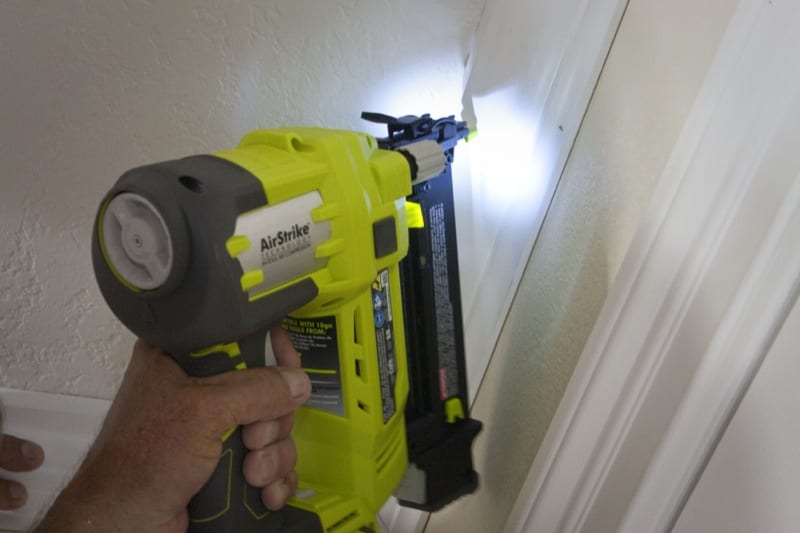
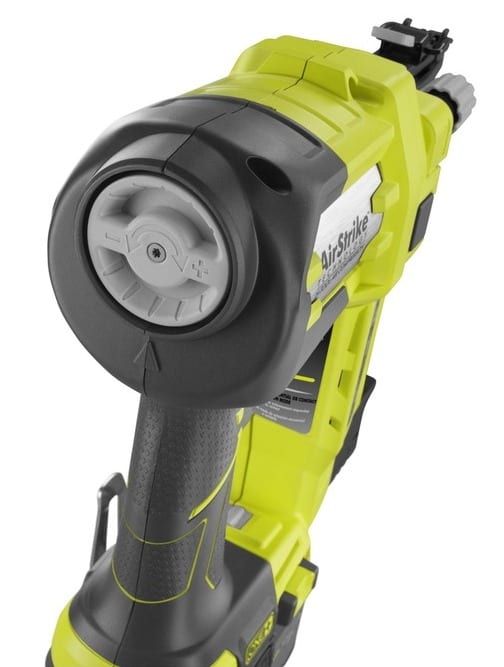
Adjusting the air pressure is facilitated by a large dial on the back of the tool. You just turn it clockwise for more and counterclockwise for less. If you find that you hit either extreme, you may want to verify that your depth of drive setting isn’t also maxed out in the opposite direction. It’s always good to get everything normalized and adjust from there. Overall, I found it very quick to set up, and I was able to get my nails to set exactly how I like them—which is to say, just below the surface of the wood where I can hit them with just a touch of filler.
Nailing Consistency
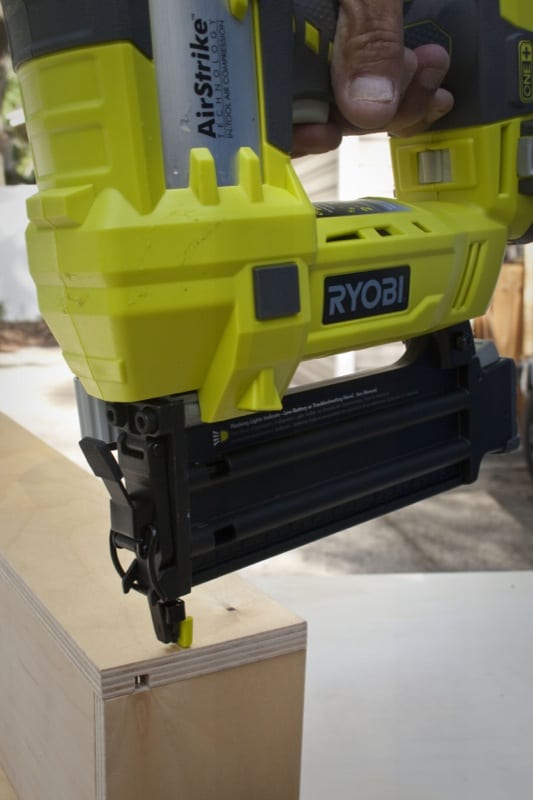
After using the AirStrike brad nailer for a while and getting the air pressure and depth of drive dialed in, I was impressed by the consistency with which I could countersink a 2″ brad into birch, pine, or maple. It even seemed more consistent than my pneumatic brad nailer, if that’s possible. Perhaps due to the consistency of the battery-powered air supply, the fluctuations between shots are decreased. Who cares? We’ll let the guys over at “How’s It Work?” sort all that out. The bottom line is that it works well and provides a very reliable shot.
Conclusion
I actually find myself looking for excuses to pull out this nailer and use it on projects, and I can’t remember saying that about too many tools. Maybe it’s because I get to save so much time not having to drag a compressor and air hose around. Or maybe it’s just because of the surprised looks I get when I use it in front of people.
Ryobi P320 Airstrike Specifications
- Model: P320
- Nail Gauge: 18
- Fastener size: 5/8 – 2 in.
- Dimensions: 11.7 x 10.2 x 3.5 in.
- Weight: 9 lbs. (w/battery)
- Warranty: 3-year limited, 90-day exchange
- Includes: P320 brad nailer, 500 1-1/4″ brad nails, Owner’s manual
- Price: $99 (tool); $99 (battery); $30 (30-minute charger)