
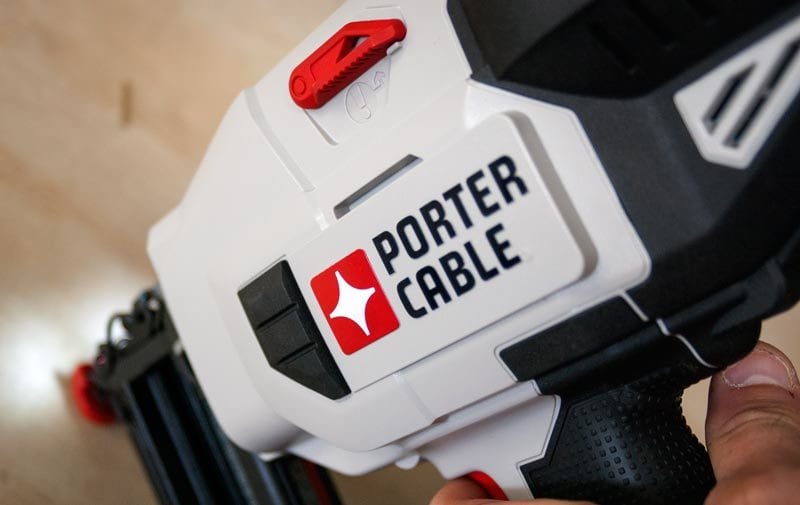
Cordless nailers have really picked up momentum in the last year. Even models by traditionally DIY brands have been heralded by Pros for the convenience they offer in leaving the compressor and hose behind. While the foundations were laid years ago, technology is reaching out to a point where cordless finish nailers can be both effective and affordable. That’s the intersection where we pick up the Porter-Cable 20V Max 16 Gauge Finish Nailer.
Following the recent launch of Porter-Cable’s 20V Max 18 Gauge Finish Nailers, the new 16 gauge model has been highly anticipated. This is great news for trim and finish carpenters looking for a more complete line before jumping into the battery platform. The new Porter-Cable 20V Max 16 Gauge Finish Nailer meets the need for a larger fastener.
The new cordless finish nailer is the third in the line from Porter-Cable that seems to be after the same market sector as Ryobi’s Airstrike line. There are certainly some similarities between the concepts, but has the extended time given Porter-Cable the advantage to produce a better tool?
That’s certainly at the top of my agenda to discover.
First Impressions
The Porter-Cable 20V Max 16 Gauge Finish Nailer is a straight finish nailer as you might guess. Most brands seem to prefer a 15 gauge as their angled finish nailer before producing a 16 model angled model.
The length is fairly consistent with other cordless nailers, but they did manage to get a thinner model out. Designers oriented the motor to have its end cap on the side rather than the rear. This seems to have saved them some the width. Despite the large profile that this entire class of tool shares, Porter-Cable’s 16 gauge cordless nailer weighs nearly half a pound less than the competition. The nailer weighed in at 5.72 pounds without the battery on our scales.
Ergonomically, Porter-Cable’s PCC792 also has the class’ typical top heavy, slightly forward leaning balance. This is a little better with a 4.0 amp hour battery, but don’t expect miracles. I found the handle to be an excellent size and shape for my hand and the rubber overmold helped ensure a secure grip.
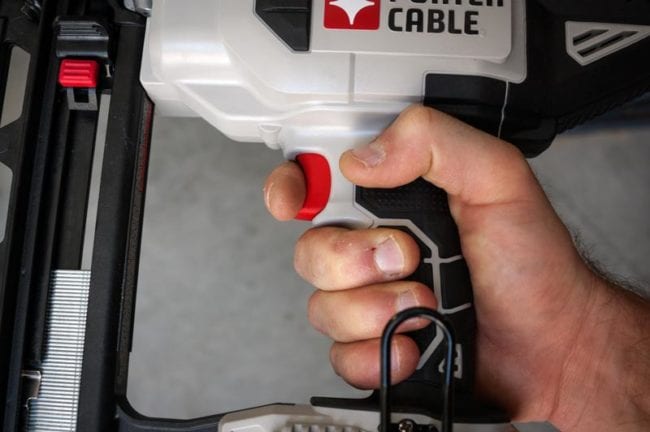
For safety, a lockout switch is present below the trigger. It’s recessed a bit which makes it a little difficult to get into, but it’s an easy trade-off to make considering you won’t accidentally flip it on or off when holding the tool.
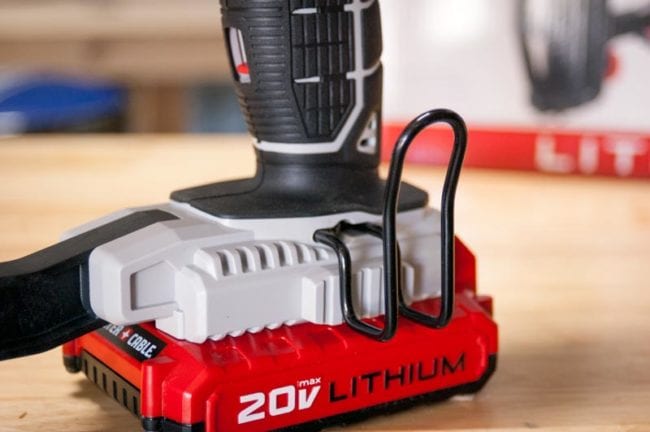
The belt hook has a very basic look to it, but is stronger than I expected. It only installs on one location, which is easiest for the right handed user to wear on his belt. Two no-mar tips are included. The first is pre-installed and the second is attached behind the lower magazine.
I don’t usually get excited about LED lights, but Porter-Cable’s are pretty intuitive. By using a dual light system, it effectively casts a shadow of the tip ahead of the nailer to help align the shot. Single LED systems typically cast a much larger shadow that does little for accuracy because of how much the nose blocks the light. You have to press in the tip to get the lights. I’d like to see them tied to the trigger so you can engage them before contacting the work surface.
Performance
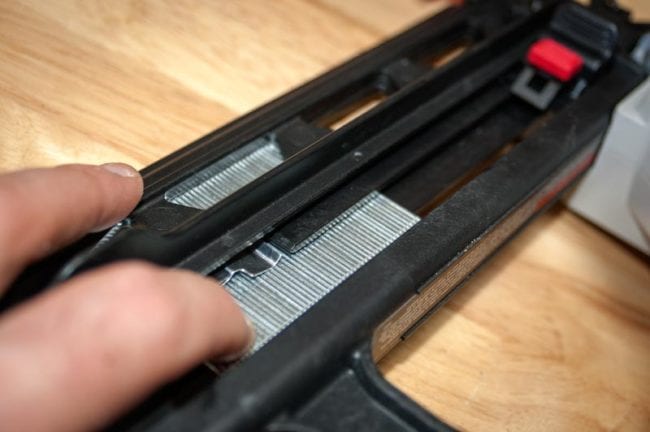
I had some odds and ends to wrap up around the shop, plus some scraps to test fastening speed and depth of drive on. Loading the nails is a familiar process. You’ll need to slide your choice of fastener beyond the clip that prevents nails from falling out when the pusher is above it. Slide the pusher back over the nails and it will pick them up and hold them in place – if you’re playing nicely. A lot of people like let the pusher slap back against the nails, much like the satisfying slap of a magazine into place before operating the slide to chamber a round. I found that the pusher tends pop around your nails and leave them behind if you do this.
The depth of drive adjustment is a traditional thumb wheel on the right side of the housing with positive clicks for each setting. Just behind the tip, you’ll see a window showing you what level you’re on with your depth that I found very helpful. It simply moves along with the tip as it moves forward and back. There was more than enough power to fully drive my 2-1/2 inch nails into pine without having to come near full driving depth. That leaves plenty in reserve for your harder woods.
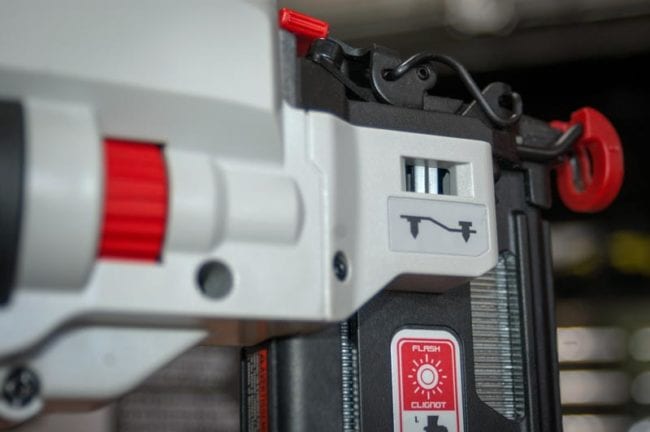
There’s just one firing mode on the Porter-Cable 20V Max 16 Gauge Finish Nailer. You’ll need to depress the tip and pull the trigger each time you fire. You have to fully disengage and reengage the tip before you’ll be able to fire the next nail. That may sound cumbersome, but it really didn’t change my methods at all. With just a to-do list of things to secure, accuracy was a much greater priority than speed.
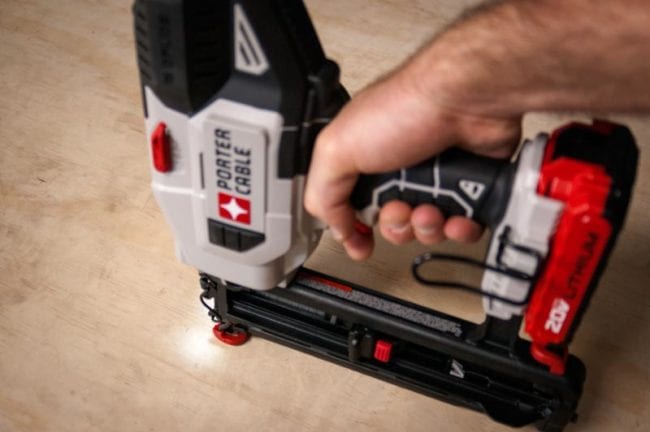
Speaking of speed, I couldn’t help myself but to see how fast I could fire. Bringing out both the Porter-Cable PC796 and its Ryobi counterpart, I fired ten 2-1/2 inch nails as fast as I could. It took several rounds to figure out the most efficient method for each nailer and I took the fastest set I could manage.
The results?
Porter-Cable was nearly 3/4 of a second faster at 7.39 seconds. I can’t imagine that anyone would really need to fire that fast with a finish nailer, but we can easily conclude that one nail per second is easily achievable even if you haven’t practiced. Like the other cordless nailers currently on the market, you will experience the motor spin up required before the nail is delivered. With the results of this test, it’s clearly not a major detriment to your efficiency.
Another interesting characteristic I noticed with the Porter-Cable 20V Max 16 Gauge Finish Nailer was the reduced recoil. It was a noticeable difference compared to other cordless options in this class.
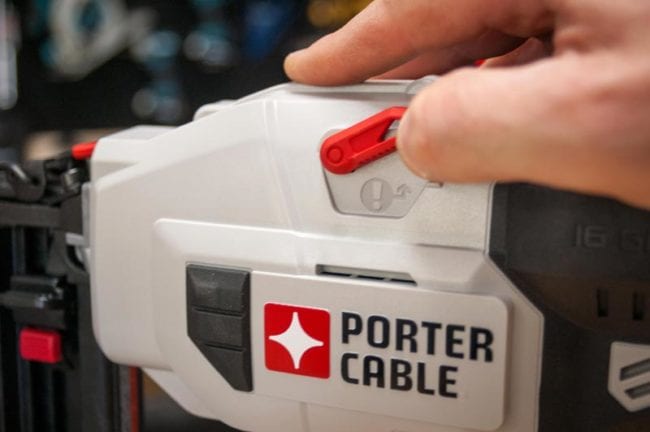
I didn’t experience any jams or misfires during my testing, but a couple of things stand out in that department. First, there’s no dry fire lockout. This is one of those features that is a big deal for me. I guess I’ve been spoiled into not really looking at the magazine as I go. If you do get a jam, there’s a tool-free release above the nose that makes getting to the offending nail easy. When that happens, you’ll need to reset the motor by flipping the stall release lever on the left side.
If you’re going for the kit, expect to get in the neighborhood of 375 nails on one charge of the included 1.5 amp hour battery. If you don’t mind trading off a bit of weight for more run time, grab the bare tool and use a 4.0 amp hour battery for up to 1000 nails. Those nails fall into a range of 1″ to 2-1/2″ in length.
Conclusions

The Porter-Cable 20V Max 16 Gauge Finish Nailer took a while to come out compared to some of their closest competition, but the results of their efforts are certainly positive. We’re at a point now where a second tier of cordless nailers is emerging with brushless motors and lighter weight, but I have to say that the performance, feature set, and value in this model is compelling for anyone looking to ditch the compressor and hose for good.
Porter-Cable has improved on other nailers in this class to be more than just relevant – they’re competing for the top. While it would take a serious head to head to quantify all the differences in this tier, I can confidently say there’s no reason not to pull the trigger, especially if you’re already in the Porter-Cable battery system. Unless of course the lack of a dry fire lockout is a deal breaker for you.
Looking forward, a 15 gauge angled nailer seems to be the most logical next step. Several people have commented that they’d like to see more investment in smaller pinners since they’re dead useful and should be easy on a cordless platform. Either way, look for more cordless solutions for woodworking from Porter-Cable in the coming months.
Porter-Cable 20V Max 16 Gauge Finish Nailer Specifications
- Model: PCC792LA (kit), PCC792 (bare tool)
- Power Source: Porter-Cable 20V Max Battery
- Nail Size: 16 gauge
- Nail Length: 1″ – 2-1/2″
- Run Time: 375 nails (1.5 AH), 1000 nails (4.0 AH)
- Weight: 5.72 pounds (bare)
- Price: $269.99 (kit), $199.99 (bare)
- Warranty: 3 years limited, 1 year service agreement