
Think you know everything about the OSHA silica dust standards and rules? Dust collection and mitigation have been a big topic overseas and domestically for years. The OSHA Respirable Crystalline Silica Standard protects workers from exposure to crystalline silica. The rule deals with construction environments as well as general industry and maritime. This lets employers address the issues and provide solutions for the specific conditions found in their workplaces. A recent report by the U.S. DOL has some concerns following the implementation of the 2017 rule.
The OSHA Respirable Crystalline Silica Standard became law in 2017. It brought with it increased business costs for mitigation. This necessarily drove up costs to consumers—but it also facilitated better working conditions and a path to a safer work environment. Since it affects both commercial construction companies as well as smaller residential construction and remodeling companies, the effects of the OSHA Respirable Crystalline Silica standard or rule are enormous once you take into account compliance costs, insurance, and potential penalties.
Be sure to check out our article on the OSHA Silica Dust Permissible Exposure Limit (PEL)
February 2020 Update
On February 5, 2020, the U.S. Department of Labor Revised the National Emphasis Program to Reduce or Eliminate Worker Exposure to Silica. It made the following changes:
- Revised application to the lower permissible exposure limit for respirable crystalline silica to 50 micrograms per cubic meter (µg/m3) as an 8-hour time-weighted average in general industry, maritime, and construction;
- Updated the list of target industries (as listed in the appendix of the NEP);
- Compliance safety and health officers will refer to current enforcement guidance for RCS inspection procedures;
- All OSHA regional and area offices must comply with this NEP, but they are not required to develop and implement corresponding regional or local emphasis programs; and
- State Plans must participate because of the nationwide exposures to silica.
How We Got the OSHA Respirable Crystalline Silica Standard or Rule
OSHA claims that 1.85 million workers are currently exposed to respirable crystalline silica in construction workplaces. That number is awfully high, but it merely deals with people around those materials, not people negatively affected by overexposure. OSHA does give us another number that estimates 640,000 (roughly one-third) of these workers may have exposure to silica levels that would exceed the proposed permissible exposure limit (PEL).
The OSHA Respirable Crystalline Silica Standard puts some hard data and solutions in place to deal with these issues. Check out our article on Table 1 compliance for even more information on tools and systems.
When you talk about crystalline silica you’re talking about mixing, grinding/polishing, cutting, and drilling concrete as well as tuckpointing and using demo hammers. You also have to address rock crushing, drywall finishing, and using heavy equipment when moving concrete and dirt.
OSHA believes the Respirable Crystalline Silica Standard will save as many as 560 lives and prevent up to 1080 silicosis conditions per year in just the construction market alone. We’re continuing to see tools hit the market that address this standard and help mitigate silica dust exposure.
So far, OSHA has yet to force the use of apparatus designed to filter dust to the lungs in most scenarios. That would mean having to don some pretty bulky headgear!
What is Crystalline Silica?
Respirable crystalline silica is made up of particles that are 100 times smaller than ordinary sand (or less). Crystalline silica is found on beaches and playgrounds—and of course on job sites where concrete, tile, and masonry materials like brick, block, and mortar are being moved, cut, or otherwise manipulated. Workers can respirate crystalline silica when cutting, sawing, grinding, drilling, or even crushing or transporting these materials.
Major Provisions of the OSHA Respirable Crystalline Silica Standard
The OSHA Respirable Crystalline Silica Standard for construction forces employers to do the following:
- Measure the amount of silica that workers are exposed to if it may be at or above an action level of 25 μg/m3 (micrograms of silica per cubic meter of air), averaged over an 8-hour day
- Protect workers from respirable crystalline silica exposures above the PEL of 50 μg/m3, averaged over an 8-hour day
- Limit workers’ access to areas where they could face exposure above the PEL
- Use dust controls to protect workers from silica exposures above the PEL
- Provide respirators to workers when dust controls cannot limit exposures to the PEL
- Offer medical exams-including chest X-rays and lung function tests-every three years for workers exposed above the PEL for 30 or more days per year
- Train workers on work operations that result in silica exposure and ways to limit exposure
- Keep records of workers’ silica exposure and medical exams
Small Business Construction Alternatives
Fortunately for small businesses and construction companies, the OSHA Respirable Crystalline Silica Standard lets employers measure their workers’ exposure to silica and independently decide which dust controls work best in their workplaces. In this way, employers can use control methods indicated in the following table:
Exposure Control Methods for Grinders
| Operation | Engineering and Work Practice Control Methods | Required Air-Purifying Respirator ≤4 hrs/day | Required Air-Purifying Respirator ≥4 hrs/day |
|---|---|---|---|
| Using Hand-Operated Grinders | Use a water-fed grinder that continuously feeds water to the cutting surface. OR | None | Half-mask |
| Using Hand-Operated Grinders | Use grinder equipped with a commercially available shroud and dust collection system operated and maintained to minimize dust emissions. Collector must be equipped with a HEPA filter and must operate at 25 cubic feet per minute (cfm) or greater airflow per inch of blade diameter. NOTE: Additional specifications (wherever applicable): • Prevent wet slurry from accumulating and drying. • Operate equipment such that no visible dust is emitted from the process. • When working indoors, provide sufficient ventilation to prevent the build-up of visible airborne dust. | Half-mask | Half-mask |
| Tuckpointing | Use a grinder equipped with a commercially available shroud and dust collection system. The grinder must be operated flush against the working surface and work must be performed against the natural rotation of the blade (i.e., mortar debris must be directed into the exhaust). Use vacuums that provide at least 80 cfm airflow through the shroud and include filters at least 99 percent efficient. NOTE: Additional specifications: • Operate equipment such that no visible dust is emitted from the process. • When working in enclosed spaces, provide sufficient ventilation to prevent the build-up of visible airborne dust. | Powered air-purifying respirator (PAPR) with a loose-fitting helmet or negative pressure full facepiece | Powered air-purifying respirator (PAPR) with a loose-fitting helmet or negative pressure full facepiece |
Exposure Control Methods for Jackhammers (Demo Hammers) and Rotary Hammers
| Operation | Engineering and Work Practice Control Methods | Required Air-Purifying Respirator ≤4 hrs/day | Required Air-Purifying Respirator ≥4 hrs/day |
|---|---|---|---|
| Using Jackhammers and Other Impact Drillers | Apply a continuous stream or spray of water at the point of impact. OR | None | Half-mask |
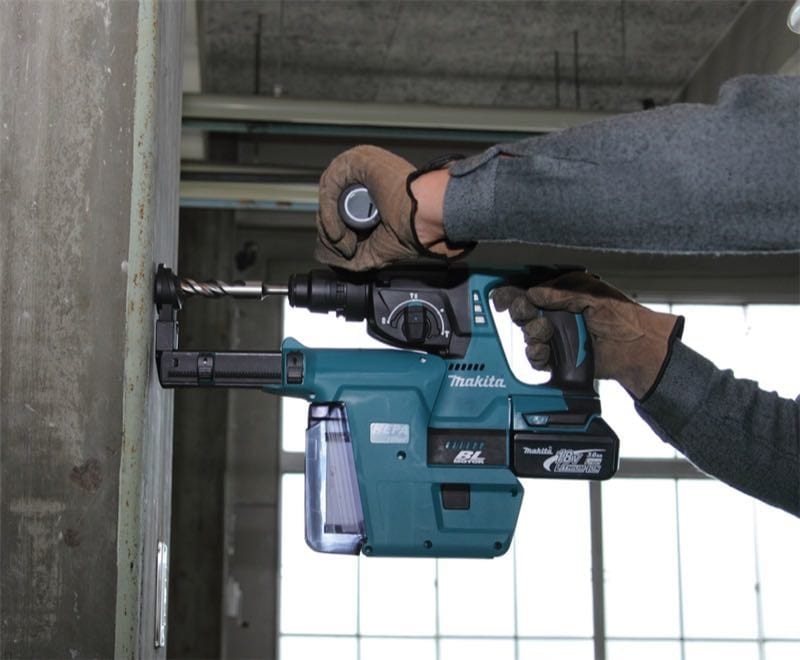
| Using Jackhammers and Other Impact Drillers | Use tool-mounted shroud and HEPA-filtered dust collection system. NOTE: Additional specifications: • Operate equipment such that no visible dust is emitted from the process. • When working indoors, provide sufficient ventilation to prevent the build-up of visible airborne dust. | None | Half-mask |
| Using Rotary Hammers or Drills (except overhead) | Use drill equipped with hood or cowl and HEPA-filtered dust collector. Eliminate blowing or dry sweeping drilling debris from the working surface. NOTE: Additional specifications: • Operate equipment such that no visible dust is emitted from the process. • When working indoors, provide sufficient ventilation to prevent the build-up of visible airborne dust. • Use dust collector in accordance with manufacturer specifications. | None | None |
Exposure Control Methods for Masonry Saws
| Operation | Engineering and Work Practice Control Methods | Required Air-Purifying Respirator ≤4 hrs/day | Required Air-Purifying Respirator ≥4 hrs/day |
|---|---|---|---|
| Using Stationary Masonry Saws | Use saw equipped with integrated water delivery system. NOTE: Additional specifications: • Change water frequently to avoid silt build-up in water. • Prevent wet slurry from accumulating and drying. • Operate equipment such that no visible dust is emitted from the process. • When working indoors, provide sufficient ventilation to prevent the build-up of visible airborne dust. • Ensure saw blade is not excessively worn. | None | Half-mask |
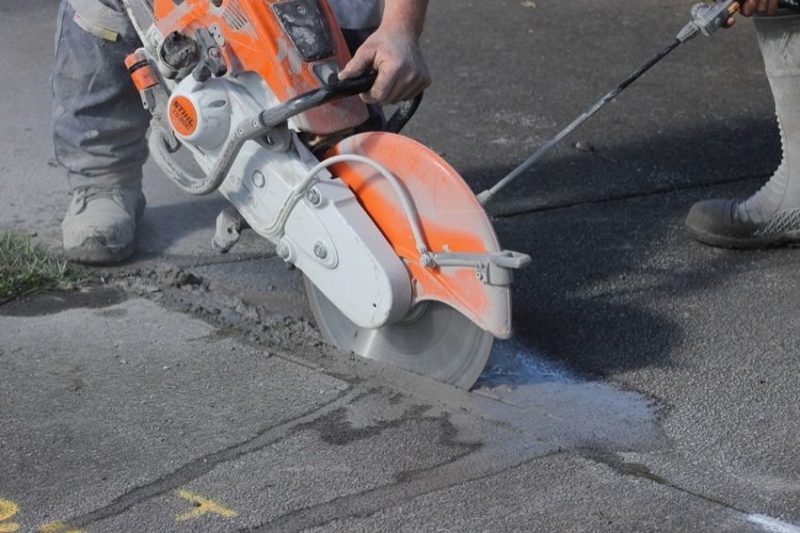
| Using Handheld Masonry Saws | Use a water-fed system that delivers water continuously at the cut point. • Used outdoors. • Used indoors or within a partially sheltered area. OR | None Half-mask | Half-mask Half-mask |
| Using Handheld Masonry Saws | Use saw equipped with local exhaust dust collection system. • Used outdoors. • Used indoors or within a partially sheltered area. NOTE: Additional specifications: • Prevent wet slurry from accumulating and drying. • Operate equipment such that no visible dust is emitted from the process. • When working indoors, provide sufficient ventilation to prevent the build-up of visible airborne dust. • Use dust collector in accordance with manufacturer specifications. | Half-mask Full facepiece | Half-mask Full facepiece |
| Using Portable Walk-Behind or Drivable Masonry Saws | Use a water-fed system that delivers water continuously at the cut point. • Used outdoors. • Used indoors or within a partially sheltered area. NOTE: Additional specifications: • Prevent wet slurry from accumulating and drying. • Operate equipment such that no visible dust is emitted from the process. • When working indoors, provide sufficient ventilation to prevent the build-up of visible airborne dust. | None Half-mask | None Half-mask |
Exposure Control Methods for Drywall Finishing and Heavy Equipment
| Operation | Engineering and Work Practice Control Methods | Required Air-Purifying Respirator ≤4 hrs/day | Required Air-Purifying Respirator ≥4 hrs/day |
|---|---|---|---|
| Drywall Finishing (with silica-containing material) | Use a pole sander or hand sander equipped with a dust collection system. Use dust collector in accordance with manufacturer specifications. OR Use wet methods to smooth or sand the drywall seam. | None | None |
| Use of Heavy Equipment During Earthmoving | Operate equipment from within an enclosed cab having the following characteristics: • Cab is air-conditioned and positive pressure is maintained • Incoming air is filtered through a prefilter and HEPA filter • Cab is maintained as free as practicable from settled dust • Door seals and closing mechanisms are working properly. | None | None |
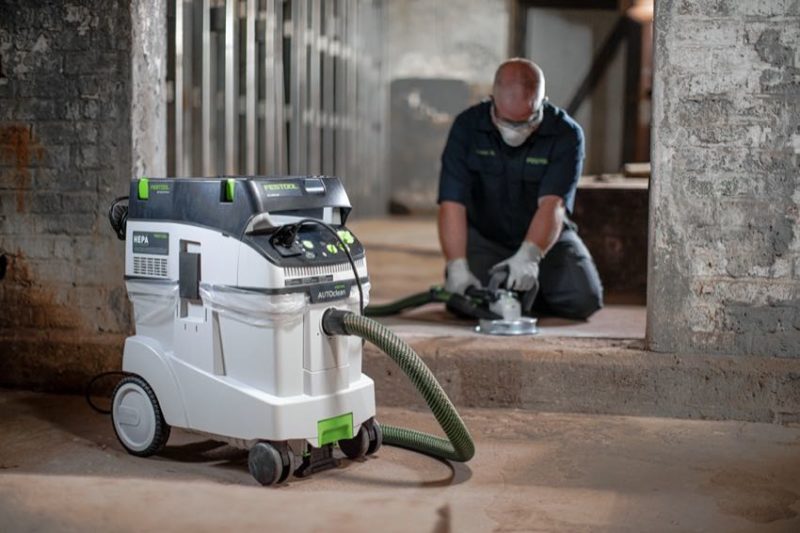
While the most common method of limiting exposure to silica dust on a construction site uses water, the best dust extractors also play a big part in mitigating airborne particles. This plays a large role in the OSHA Respirable Crystalline Silica Standard.
What Happened Since the Silica Rule Became Enforceable?
Oddly enough, OSHA performed fewer inspections since the proposed rule became law. In fact, a September 29, 2021 report on a performance audit by the U.S. Department of Labor found that “OSHA’s diminished enforcement following the enforceable date of the final rule on September 23, 2017, may have left more workers at risk for exposure to silica.”
First, OSHA’s inspection data for the two fiscal years after the final rule became enforceable shows OSHA performed an average of 440 inspections annually. In contrast, for the two fiscal years before the final rule became enforceable, OSHA performed an average of 1,054 silica inspections per year. Therefore, after the final rule became enforceable, OSHA performed approximately 600 fewer silica inspections per year, a decrease of more than fifty percent.
Also, inspection data provided by OSHA was inconsistent with data extracted from OSHA’s publicly available database. Last, OSHA did not set clear goals and processes for evaluating whether outreach efforts sufficiently reached covered industries and 2.3 million workers at risk for silica exposure.
Important OSHA Respirable Crystalline Silica Standard Dates and Facts
- March 2016: OSHA published its final rule on Workplace Injury and Illness Tracking
- Rule Details: Requires companies with 20 or more employees submit an OSHA 300A summary of injuries electronically once a year. Companies with over 250 employees must submit quarterly electronic logs.
- January 2017: OSHA published its final Walking Working Surfaces and Personal Fall Protection rule.
- February 5, 2020: U.S. Department of Labor Revises National Emphasis Program to Reduce or Eliminate Worker Exposure to Silica
Final Thoughts
Do you work with tools that generate and release silica dust into the environment? How has your company handled the new rules and guidelines? Has it impacted your safety in a positive manner? How has it affected (if at all) your productivity and workflow? Let us know in the comments below.