
Let me just start off by voicing a general sense of wariness with new Lithium-ion technology in general. While there are tons and tons of articles about new anode and cathode technology, slimmer batteries, and differing compounds… most of the tech has been theoretical, or at the very least, impractical to mass produce. I’m going to say that this most recent paintable lithium-ion battery technology, which can turn virtually any surface into a lithium-ion battery, also falls into that category. But it’s still cool – and perhaps someday we’ll see some of this tech get practical and come to fruition. Which brings us to this week’s lithium-ion advancement: researchers at Rice University have developed a lithium-ion battery that can literally be painted on the surface of any object.
Paintable Lithium-ion Battery Technology Features
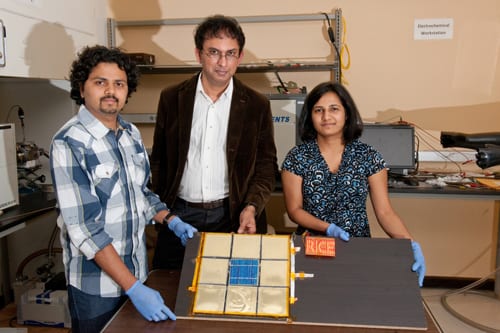
The rechargeable battery was created in the lab by Rice materials scientist Pulickel Ajayan and consists of spray-painted layers, each representing the anode and cathode components of a traditional battery. The research appears in Nature’s online, open-access journal Scientific Reports. The implication is that traditional packaging for batteries could give way to new design and integration possibilities for storage devices. Your batteries could be integrated into the very products they power. Forget form factor, the batteries could BE the tools.
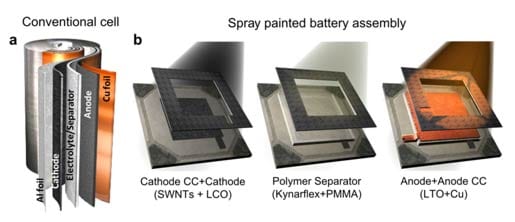
Lead author Neelam Singh, a Rice graduate student, and her team spent painstaking hours formulating, mixing and testing paints for each of the five layered components – two current collectors, a cathode, an anode and a polymer separator in the middle. The materials were airbrushed onto ceramic bathroom tiles, flexible polymers, glass, stainless steel and even a beer stein to see how well they would bond with each substrate.
In the first experiment, nine bathroom tile-based batteries were connected in parallel. One was topped with a solar cell that converted power from a white laboratory light. When fully charged by both the solar panel and house current, the batteries alone delivered 2.4 volts and powered a set of light-emitting diodes that spelled out “RICE” for six hours.
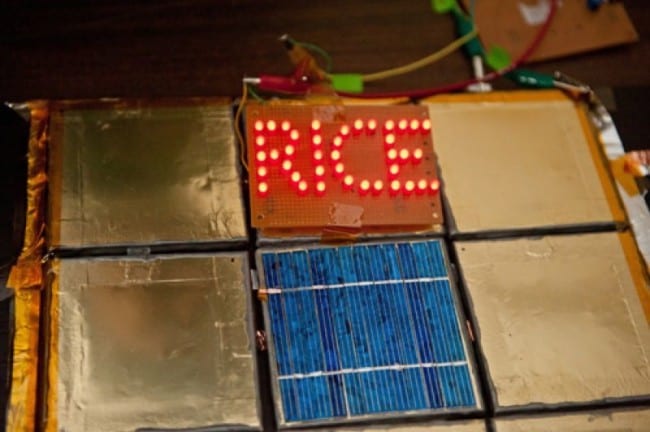
The researchers reported that the hand-painted batteries were remarkably consistent in their capacities, within plus or minus 10 percent of the target. They were also put through 60 charge-discharge cycles with only a very small drop in capacity, Singh said.
The multi-layer painted-on system is actually pretty interesting. The first layer is the positive current collector. The second layer is the cathode. The third is the polymer separator paint. The fourth layer is the anode, a mixture of lithium titanium oxide and UFG in a binder. The final layer is the negative current collector, a commercially available conductive copper paint, diluted with ethanol.
Singh said the batteries were easily charged with a small solar cell. She foresees the possibility of integrating paintable batteries with recently reported paintable solar cells to create an energy-harvesting combination that would be hard to beat. As good as the hand-painted batteries are, she said, scaling up with modern methods will improve them by leaps and bounds. “Spray painting is already an industrial process, so it would be very easy to incorporate this into industry,” Singh said.
The Rice researchers have filed for a patent on the technique, which they will continue to refine. Singh said they are actively looking for electrolytes that would make it easier to create painted batteries in the open air, and they also envision their batteries as snap-together tiles that can be configured in any number of ways.
I, for one, would love to think that we could one day go to the store and pick up a 5-can spray pack to produce a rechargeable lithium-ion battery that would power a particular device of our choosing.
Of course, that might be something more for my grandkids… but who knows.