
We try and stay on top of issues affecting tradesmen, and one issue that keeps rearing its head is the pending “skills gap”. When the Discover Your Skills with Mike Rowe website was announced, it was hard not to realize that we really needed to address this issue head-on. Klein Tools has been a consistent advocate for both vocational training and the general education of tradesmen in the industry. This week, Klein announced results from its third-annual ‘State of the Industry’ survey. They surveyed over 400 electricians and asked them, among other things, about their concerns for the future of the industry. Electricians leaving the industry was a chief concern.
Electricians Leaving the Industry
 As you might expect, a major theme was the growing skills gap, but they also expressed concern over the availability of jobs through the next decade. These two things might seem at odds (less available workers would necessarily lead to more demand for those who can perform the needed work). After thinking about it, we wonder if it’s not expressing a general sense of instability in the trades in general.
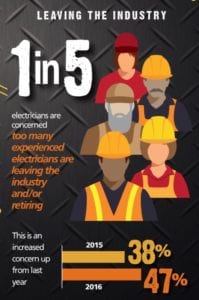
In exploring the skills gap, Klein found that a large number of surveyed electricians (20%) expressed their chief concern to be the number of experienced electricians leaving the industry. Nearly half said that this is at least a general concern. Last year that number was 38 percent, so the concern seems to be growing—at least according to this survey. Regardless of whether they’re leaving through retirement or some other reason, many companies are not hiring back into those positions, but rather finding other ways to meet needs.
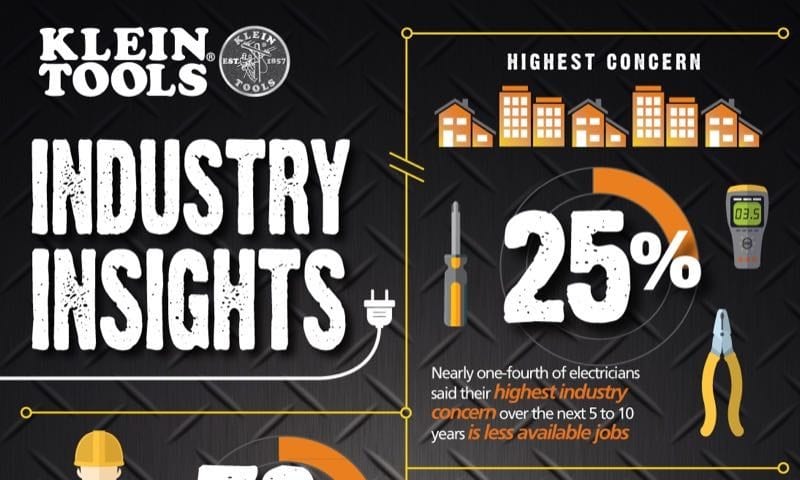
This highest concern by far—at 25%—was job availability over the next 5-10 years.
“We’re finding that many electricians have concerns about the future of the industry in the next five to 10 years. Many electricians see the number of experienced electricians leaving the industry. They are concerned that not enough young electricians and apprentices are joining the field to replace them. A large number of electricians are also concerned with the amount of jobs that will be available in the next 5 to 10 years. With more high-tech installations, including smart homes and the dependency on high-tech electronics, the industry is experiencing dynamic change.”
– Mark Klein, president of Klein Tools
Current Concerns of Electricians Leaving the Industry
While the survey addressed future concerns, the current concerns of electricians leaving the industry was clear as well. The 2016 Klein Tools State of the Industry survey found that 70% of electricians think there is a current shortage of experienced electricians in the field. To remedy this, a large percentage also felt that on-the-job training was the answer.
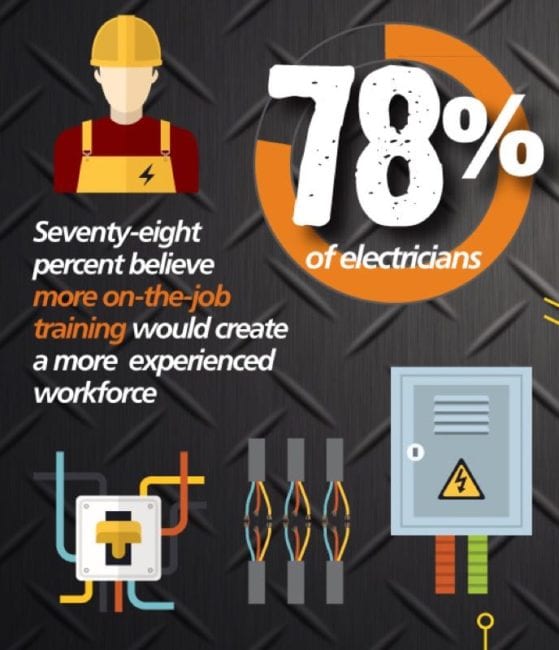
It was interesting to see that this shortage of experienced electricians came up with a majority of the electricians surveyed. Many of the electricians also had similar suggestions for solving the problem with on-the-job training. This seems to speak to the fact that there may be unskilled laborers in the field who can be brought up to the levels required by journeyman electricians. Continuing education, training in the classroom, and online training were key. Vocational approaches largely overshadowed these methods.
Consequently, Klein is doing its part to help the problem. They plan to increase educational investments to $2 million over the next five years. This will go towards training and educational programs. The programs largely include scholarships and tool endowments for apprentices.
About the Survey
Russell Research conducted the Klein Tools ‘State of the Industry’ survey. They conducted 201 online interviews from January 20-26, 2015. From January 27 through February 5, 2016 they completed another 200. Forty percent of respondents were union members and sixty percent were not.