
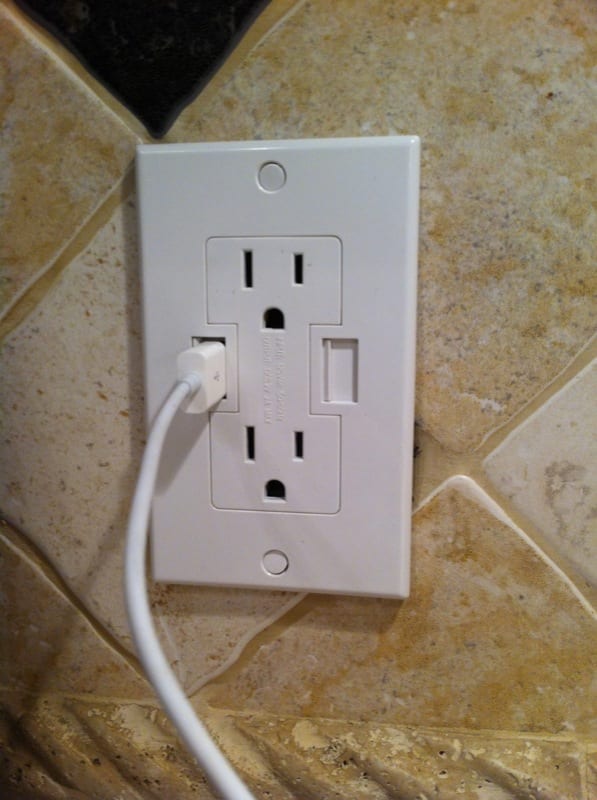
It seems like every portable consumer device needs a USB power supply these days. So, how does the rampant availability and use of iPads, smartphones, and Kindles affect how we build homes? Since it’s very likely that your office, kitchen, and possibly even your bedroom are littered with a myriad of power adapters, accommodating this new trend would be convenient for you and certainly beneficial to your clients.
Features and Build Quality
Newer Technology’s Power2U is an innovative USB outlet that combines two USB charging ports with a standard electrical outlet or receptacle. This eliminates bulky power adapters and allows you to plug in a USB cable directly to the outlet’s accessory ports. The 2A (2000mA) rating delivers enough power to charge even high-current devices like the new iPad.
The Power2U USB outlet receptacle is somewhat revolutionary for home builders and renovators alike. Want to make a difference? Install one of these. Honestly, it’s only slightly ahead of its time – or perhaps right on time. We can really see this product – or ones like it – redefining what electrical outlets could be. While one of these may not make sense in a bathroom, it would improve just about any other location we could think of. Unfortunately, the Power2U USB outlet doesn’t use a standard decorator-style plate.
That means that you won’t be able to match it to all of those custom finishes available on that platform. It does, however, come in Black, Ivory, Almond, or White, and it comes in single packs or 2, 10, 20, and 100 packs. The problem is, there doesn’t seem to be a discount (at least not on Newer Tech’s site) for buying them in bulk. Online, it looks like you can find cheaper versions, and even less expensive contractor packs are available.
Installing and Using the Power2U USB Outlet
The Power2U USB outlet is significantly bigger (both depth and width) than a standard 15A receptacle. In fact, if you’re not using a full-size single-gang box, you may have difficulty installing it (and Newer Tech gives a list of compatible boxes for new and old work). Shallow boxes simply may not cut it (essentially,y this receptacle is similar in size to a GFCI), and you really need a full two inches to make everything clear the sides of the box.
The design of the outlet is such that the hot and neutral connections require you to run the 12/2 wire up and over the outlet or face scraping the sides of the receptacle box. With the wires in place, the width of the outlet is exactly the width of a standard single-gang old work box. That’s a tight fit. A better design would figure out a way to “tunnel” the wire straight through from the back so that you could clamp down the terminals on the straight stripped ends as opposed to having to bend them over and around the bulky plastic housing.
Aside from the difficulty of fitting it into the box, installing the Power2U didn’t involve any acrobatics. It uses four screws that clamp down onto your 12/2 wire and a separate ground screw. The clamps seemed like they were sized for 14 gauge, and so the 12/2 wire seemed almost too thick for the mechanism, but it went together OK in the end. Everything was finally screwed down tightly and securely. One word of advice is to make sure you don’t overtighten the screws (Newer even gives you a torque setting), as they will strip, and then you’ve rendered that terminal unusable. In all honesty, the mechanism could be designed better.
Once everything was in place, we were ready to install the cover plate. On the Power2U, the device-specific cover plate isn’t just a nicety; it actually installs spring-loaded covers over the USB ports to keep them from getting dirty or otherwise contaminated by the environment. It’s a great feature and one that puts the Power2U a step above other solutions (in our opinion) in terms of aesthetics (though, as we mentioned, its non-standard layout causes some potential problems).
Conclusion
I think a USB outlet design like this, and USB outlets in general, are going to take off over the next few years. It’s our hope that they become easier to manufacture and tip the scales in terms of economy of scale. We really can see these becoming the new norm – or, at the very least, an inexpensive upgrade option for kitchen outlets and bedroom/office outlets. Seeing this technology get built into GFCI circuits would also be cool, but it would almost certainly have to be made as a cohesive unit by a manufacturer like Leviton, who’s breaking ground in reducing the size of the required electronics.
In either case, for now, the Power2U can be daisy-chained off an existing GFCI circuit, making it perfectly code-ready for a kitchen countertop location. Great product. Great solution. Highly recommended for anyone with USB-powered devices. We just hope it hits economy-of-scale pricing quickly.