
It’s Teal against Yellow in the latest Pro Tool Reviews Thursday Throwdown! We set up a Makita 18V LXT vs DeWalt 20V Max XR impact driver competition to see who comes out on top. Makita’s XDT16 and DeWalt’s DCF888 represent both brands’ flagship impacts with a boatload of bells and whistles to tempt your tool budget. Game on!
A Quick Word About 20V Max
A lot of folks still think 20V Max tools are more powerful than 18V and it’s understandable. When DeWalt made the shift from Ni-Cad batteries to Li-Ion, they changed the branding from 18V to 20V Max and the new tools were definitely better.
But it’s not because of the voltage. 20V Max is 18V nominal—the same exact voltage that every 18V tool is. You can read more about the why’s and how’s here.
Makita 18V LXT Vs DeWalt 20V Max XR Impact Driver
Let’s take a quick look at our two contenders.
For Team Teal, we have the Makita XDT16.
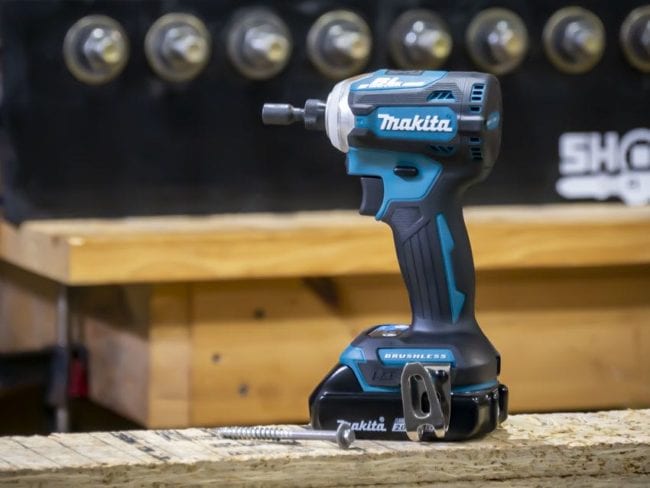
- Power Source: Makita 18V LXT batteries
- No-Load Speeds: 0 – 3600 RPM
- Max Torque: 1600 in-lbs
- Impact Rate: 0 – 3800 IPM
Read the standalone review here.
Reporting for Team Yellow, it’s the DCF888
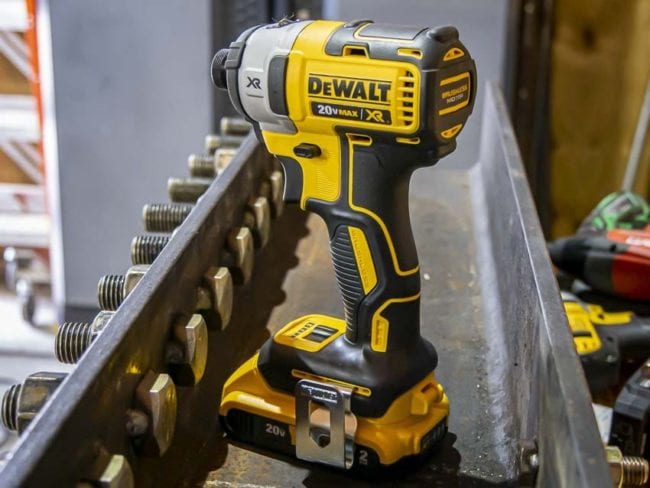
- Power Source: DeWalt 20V Max or FlexVolt batteries
- No-Load Speed: 0 – 3250 RPM
- Max Torque: 1825 in-lbs
- Impact Rate: 0 – 3600 IPM
Read the standalone review of the non-Tool Connect model here.
Footprint
Most premium impact drivers have a pretty tight size. Many even have head lengths that are shorter than their 12V counterparts. DeWalt kicks things off with a very reasonable 5.3″ head length and 7.7″ height.
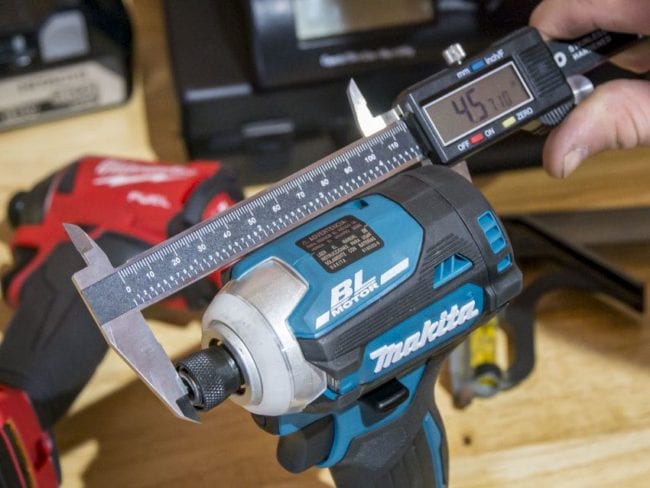
Makita is the most compact in the business, though. Its head measures 4.6″ and its height is a little shorter at 7.4″. While neither tool is bulky, Makita is clearly more compact.
Verdict: Makita
Weight
We measured both impact drivers on our digital scale bare and with their compact 2.0Ah batteries. DeWalt weighs just 2.1 pounds bare and 3.1 pounds with a battery.
Makita edges out DeWalt, though, thanks to a 2.0-pound bare weight and adding just 0.9 pounds with a battery. The results were close, but Makita has a slight advantage here.
Verdict: Makita
Feature Set
Here’s a look at the standard features we look for on our impact drivers:
| Makita XDT16 | DeWalt DCF888 | |
| Brushless Motor | Yes | Yes |
| Speeds | 4 Standard Modes | 3 Standard Modes |
| Assist Modes | 4 Assist Modes | None |
| LED Light | 2 Lights Around the Collet | 3 Lights Around the Collet |
| Belt Hook | Yes | Yes |
| One-Hand Bit Insertion | Yes | Yes |
| Spring Bit Ejection | No | Yes |
| Smart Controls | No | Yes |
This simple chart doesn’t tell the full story. We need to dig deeper to see how special these two impact drivers really are.
Makita’s assist modes include slow start, reverse auto-stop, and two self-tapping screw modes. The XDT16 goes a step further by adding a programmable button below the chuck. You can custom select any two modes you want to switch back and forth between. You can see how to program it in our written review or our video.
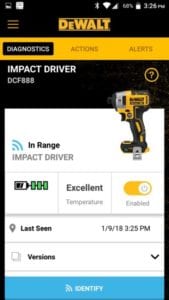
DeWalt has smart controls through its Tool Connect integration. You can customize several controls, track the tool, view diagnostics, and more.
On one side of the coin, I like that Makita has everything on the tool and you don’t need an app to do everything. On the other hand, you get tracking, diagnostics, inventory management, and more with DeWalt’s Tool Connect system. Our office is split over which one is better and it really boils down to preference.
In my opinion, DeWalt has the edge, but it’s far from a decisive call for every user.
Verdict: DeWalt
Power
We have two ways to test impact driver power. In our fastening test, each impact driver fastens a hardened nut onto a bolt and we use a digital torque wrench to measure how much force it requires to break it. This test method does not give the same results as the manufacturer’s specification testing.
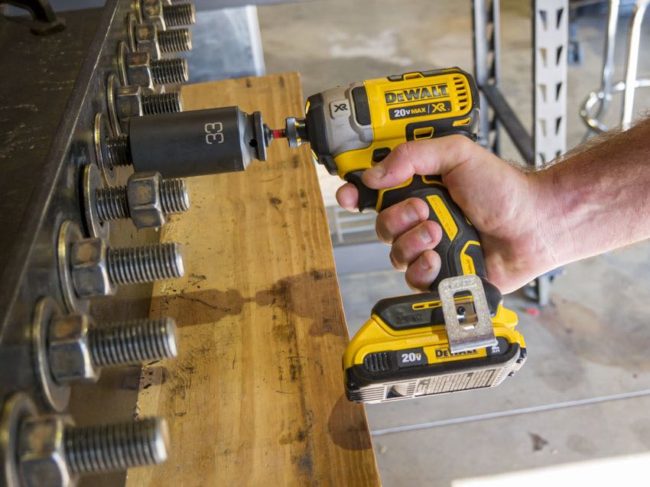
Averaging out a series of tests, it takes 2131 in-lbs of force to undo Makita’s bolts while DeWalt requires 2237 in-lbs.
DeWalt takes a close lead.
In our second test, we proof-load the same hardened nuts to specific intervals and how much nut-busting force each impact driver has.
Makita takes it all the way 3300 in-lbs of bolt-breaking force. DeWalt stops a little short at 3000 in-lbs.
What’s interesting in this mixed result is that Makita has 12.3% less torque than DeWalt on paper. Yet in an actual application, Makita can hang well head-to-head.
Verdict: Tie
Fastening Speed
For fastening speed, we used a 1/4″ lag screw to test which impact can keep its RPMs higher once all the threads are engaged.
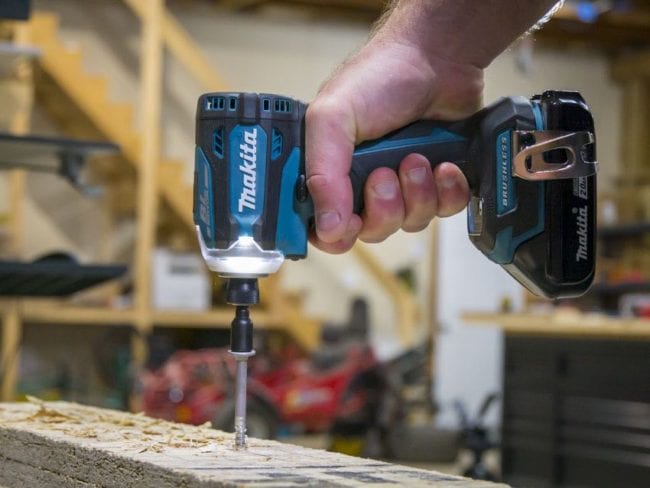
Makita leads the entire 18V field by a pretty significant margin. Its 651 RPM leaves DeWalt in the dust by over 200 RPM. Still, DeWalt’s 429 RPM is effective, it’s just not as competitive head-to-head.
Verdict: Makita
Fastening Efficiency
By comparing the speed under load in our ledger screw test to the no-load speed we tested, we get an idea of how hard the motor has to work. The higher the efficiency as a percentage, the less strain we’re putting on the motor and the longer we expect the tool to stay in service.
Makita’s class-leading speed came with an efficiency rating of 21.0%. That’s not at the top, but it’s definitely in the top tier. DeWalt was closer to the bottom of the group at 13.1%.
Verdict: Makita
Noise
Impact drivers are far from being quiet tools. It’s one of the reasons hydraulic impact drivers are becoming more popular. A few decibels makes a big difference in both how loud an impact driver sounds and the sound pressure level that reaches your ears.
If that’s part of your consideration, Makita is the better bet. Under load, it produced just 97 decibels. Yes, that’s still loud, but it’s 7 decibels less than DeWalt’s 104 decibels.
Verdict: Makita
Compatible Tools
Makita and DeWalt are two of the deepest cordless lines available today. For 2020, Makita expects to hit 250 tools that all work on its 18V LXT battery. It includes 18V LXT Sub-Compact, 18V LXT, and 18V X2 (36V) LXT.
DeWalt is no slouch, though. There are currently more than 200 tools on its 20V Max platform.
The big difference between the two is when you want to move up in power. Makita uses two of its 18V batteries to give you 36V, while DeWalt requires you to buy into another battery platform. Even though FlexVolt batteries are backward compatible to 20V Max, 20V Max batteries aren’t forward compatible to 60V Max tools.
Verdict: Makita
Price
There’s some variance in price depending on where you like to shop and you can get both of these tools at Acme Tools, Amazon, Home Depot, and others.
Makita 18V LXT Impact Driver
- XDT16Z Bare tool: $177.99
- XDT16R Kit with two 2.0Ah batteries: $289
- XDT16T Kit with two 5.0Ah batteries: $325
DeWalt 20V Max XR Impact Driver
- DCF888B Bare tool: $135
- DCF888D2 Kit with two 2.0Ah batteries: $229
- DCF888P2BT kit with two 5.0Ah Tool Connect Bluetooth batteries: $339
If you’re not interested in the Tool Connect Feature, you can get the same impact driver without it and save some money.
- DCF887B Bare tool: $115
- DCF887D2 kit with two 2.0Ah batteries: $199
- DCF887M2 kit with two 4.0Ah batteries: $231
DeWalt has a significantly lower pricing structure than Makita. Even with the Bluetooth Tool Connect batteries, DeWalt comes in lower.
Plugging all the data into our value calculation, Makita scores a respectable 81 points, but DeWalt moves further up the ladder with 86 points.
Verdict: DeWalt
Warranty
Both Makita and DeWalt warranty their tools for three years. However, DeWalt’s addition of a 1-year service agreement and 90-day money-back guarantee tips the scales slightly in its favor.
Verdict: DeWalt
Final Verdict
In this Makita 18V LXT Vs DeWalt 20V Max XR Impact Driver Thursday Throwdown, Makita comes away with a convincing win, 6 – 3 with 1 tie. Two of DeWalt’s three wins are close ones and the only area Team Yellow really pulls away is in price.
Buy the Makita XDT16 if you’re looking for the best combination of size and performance with a rich feature set and a deep line of compatible tools.
Buy the DeWalt DCF888 if you’re looking for smart controls, a deep line of compatible tools, a rich feature set, and want to spend less money on a professional brand. Also, consider the DCF887 if that sounds good but you aren’t interested in smart controls.