
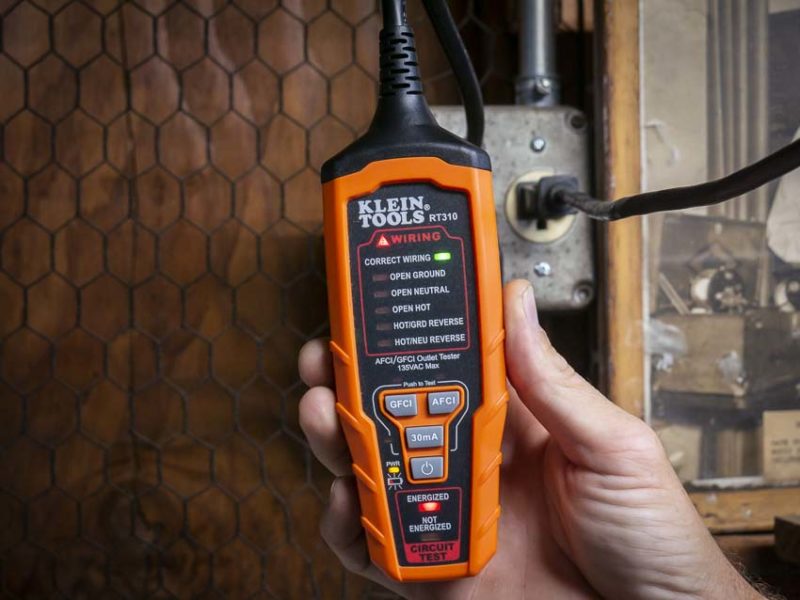
The Klein Tools AFCI/GFCI Outlet Tester is a diagnostic and safety tool that’s indispensable to service electricians, home inspectors, and maintenance Pros. What makes it unique? It not only detects wiring faults, but it also simulates arc and ground fault conditions with patent-pending technology. Get charged up to learn all about it below.
Pros
- Detects wiring faults
- Simulates AFCI and GFCI faults
- Uses patent-pending technology to detect simultaneous open neutral and open ground fault
- Actively shows both energized and de-energized conditions
- Tough construction
- Auto-shutoff after two minutes
Cons
- Case is available but sold separately
How Do You Test for Arc Fault and GFCI Ground Faults?
After I’ve reviewed a tool for a couple of weeks, it’s fun to jump online and read what other people have said about it. Have other users generally had an experience like mine? How did they use it? What do they think could be improved? In the case of Klein Tools AFCI/GFCI Outlet Tester, I discovered that many users didn’t realize the tool’s unique ability to simulate ground and arc faults. It seemed like most used it as a sophisticated outlet tester without knowing its full capability.
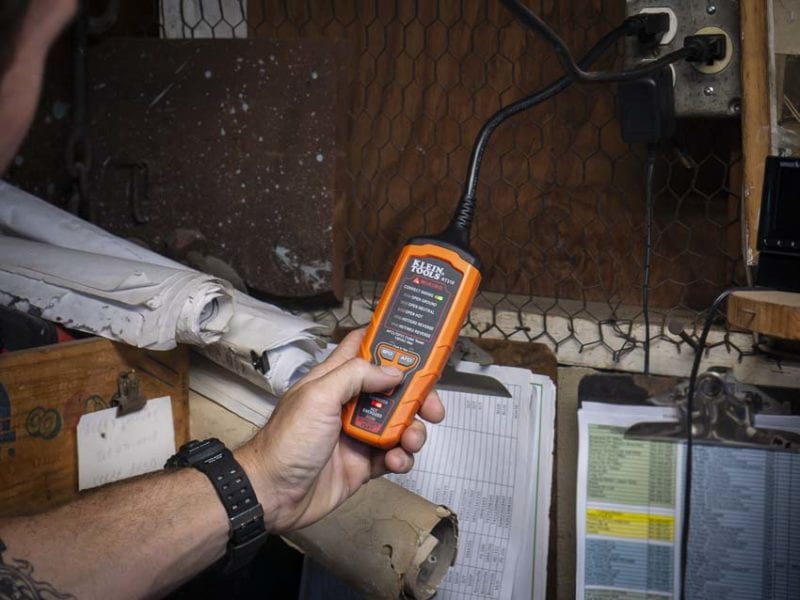
This capability is a bigger deal than Klein makes about it on the RT310 product page. A quick bit of Internet research reveals that in the US alone, arc faults result in 40,000 fires and more than 350 deaths annually. The problem poses so much of a risk that AFCI breakers became a standard part of the NEC in 1999. Those rules expanded further in 2008 and 2014.
Usually, no one likes an interrupter, but that doesn’t apply to arc faults! The Klein AFCI/GFCI outlet tester provides a quick and easy way to add a layer of safety and service to your work.
Checking for Energized Circuits
I really like how the RT 310 is designed to give you active information about a circuit. Two different indicator lights are used to show you the circuit’s energy status. One illuminates for energized and one for not energized. The unit doesn’t make me take for granted that it’s working properly if the energized light isn’t illuminated. This could be a dangerous assumption. The RT310 also includes a battery indicator light.
How Does the Klein RT310 Simulate a GFCI or Arc Fault?
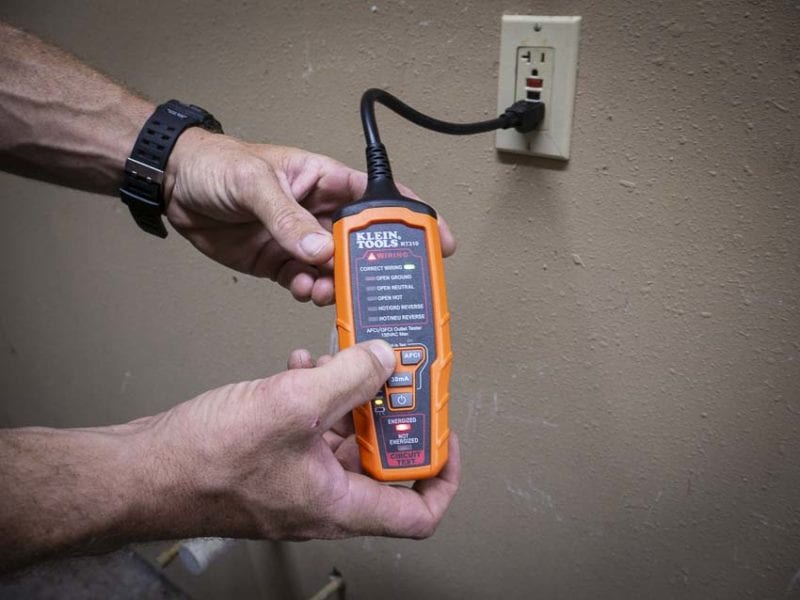
So how does the RT310 accomplish its simulations? Good question! It uses patent-pending technology that’s beyond the scope of this review. But you simply plug the standard 120V, 3-pin plug into an outlet on the AFCI circuit (which are increasingly common, especially since a 2014 NEC update). Pressing the Klein Tools AFCI/GFCI Outlet Tester’s AFCI button simulates an arc, tripping the breaker.
If the AFCI breaker trips as its designed to do, the energized light switches off and the not energized light switches on. Likewise, the Correct Wiring light darkens and the Open Hot light illuminates. You’ll also notice the RT310 gets warm during the simulation. This has to do with the internal wiring needed to simulate the arc fault—very different from a simple GFCI ground fault test. An indicator light alerts you if the unit needs to cool off before the next simulation.
You simulate a GFCI fault in the same manner by pressing its corresponding button.
Additional Indicators
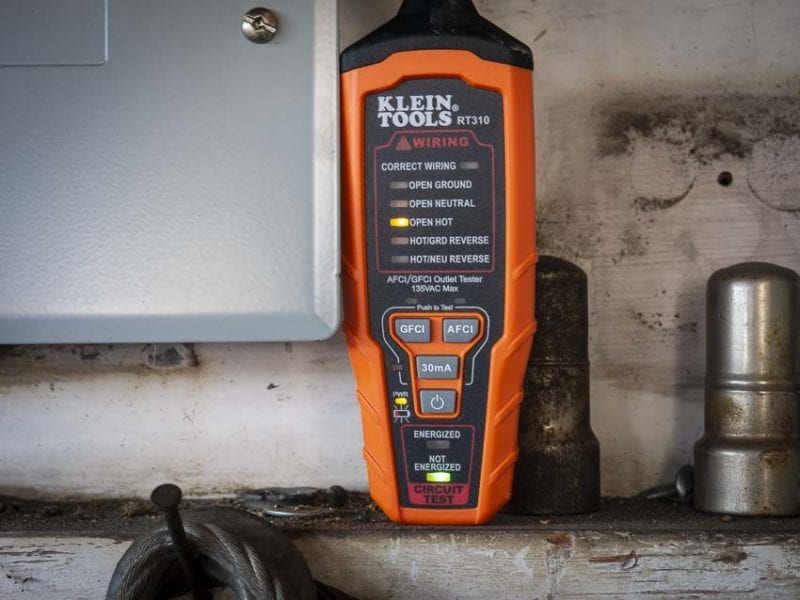
The fault simulations alone should make you consider buying the Klein Tools AFCI/GFCI outlet tester. But it also detects dual-open wiring faults with simultaneous open neutral and open ground wires, hot/neutral reversed wiring, and hot/ground reversed wiring.
Go Ahead…Drop It
It’s built with a heavy-duty cord and tough housing that can withstand a 6.6-foot drop. I also really like the 2-minute auto-off that conserves the three AAA batteries that power it. You can use your Klein pocket screwdriver to access the batteries via a small Phillips screw.
If I have one tiny gripe, it’s that Klein offers a case for the RT310—but it’s sold separately. This seems a little silly, although I know Klein probably considered that it could offer the unit at a lower price and most guys would just keep it in a protective pouch/bag they already have.
How Much Does the Klein RT310 Cost?
The Klein Tools AFCI/GFCI Outlet Tester costs around $40. There’s really no comparison for a tool that has unique features. But consider that a normal outlet tester will run about $10. For a little extra, the RT310 lets you exponentially increase the safety and service you provide to your customers. It seems like an easy decision.
The Bottom Line
The Klein Tools AFCI/GFCI Outlet Tester is a valuable diagnostic tool that reveals common wiring faults and even simulates the most dangerous kind – ground and arc – so you can prevent them. It’s hard to overstate the importance of such capability. With a reasonable price, picking up the RT310 seems like an easy decision for Service Electricians, Home Inspectors, and Maintenance Pros.
Klein AFCI/GFCI Outlet Tester Specifications
- Item Number: RT310
- Material: PC/ABS Housing with Electronic Components
- Drop Protection: 6.6 feet
- Voltage: 120V AC in 3-Wire Grounded Electrical Outlet
- Batteries: 3 x AAA (Included)
- Standard: CATIII 135V
- Length: 7.4 inches
- Height: 1.3 inches
- Width: 2.3 inches
- Weight: 8.5 ounces