
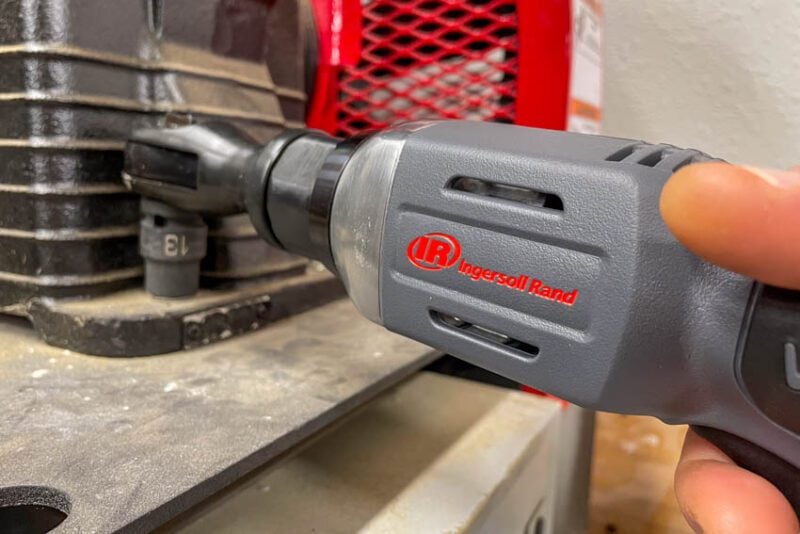
There’s no question that cordless ratchets are more convenient than air ratchets thanks to their unlimited freedom to move around. So why haven’t more auto techs, MRO crews, and tradesmen made the switch to models like the Ingersoll Rand 20V cordless ratchet?
We’ve been using the 3/8-inch and 1/2-inch models for tasks around the shop to see how they compare to air ratchets and cordless ratchets from other brands. There are plenty of talking points, and I’m going to share what I learned during my testing about the performance and the design.
Pros
- No hose to limit your movement
- Same performance as air ratchets
- Outstanding durability
- Comfortable grip
- 3/8-inch and 1/2-inch models available
Cons
- Heavier working weight
Ingersoll Rand 20V Cordless Ratchet Performance
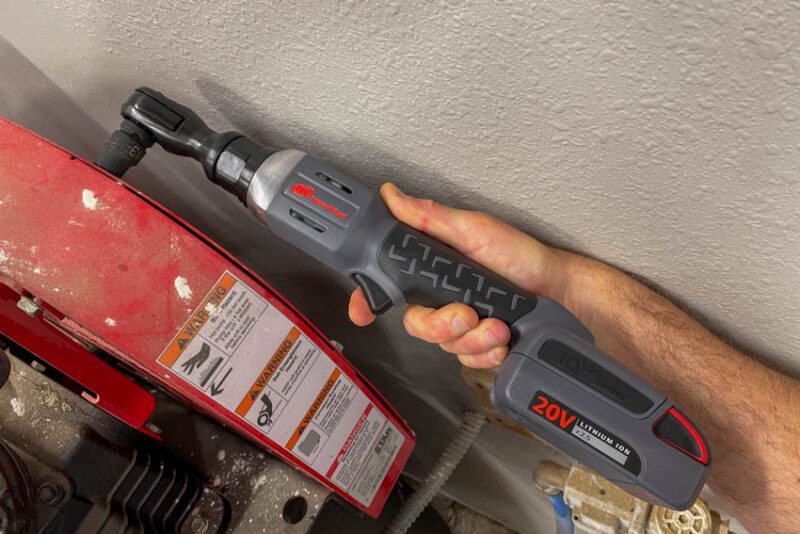
The first thing you need to know is that Ingersoll Rand has both 3/8-inch and 1/2-inch versions of this tool. Unlike other brands we’ve tested, the performance is the same on both.
Controlled by a variable speed trigger, the speed runs 0 – 225 RPM. For torque, there’s a maximum of 54 ft-lbs. However, the tool is at its most effect in the range of 10 – 45 ft-lbs. Compared to other cordless ratchets on the market, that’s right where we expect it to be.
The question for those of you thinking about switching from air to battery is… what’s the performance compromise?
Depending on what you’re currently using, you might actually see better performance by ditching your hose and air supply. Take Ingersoll Rand’s popular pneumatic 107XPA/1077XPA for example. The recommended and max torque is exactly the same. Yet, the cordless ratchet is faster by 65 RPM (160 RPM vs 225 RPM). That’s a difference you’ll notice!
There are air ratchets with higher power, such as Ingersoll’s 109XPA/1099XPA at 76 ft-lbs. But the cordless version still edges it out in speed.
Need more power? Check out Ingersoll Rand’s cordless compact impact wrench!
Ingersoll Rand 20V Cordless Ratchet Design Notes
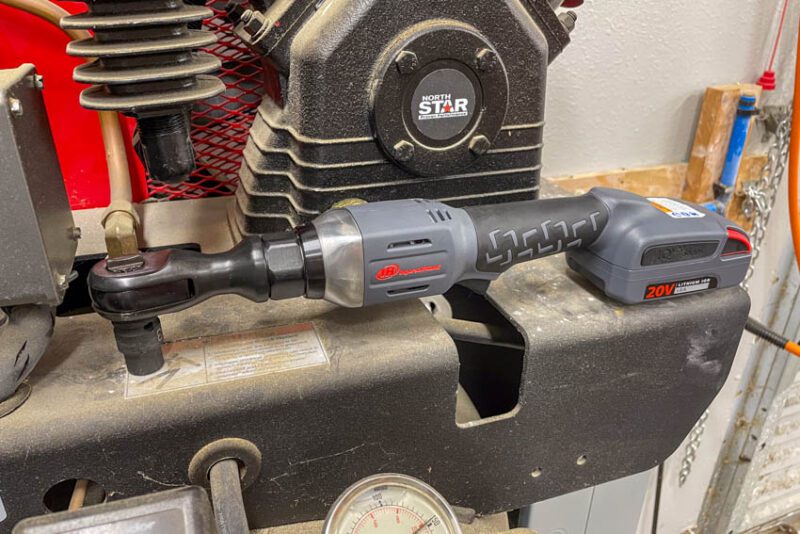
While we often think of ratchets primarily as an automotive tool, there are plenty of applications across other trades as well. MRO, plumbers, HVAC, and a variety of other installers can all make use of a powered ratchet. The further you go, the more convenient cutting the hose and compressor out the equation becomes.
If you’re coming from air ratchets, the first thing you’ll notice is that an Ingersoll Range 20V cordless ratchet is heavier than most air models. Bare, it weighs 3.5 pounds, and a 2.5Ah battery brings the weight up to 4.4 pounds.
While the battery is partly responsible, the construction plays a big part. Even on the outside, you can see the combination of composite and metal components. As you well know, metal weighs more than composite, and some brands remove as much as possible to get the weight down.
However, Ingersoll Rand’s product team made the conscious decision to make sure their cordless ratchet would have the durability you’re used to from IR’s air products. Notice the front half of the tool—the ratchet head is exactly the same of the air versions. Inside, there’s an all-metal gear train. In addition to optimizing power transfer through to the socket, it’s also more durable than models that swap in composite.
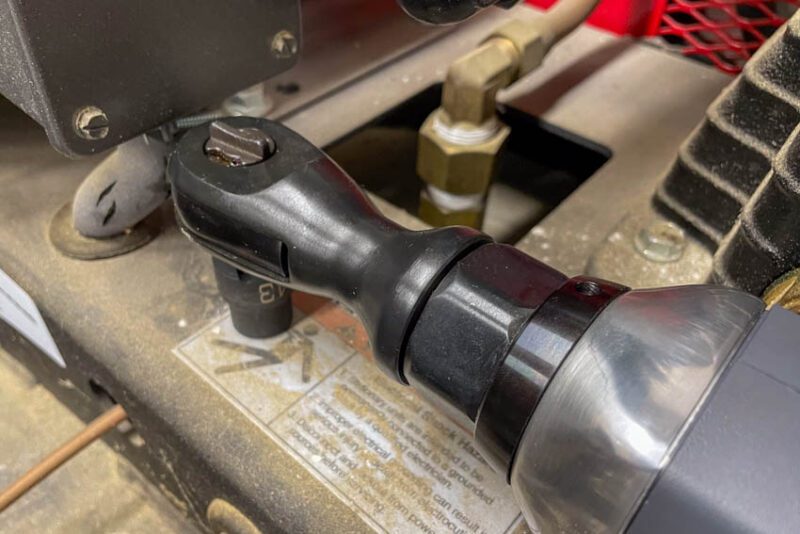
So, while there’s some additional weight on the tool, you won’t have to worry about the body cracking when you’re trying to break loose a stubborn bolt on a diesel engine or panic if it drops to the floor.
In terms of reach, there’s no compromise by going cordless. With the battery installed, the tool is 17.5 inches long, which is longer than IR’s similar air ratchets. Most of the extra length is for the battery. When you look at where you grip and operate the tool, you have the same reach.
The biggest design difference you’ll have to get used to is the move from a paddle trigger to a one-finger trigger.
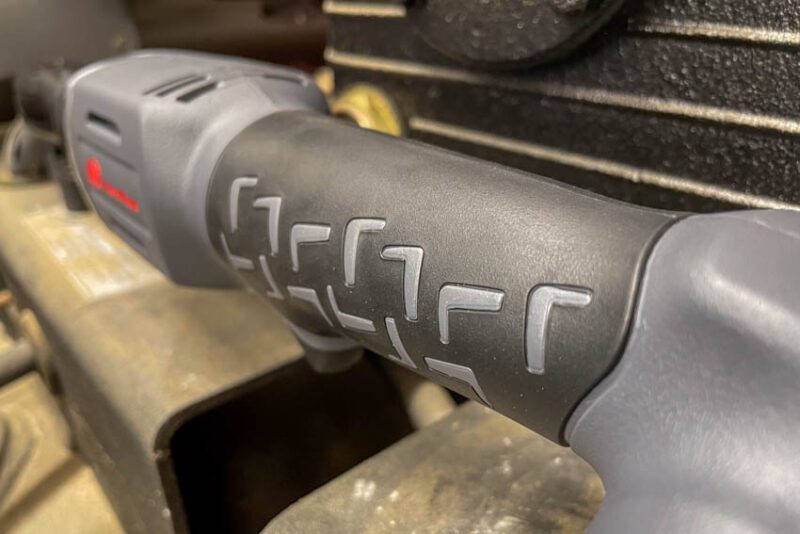
Working with the tool in a variety of spaces and angles, the rubber overmold grip is a nice upgrade from all-metal air ratchet grips. It’s softer, absorbs some of the vibration, and offers a more secure grip when your hands are sweaty and greasy. Here in Florida where the sun is always shining, it also doesn’t get as hot when it sits in the sun.
Ingersoll Rand 20V Cordless Ratchet Model Comparison
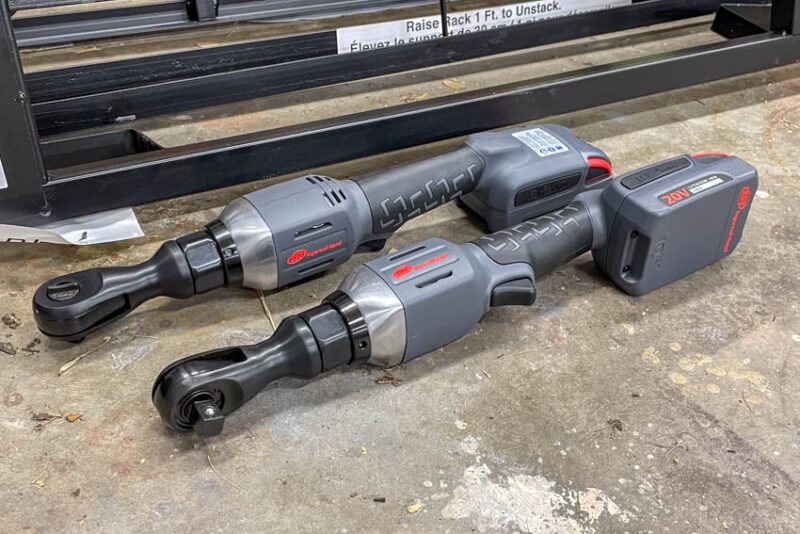
As you can see, the only noteworthy difference between the two models is that the 3/8-inch has a slightly shorter head. Otherwise, their performance and physical features are the same. It all boils down to which drive size you prefer.
| 3/8-in R3130 | 1/2-in R3150 | |
| Speed | 0 – 225 RPM | 0 – 225 RPM |
| Recommended Torque Range | 10 – 45 ft-lbs | 10 – 45 ft-lbs |
| Max Torque | 54 ft-lbs | 54 ft-lbs |
| Head Width | 1.57 in/40 mm | 1.57 in/40 mm |
| Head Height w/out Socket | 1.73 in/44 mm | 1.89 in/48 mm |
| Bare Weight | 3.5 lbs | 3.5 lbs |
| Weight w/2.5Ah Battery | 4.4 lbs | 4.4 lbs |
| Length w/2.5Ah Battery | 17.5 in | 17.5 in |
Ingersoll Rand 20V Cordless Ratchet Price
Online prices vary by retailer, but we were able to find model models as a bare tool for around $259.99. Look for a one-battery kit around $369.99 and a two-battery kit in the $509.99 range.
Ingersoll Rand offers a 3-year warranty on the tool.
The Bottom Line
If you’ve been hesitant to leave the known capacity of your air compressor, it’s time to step out of the nest and take flight with an Ingersoll Rand 20V cordless ratchet. There’s no compromise in performance, its durability is outstanding, and it offers a comfortable design. While it’s heavier to go cordless, I believe the benefits you gain easily overcome the differences you have to adjsut to.