
There has been an increase in the number of and interest in jobsite work lights recently. More affordable LEDs and a demand to have a light that runs on the same battery platform you’re already using is driving manufacturers to meet that demand. There are still some questions left to be answered though. I’ll help you figure out what’s important to consider, but it’ll be up to you to decide. The best part is that it’s all about preference, so there’s really no right or wrong answer here!
Editor’s Note: Check out the best DeWalt LED work lights for our top picks.
Jobsite Work Lights: Light Output vs. Light Throw
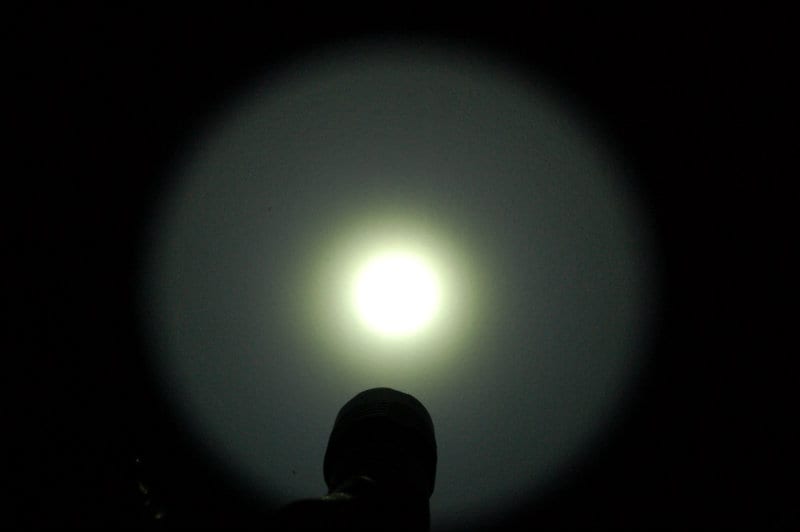
Time to go back to high school Physics! Hey, I get excited about this stuff. After all, Physics is what helps us understand explosions. Without getting overly complicated, remember that light is made up of photons that are absorbed by most materials (it’s why we can see) and reflected by a few others. It’s that reflection that we’re concerned about right now. So your Light Emitting Diode (LED) is producing light on the little white chip(s) you see on your light. It just tosses it out there and each photon tries to travel in a straight line from the direction it was produced. Jobsite work lights, like flashlights, use reflective material to direct the light where it will do the most good.
I can get 6 different jobsite work lights rated for the same number of lumens (light output) and get 6 different types of light production. Why? Here’s where output and throw come into play. Light output is how much light is being produced. Light throw is how broad or narrow a beam that light is being forced into. The more photons that hit a specific area, the brighter it will appear. So choosing the correct light depends on a balance of how far away that light is going to be in order to get enough photons in the area you need to see.
The Physics of Light
Let’s say that you’ve got a shotgun. When you pull the trigger, the pellets bounce around the barrel until they reach the end where they are free to travel in the last vector they bounced from. Take your shotgun and shoot at a paper target 20 feet away and you’ll see the pattern. Saw off a foot of the barrel and the pattern won’t be as tight because the pellets weren’t directed as long. Saw off another foot and you get a pattern that’s really spread out. This is what we are doing with the reflectors in our light. The steeper the angle and the longer it is, the tighter the beam. Take a very shallow angle on the reflector and you get a very broad beam.
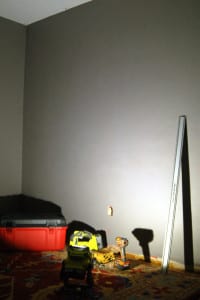
Just like the shotgun, there’s a trade-off. The further away you are from your target, the longer your barrel needs to be in order to get a good number of pellets on it. The same for light. If you want to illuminate a dark corner workspace from 3 feet away, a broad throw will do great. If your light source is 30 feet away, all of the light is still headed in that direction, but not as much of it will hit the specific spot you need it to. A tighter beam is necessary for that situation. Then there is the issue of even longer distances where you need the tight beam of a spotlight or flashlight to hit 300 feet away or more.
Jobsite Work Lights: Which Light Throw is the Best?
All of the above, my friends. Each type of light found on a jobsite work light has its advantages and disadvantages. This is where your preference comes in. If you’re working in tight spaces or need to illuminate a very broad area, a broad throw like that of the Ryobi P270 Hybrid Work Light might work for you. It’s got 1700 lumens of output but throws it almost 150 degrees from the LED to illuminate a large area from very close. Need to get solid light to check for leaks on a ceiling or quickly inspect work without dragging the light with you? A light more like DeWalt’s 20V Jobsite LED Spotlight is more your style. This jobsite work light directs a tight beam up to 1,525 feet.
Most professionals will tell you that both styles, plus something in between, could all be used at some point and all would be welcome in their arsenal. Perhaps the best solution will be to wait for someone to create a jobsite work light that has an adjustable focus to cover all types of situations that it could be used for. Give us some feedback! What style of jobsite work light (or flashlight for that matter) do you find yourself going to most of the time? Tell us what you think on Facebook or Twitter!