Did you know that The Home Depot had a Home Depot Product Quality and Engineering Laboratory? We didn’t, though; once we saw it, we’re not sure how any major retailer of power tools could do without one.
Starting the Home Depot Product Quality and Engineering Laboratory Tour
Our Home Depot Product Quality and Engineering Laboratory tour started off simply enough: We would see a ratchet strap failure. Engineers placed a Husky ratchet strap into a TiniusOlsen universal testing machine and tested it to failure. We knew it was coming, but the sudden ‘Snap’ startled nearly everyone in the room…
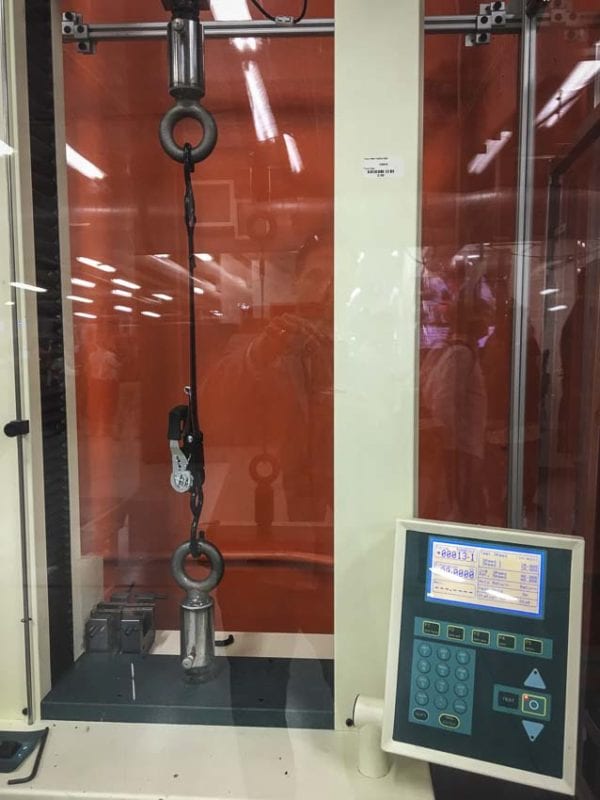
In another test, the universal testing machine was used to determine at what force a Husky hammer handle would break. Incidentally, it took 440 pounds to fracture this Husky hammer handle. It took 6000 pounds to crush that husky 48″ rolling toolbox you see in the back of the following photo.
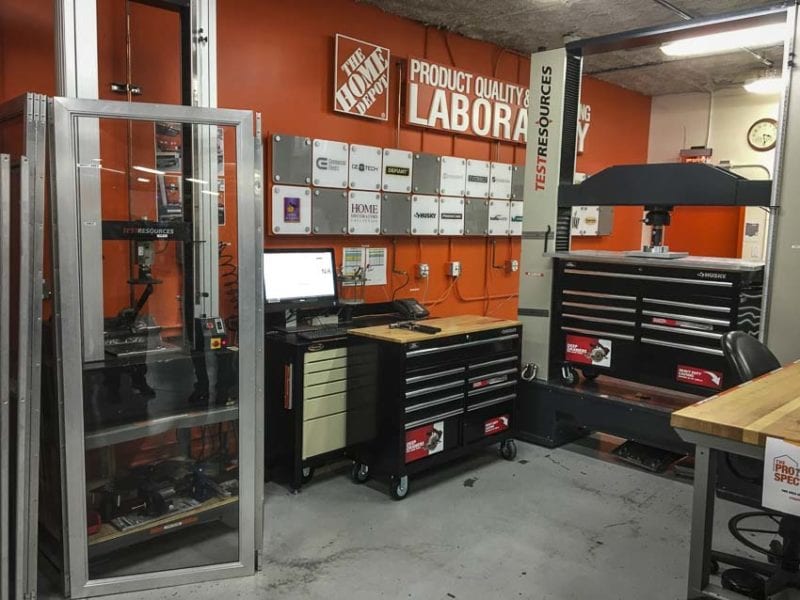
Editor’s Note on the TiniusOlsen Testing Machines
Back in 1880, a Norwegian immigrant to Philadelphia (and engineer) named Tinius Olsen devised and patented what became known as the Little Giant. Modern versions of these machines can test tools and devices for tensile, shear, and compressive strength. They also test for flex, puncture, and burst resistance, tear strength, and peel strength. That’s not all, but the remaining terms would be unfamiliar to all but the most ardent physics student or mechanical engineer!
Torque & Torsion Testing
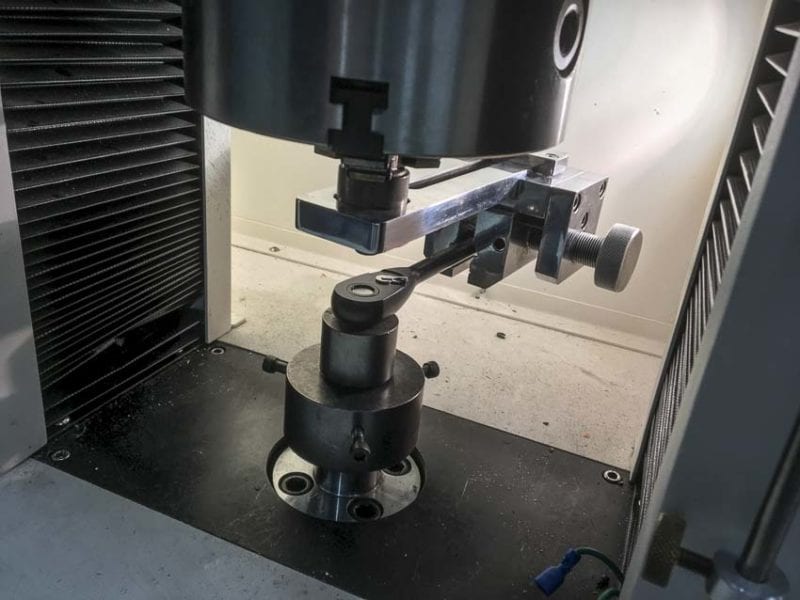
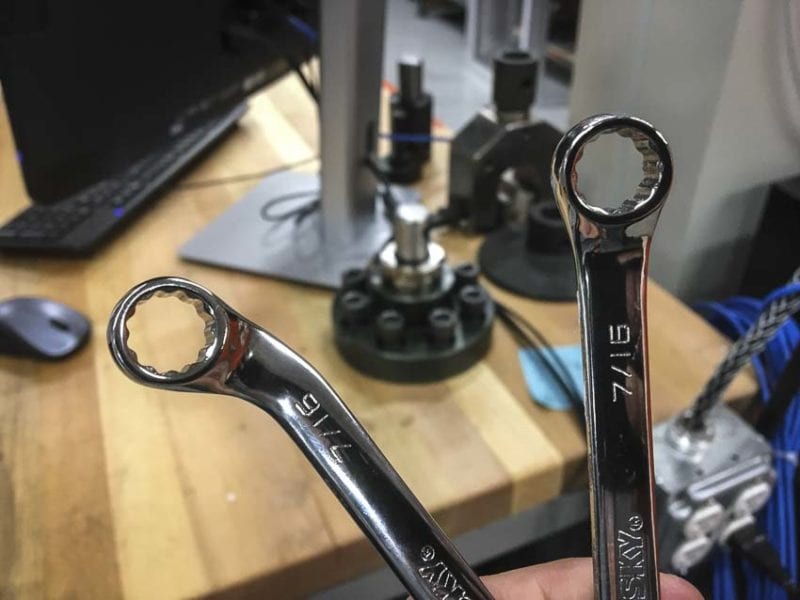
The next phase of our Home Depot Product Quality & Engineering Laboratory tour involved torque and torsion testing of hand tools. An SMiPO ST-500 torsion testing tool lets The Home Depot how much torque a Husky wrench could handle. It also showed that, when over-torqued, the wrench bends rather than shatters—a good feature to look for.
Another torsion tool tested usage cycles on a ratchet. This allows The Home Depot to know the tool can be used to its full expected life cycle (or more). I could tell you what that is, but then I’d have to…you know the rest.