
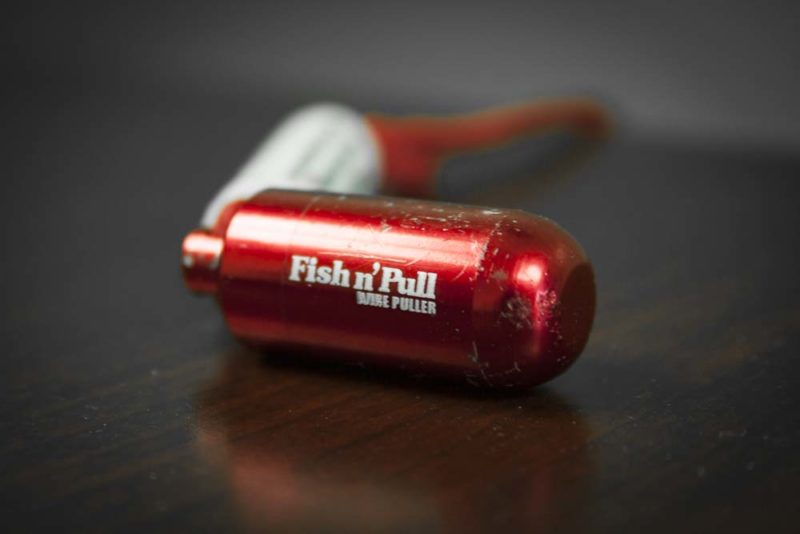
A few months ago, I reviewed Klein Tools’ version of a magnetic wire pulling system for installing wires, tubing, and cable behind finished surfaces like walls, ceilings, and floors. At about the same time, the remarkably witty and handsome PTR team threw out a preview of the MagBench Workstation’s Fish N’ Pull Wire Pulling System and now we’re coming back around with the review since I’ve had some solid time to put it to the test.
I’ve been busy reviewing other tools and bringing a third son into the world (well, my wife did most of the work there), but I finally got the Fish N’ Pull on a job. And what’s better than having one of these tools? That’s right – having two of them! Comparisons like these often reveal things that aren’t immediately evident.
That’s the goal of putting the Fish N’ Pull – with its compact fish and presumably strong magnet – to the test. Its creators didn’t invent the idea of a magnet-based installation kit, but it looks like they might have made improvements on the design which could aid difficult installation work. In new construction, getting cables, tubing, and wires in place is easy, but once the walls are up and the floors are down, it’s a different story. Fish tapes and fish rods work well when there’s conduit to guide them, but not so well otherwise. I know tradesmen who have even homemade magnetic creations for wire installation. When guys start making their own tools, you know it’s time for a production model! Let’s see how it works.
Fish n Pull Wire Pulling System Key Features
Fish and MagRing
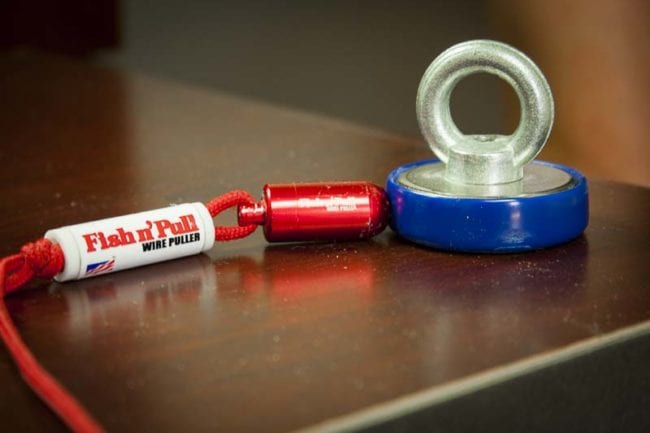
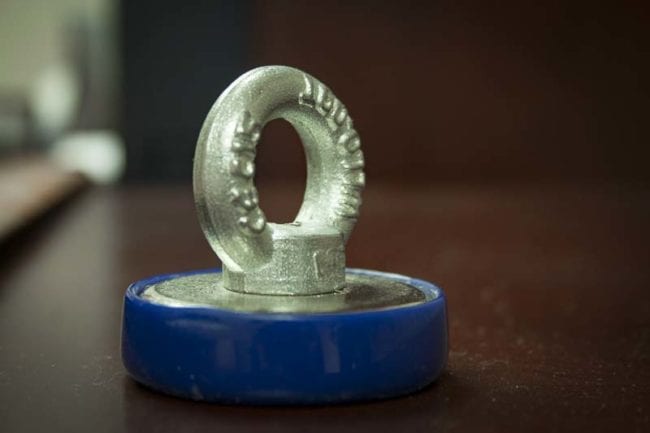
The Fish N’ Pull’s two main features are a red, bullet-shaped Fish and a 2-inch disc with a ring, appropriately called the MagRing. Both the Fish and the MagRing are made of neodymium, a rare-earth element known for its remarkably strong magnetism. In fact, the Fish has a 40-pound pull force and the MagRing a 200-pound pull force. It’s this magnetism that allows the MagRing on the outside of the wall to guide the Fish through the inside of a wall – even through two sheets of drywall or across 6-inch gaps.
Cord
Attached to the Fish’s tail is 15-feet of 325-pound cord. The end of this cord is tied to the end of the wire. When a Pro drops the Fish behind the installation surface and guides it with the MagRing, the cord pulls the wire into place.
Plastic Guide Tool and Surface Protection Cap
The kit includes a removable surface protection cap to protect delicate surfaces that the MagRing might scratch. There’s also a plastic guide tool for getting past metal top plates. Well, let’s go fishin’!
Performance
Go Fish N’ Pull
It’s hard not to notice the remarkable force between the Fish and MagRing. There’s no setting them anywhere near each other without them forcefully snapping together. Just make sure your fingers aren’t between them when it happens – yowza!
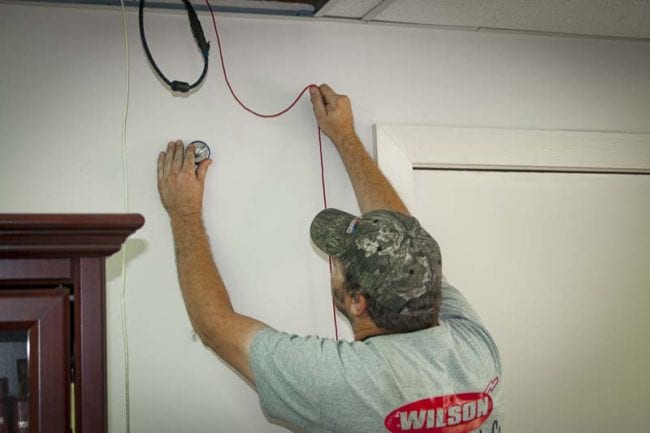
I was called out to a local business to install some phone line in an office. It was the perfect opportunity to use the Fish N’ Pull Wire Pulling System. The line was already above the drop ceiling and needed to make its way down the wall to a hole that would be the outlet. I removed a ceiling tile to reveal the Fish’s entry point, tied the red cord to the phone line just behind the modular plug, and dropped the Fish behind the wall and in line with the hole.
Heading for the Exit
This wall was a great test for the Fish N’ Pull Wire Pulling System because it was heavily insulated. It wasn’t as if the Fish had a clear shot straight to the outlet. It would have to fight its way through the insulation, guided by the MagRing. I put the blue surface protection cap on the MagRing and hooked it up with the Fish on the other side of the wall. I was once again struck by the magnets’ strength. If it had been unimpeded, I could have simply pulled the MagRing down the wall and pulled the Fish out through the outlet. As it was, I had to work the MagRing back and forth in short horizontal strokes to move it through the insulation.
Soon the Fish was near the outlet. I grabbed it and pulled it along with the cord and phone line. It was simple – and I doubt a lesser magnet could have made it through the insulation. But it’s not just the strength of the magnetism – it’s the small size of the Fish that gives this system its advantage.
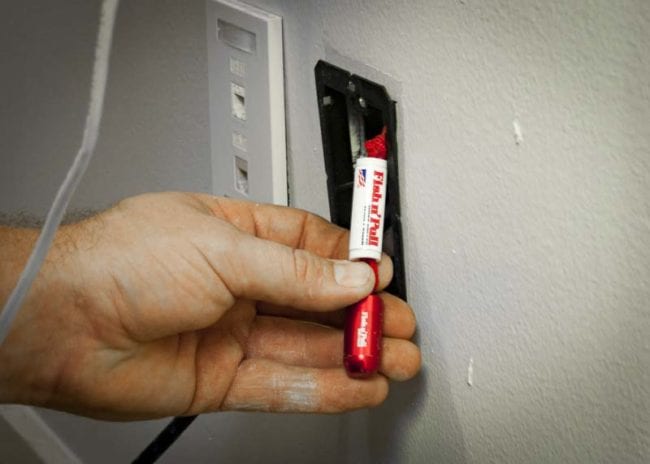
Not only is there less mass to obstruct on the way down the wall, but more importantly the entry hole in the top plate only needs to be 3/4-inch. Pros often gripe about the size of the hole they have to drill in wooden top plates with other magnetic wire pulling systems. But the Fish N’ Pull Wire Pulling System’s has the smallest entry hole I’ve seen and it’s great.
Forces of Attraction
Now, things can get a little tricky with steel studs and top plates because the Fish is attracted to them. To combat this, the Fish N’ Pull has a plastic guide tool but it wasn’t immediately clear how it worked. I found the website’s explanation lacking and its accompanying video didn’t address the guide tool’s use. This is the best I can figure: When the entry point is through a steel top plate, pull the cord while holding the plastic guide tube snugly against the back of the Fish’s head. Insert the Fish through the entry hole until it’s safely past the magnetism range.
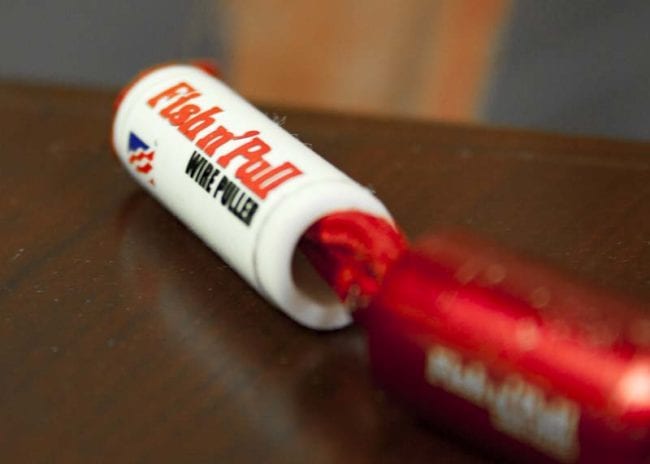
Still, you’ll have to use the MagRing to guide the Fish between metal studs. If the Fish does connect with one, pull the cord until it’s free and try again. Even in wood-framed buildings, you might encounter metal boxes that can give you some trouble. That’s not a ding against the Fish N’ Pull, it just is – as they say – what it is.
Just a Minnow
There are more uses for the Fish N’ Pull Wire Pulling System that is just as helpful. It works just as well pulling a wire up a wall as it does pulling it down one. I’ve fished several wires up from receptacle boxes to the next termination point. The magnets allow you to defy gravity – and impenetrable surfaces!
But this might have been the slickest use: with the tool, I was able to pull a home run up a wall and across a ceiling to the exit point. It saved me from having to crawl into the corner of the attic to fetch the wire. Any tool that saves me from doing that is a favorite tool of mine!
The Bottom Line
The advantages of the Fish N’ Pull Wire Pulling System are in the size and shape of the Fish as well as the strength of the neodymium magnets. There are other tools like the FNP, but their magnets either aren’t as strong or their Fishes require a big entry drilled in wooden top plates. MagBench has created a solid product whose price premium over the likes of the Klein system I reviewed makes sense.
You can run into installation hiccups when dealing with steel top plates and studs, but the plastic guide tool helps. Still, the strong magnetism is a double-edged sword as the Fish can hook up to any metal in a wall, including metal boxes. But its usefulness far outpaces any inherent disadvantages of the strong magnet. And now that I’m able to install all that wire so quickly, I have time to actually go fishing!
Fish N’ Pull Wire Pulling System Features & Specs
- Neodymium Magnetic Fish and 2-inch MagRing for installation of wires, cables, and tubes
- 15 Feet of 325-pound Rate Cord
- Plastic Guide Tool
- Surface Protection Cap
- Rare-earth Metal Neodymium with 40-pound (fish) and 200-pound (magnetic) Pull Force
- Price: $59.95