
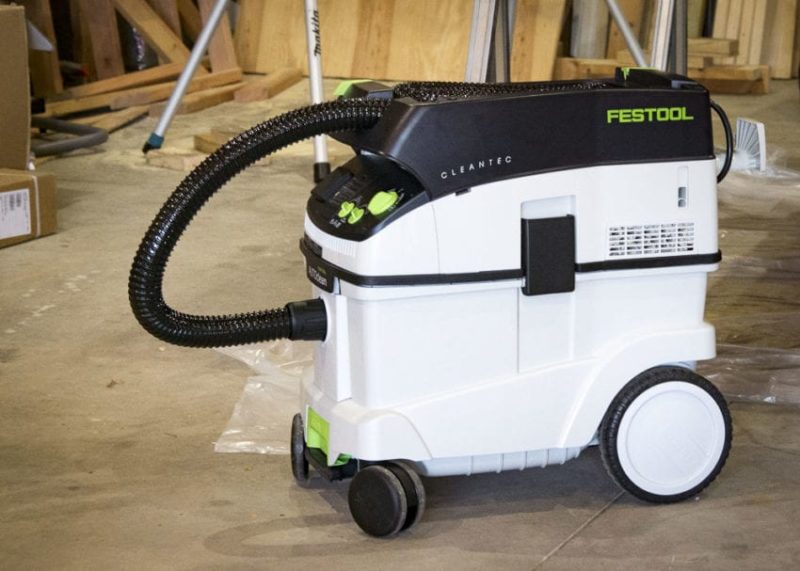
When you start looking for a quality dust extractor to supplement your work, there’s a lot more to consider than just price. The Festool CT 36 E AC is a top choice among Pros, but what attracts so many to it?
Hang around Festool for very long and you’ll hear them talk about tools as systems. The amount of care our German friends put into their designs crosses the border of obsessive. And that’s exactly the kind of mentality you want when you’re producing high-quality results.
Even the dust extractor is part of the system of any tool in Festool’s lineup. It’s more than just CFM and suction power, though. So let’s dig deeper into how the Festool CT 36 E AC compares to the rest of the industry currently.
Top Features
Anti-Static Hose
Can a hose really be a feature worth talking about?
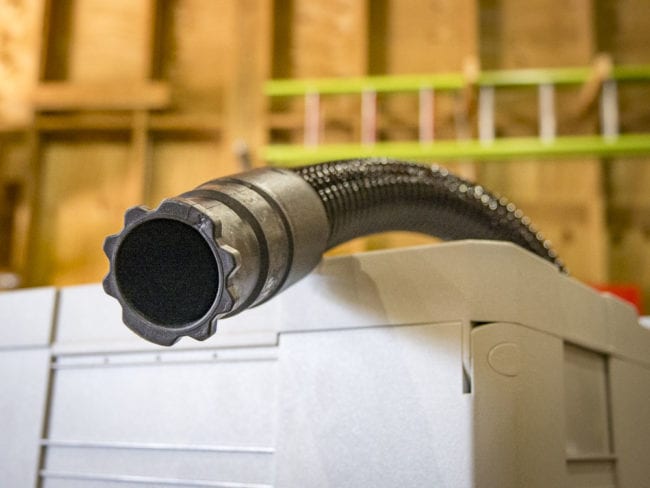
Absolutely! Festool includes an 11-1/2′ anti-static hose. That’s not the longest you’ll see in the industry, but that’s intentional. The longer your hose, the more performance loss you’ll see, so it’s actually beneficial to use the shortest hose you can get away with.
Since the Festool CT 36 E AC is specifically designed for use with the Planex sander, it comes with a 1-1/2″ diameter hose like you see with most extractors in this class. However, if you’re going to use this with other Festool sanders, you’ll want to grab their smaller diameter hose (27mm/1.06″) hose to get the best performance in those applications.
Auto Clean
Having an auto clean filter cleaning system is part of being Table 1 compliant with OSHA’s silica dust rule. The other is to have a HEPA filter (required in some applications). While you can get a Festool CT 36 with a HEPA filter, you can’t get it with auto clean as well. But Festool’s focus isn’t on concrete – it’s on woodworking, painting, and drywall. So don’t stress out about it, especially when the stock filter gets down to 1 micron.
The auto clean system helps keep the filter from getting clogged and losing suction performance. As the filter traps particles, it’s harder to move air through it. The auto cleaning system simply helps knock larger particles into the bag while keeping the smallest particles from escaping.
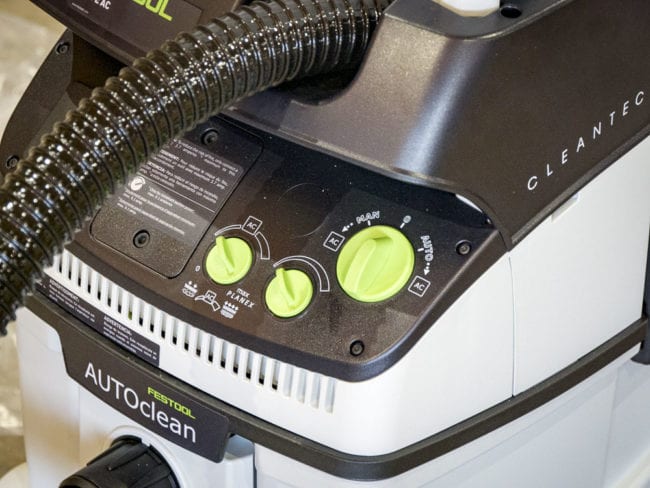
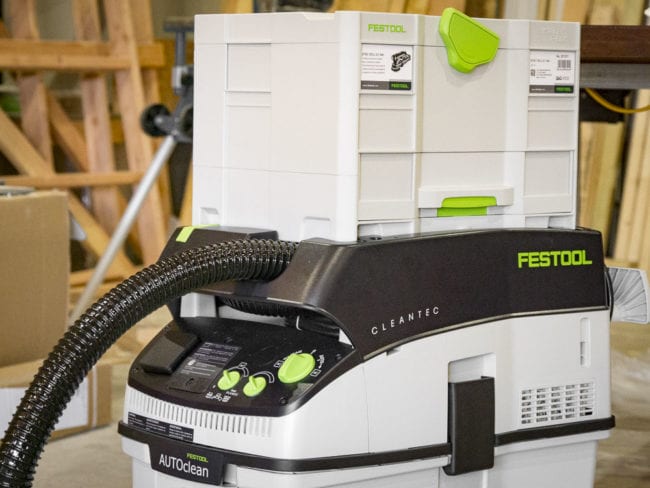
Auto clean will work in both auto (power tool activation) and manual modes. By flipping the power dial to the extreme left or right, you can also have the system run an auto clean cycle whenever you feel you need to. The other two dials you see adjust the length of time between cleaning cycles from none to every 12 seconds. There are separate dials for manual and auto on modes.
Pass-Through Power
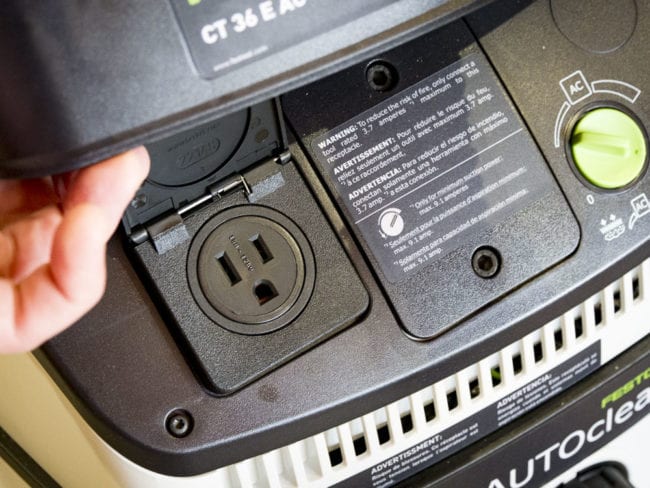
Nearly every dust extractor these days has a pass-through power plug. But you need to be careful – you can’t run a 15-amp miter saw through a dust extractor that’s also pulling 15 amps since they’re sharing the power source. Festool recommends you don’t go beyond 3.7 amps with the tool you’re tethering to reduce the risk of fire. One feature missing compared to most other extractors is a power dial so you can increase the amount of power available to a tool. But Festool believes that you shouldn’t sacrifice extractor performance to run one through the CT 36.
Storage
If you’re still not convinced that Festool sees the world through the system lens, take a look at the top of the unit. Festool has the best cord and hose storage in the industry by a pretty wide margin. everything wraps neatly in the top so you’re not fighting with cord or hose flopping off the side of the housing.
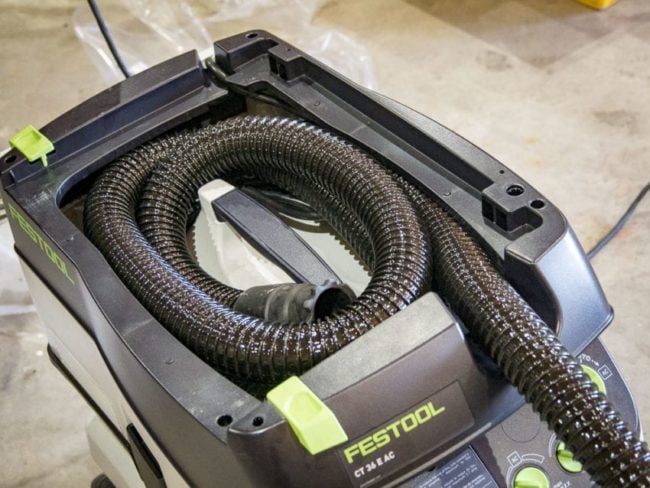
Festool Systainers will also lock onto the top – even with the hose running into it.
Performance
CFM vs Water Lift
You’ll see CFM listed on every dust extractor. Cubic Feet per Minute is how we measure the amount of air the dust extractor pulls in. Like most performance specs, higher is better. But buyer beware – not all manufacturers take the measurement at the same point. We’ll be testing from the end of the hose where the work is actually taking place.
The Festool CT 36 E AC boasts 138 CFM. You’ll see number pushing well over 150 in some of the other options out there, so this is a little lower. It’s far from inadequate, though. Even the CT SYS portable dust extractor has plenty of CFM for the sanding duties we use it on.
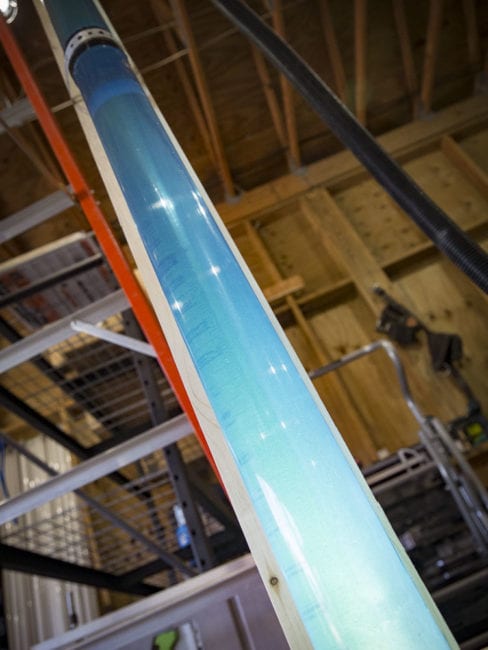
On the other hand, we have water lift – or suction power. We use water lift to measure how much weight in water the extractor can lift. Again, the higher the number the better. Since you can directly convert this measurement to a variety of others, you don’t always see it as water lift in inches. Our test rig uses a 2-1/2″ tube, so it doesn’t perfectly match the same test as other extractors.
However, we’ve run this test against most of the top names out there and have a pretty solid baseline to work with. Our current leader levels out at 85.0″ of lift. Festool comes in with 81-3/4″ – the second highest we’ve tested.
One of the other things we look at is how far the water lift reduces during filter cleaning. Our current record is a drop of just 4 inches while the worst is a staggering 30.25″ of water lift loss. Festool drops just over 20″. That may seem like a lot, but it’s better than most that we’ve tested.
After Use
Good performance with a new, clean filter is one thing. But how much power loss is there after using it?
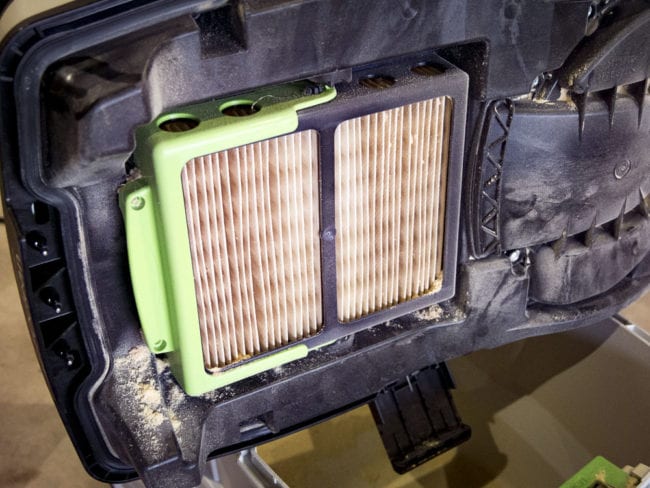
After making some cuts with a miter saw and sanding for a while, I also cleaned up the shop floor and several tools to give the extractor plenty of sawdust and dirt to chew on. Surprisingly, there was little to no drop in performance. The only difference was that the water lift drop during the auto cleaning cycle is about 2″ lower.
General Use
Scientific testing is all well and good, but it’s real-world performance that tells the whole story. I used the Festool CT 36 E AC with several sanders and find the performance to be simply outstanding. Of course, the feature set makes using it easier and the cord/hose management makes pulling it out and putting it away so much easier than the other options we have available.
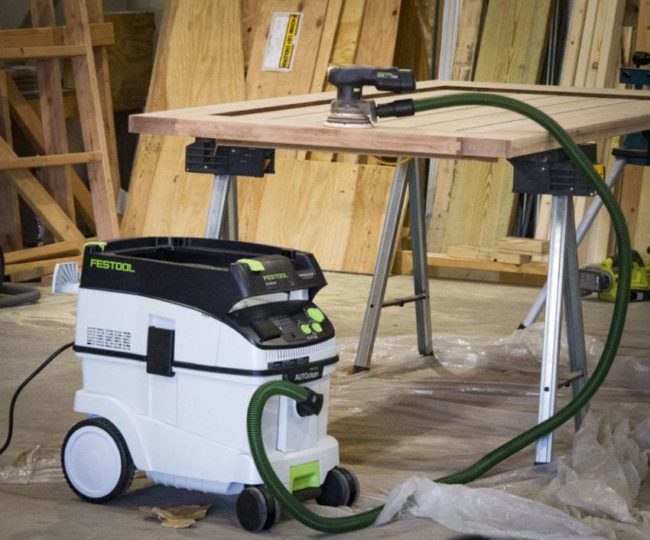
Performance on a miter saw is equally impressive compared to the other extractors we’ve put to the test. Admittedly, both of these applications use the smaller 1.06″ hose which gives us more suction power. Once we’re done working with the new Planex, we’ll update you on how well the 1-1/2″ hose performs with it.
Final Thoughts
The Festool CT 36 E AC Auto Clean Dust Extractor is a great example of why CFM isn’t everything. With the second best water lift we’ve ever tested, it’s able to get larger debris moving better than most of the other options on the market. And once it has those wood chips and sawdust moving, 138 CFM is plenty to make sure it ends up in your collection bag.
The auto clean feature is certainly nice to have to keep the performance high when you’re sanding or working on drywall with the Planex. However, it also bumps up the price from the $756 of the HEPA unit to $875. Since the auto clean model doesn’t carry a HEPA rating, it’s something you may want to think about, depending on your situation. For most Pros, though, a 1-micron filter is going to plenty to trap the dust and leave your workspace clean.
There’s clearly a gap in performance between the $500 – $600 dust extractors and the $700+ category. The nice thing is that you’re buying into more than just a streamlined system when you add the either Festool CT 36 to your Festool tools – you’re also getting legitimately higher performance.
Festool CT 36 E AC Dust Extractor Specifications
- Power consumption: 350 – 1 200 watt
- Weight: 33.51 lbs (15.2 kg)
- Rubber-insulated mains cable: 25 ft (7.5 m)
- Container/filter bag capacity: 9.5 gal (36 l)/8.9 gal (34 l)
- Filter surface area: 979 in² (6 318 cm²)
- Max. volume flow: 138 CFM (3 900 l/min)
- Max. vacuum: 2.45 static water lift (24 000 Pa)
- Price: $875
- Warranty: 3 years