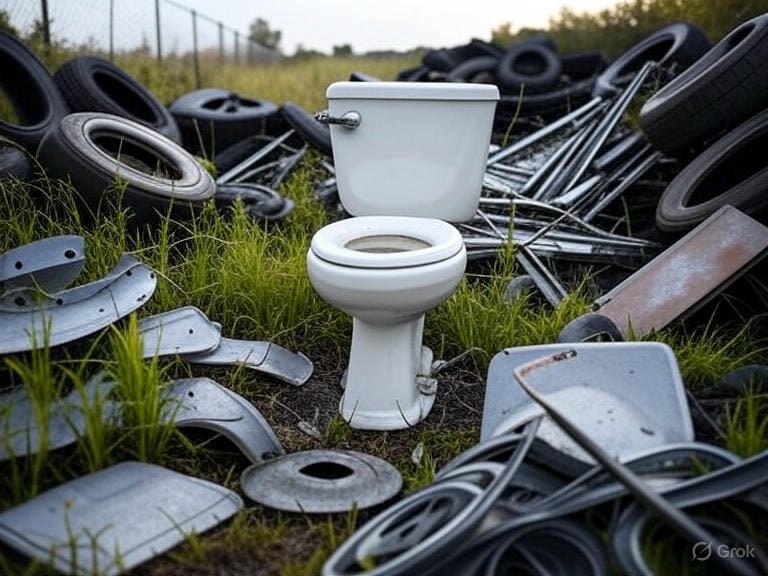
Recently while working on a little bathroom tile project, we had to pull up the toilet so that we could continue the tile work. While I have changed out and re-set a myriad of commodes, it always amazed me that we have not come up with a better method of washing away fecal matter. Since the advent of the “modern” toilet, back in 1885, not a whole lot has changed. They consume incredible amounts of water, are prone to leaks thanks to an antique wax seal design, and have sensitive parts that seem to frequently break down. All in all, we would have to agree with Bill Gates, the founder of Microsoft, who thinks we need to reinvent the toilet.
The End of the Traditional Toilet?
Dealing with human waste in many places around the globe proves to be a challenge. Here in America, we often take for granted the amount of clean water that is available and take minimal measures to conserve it. Depending on the age of your home and the type of toilet that is installed, a toilet can be one of the largest users of water in your home. Now the reason that Bill Gates is interested in toilets is because, for a big part of the world, clean water is limited and in many cases is not even available. So the idea to develop a better toilet, maybe even the ultimate toilet, does seem like a worthy cause.
The Bill & Melinda Gates Foundation, along with $10 million dollars of earmarked money from Germany, plans to provide 800,000 people in Kenya with access to proper sanitation (toilets) facilities over the next five years. The goal of this endeavor is to find innovative solutions to handle sanitation issues in poor urban areas. According to Mr. Gates, it’s time to move on from the era of the classic toilet. Even with all the recent developments in conserving water with flush-style toilets, at least 40% of the world’s population, or some 2.5 billion people, still live without proper means of flushing away waste. Simply installing a flushing style toilet isn’t possible for many of these people because of the limited water resources.
There is a certain urgency to the matter for better toilet facilities as well. Since the lack of sanitary installations and hygienic waste removal furthers the spread of disease, UNICEF estimates that 1.1 billion people worldwide don’t have access to any kind of toilet or ways of eliminating waste. That, in turn, ruins drinking water and can cause diarrhea, which spreads quickly. At least 1.2 million children under the age of 5 die of diarrhea every year according to UNICEF, and the main cause is contact with human waste.
Exploring Alternative Toilet Ideas
The Gates Foundation and German Development Policy is experimenting and exploring many different alternative toilet ideas that include dry toilets that do not use water to flush, some that separate excrement from urine and even pit latrine designs for rural areas and slums. It is also supporting research projects and giving grants to scientists who come up with new ideas for using human excrement for something productive. The importance of this research is not always easy to convey because anything having to do with human waste provokes a “yuck factor.” The reality is that as the world population continues to grow, the importance of clean water will continue to be a bigger issue.
Dealing with human waste could prove to be a big business if the right technologies and methods for treating, disposing or even reusing human waste are developed. Is this end of the traditional toilet? We can’t say for sure. It’s time for a new toilet but I hope these new toilets don’t take the Microsoft approach that will require frequent updates and have compatibility issues.