
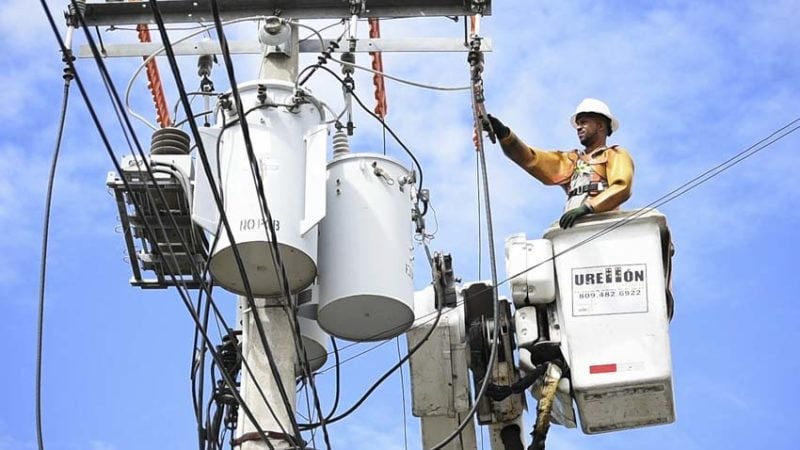
We teamed up with Red Wing’s Irish Setter crew to look at choosing the best work boots for electricians. Working around electricity, your requirements are different than a framer’s or carpenter’s. Not only do your boots need to be comfortable all day, but they also need to be comfortable in a variety of conditions and avoid acting as an electrical conductor to your body.
Best Electricians Work Boots Table of Contents
Best Work Boots for Electricians Overall
RedWing Exos Lite
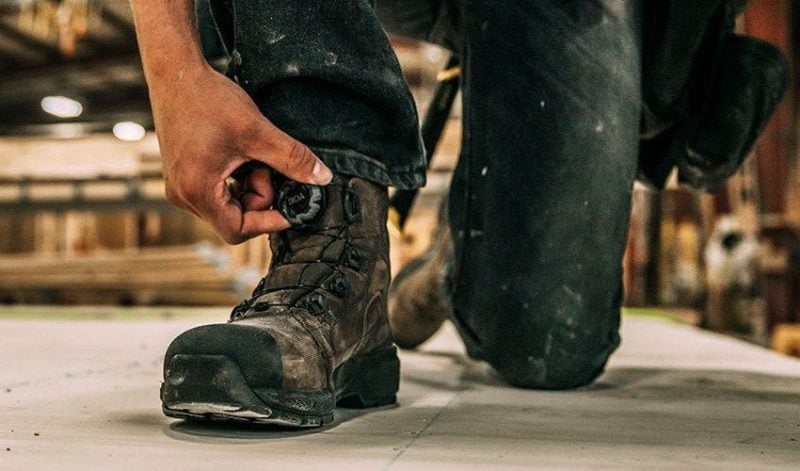
We love RedWing Boots, but the Exos Lite represents one of their lightest pairs ever. In our book—a light boot makes for a comfortable boot. Couple that with the BOA fastening system, and you also have a boot that goes on and off quickly. Back when we reviewed the RedWing 4216 Boots with the BOA system, we fell in love instantly. We’re glad those fasteners didn’t stay with the snowboarders who made them famous!
Our favorite EXOS Lite model has to be the Style 2453. It features a lightweight aluminum safety toe as well as Red Wing waterproofing. You also get a Vibram Extreme Lite sole that hits the marks across all safety ratings. At around $240 these boots are priced just right for what you get. They should give you at least a year’s worth of use—which is the maximum amount of time we recommend Pros wear a daily boot before replacing it.
Best Work Boots for Electricians on a Budget
Irish Setter Crosby Work Boots
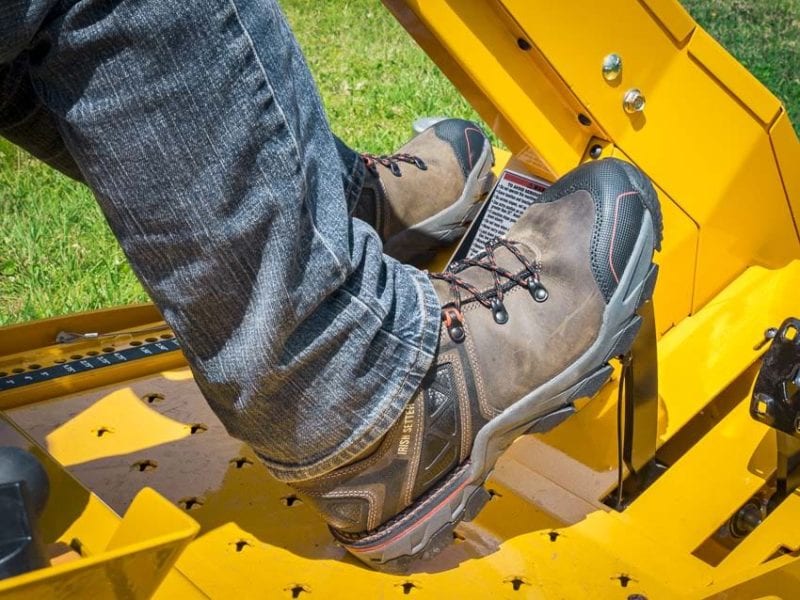
Irish Setter Crosby works boots find a nice middle ground as an all-rounder kind of boot. You can find more stable boots if you’re on soft or unpredictable ground all day or more cushioned boots if you’re on concrete all day. Our team like to lace these up when they know their day has some of each.
At $170, they also sit in the pricing middle ground between inexpensive boots that lack comfort and durability and premium boots that can cost more than $250. Even the style is versatile enough for just about anyone.
Key Components of the Best Work Boots for Electricians
The Safety Factor
If you’re new to the electrical trade, get familiar with the “EH” designation on work boots. This is ASTM’s code for “electrical hazard” protection and it’s a must-have feature in any boot you’re considering.
OSHA requires electricians, linesmen, and similar tradesmen who work around live wires to wear safety shoes. While some slip-resistant shoes also come EH-rated, you have to make sure. We actually prefer both if you primarily work indoors.
EH-rated shoes aren’t always recommended in all situations, so take care to understand your particular needs and regulations. Also, some people believe that any leather footwear automatically qualifies as EH-rated. That’s simply not true.
Comfort Matters
We’ve put some miles in a couple of boots that are a good fit. For example, Irish Setter Ashby and Keen Utility Cincinnati boots give you a comfortable wedge option. We love how you can wear a boot like that all day long without really feeling them.
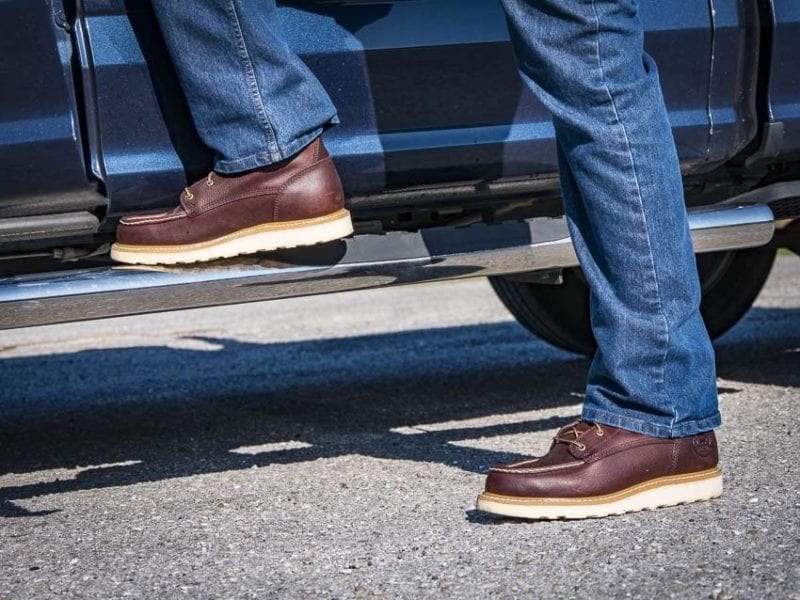
Wedge boots often come in soft or safety toe, and that’s important. OSHA isn’t currently requiring safety toes for electrical work, but your employer or the terms of a contract may.
Our resident electrician, Ben Parker, is well-known for putting some wear on his boots and some of that comes on the toe cap. Eventually, they can wear through enough for the safety toe to expose itself. Other times, an accident may cut through the leather even though your foot is protected by the safety toe. Either way, a non-metallic safety toe is a great option just in case. OSHA doesn’t consider a steel toe to be an electrical hazard, though.
Decide on Height and Traction
As a runner, I prefer low cut, lightweight boots as often as I can wear them. But when the job calls for climbing, uneven or loose terrain, and varying wetness, I want more support. Moving up to a 6″ boot is part of it, but it goes much deeper than that.
Quality work boots start from the ground up with durable non-slip tread that offers excellent traction and doesn’t hold onto mud. You also need a boot with some torsion control—a shank in the midsole that helps resist front-to-back twists on unstable ground.
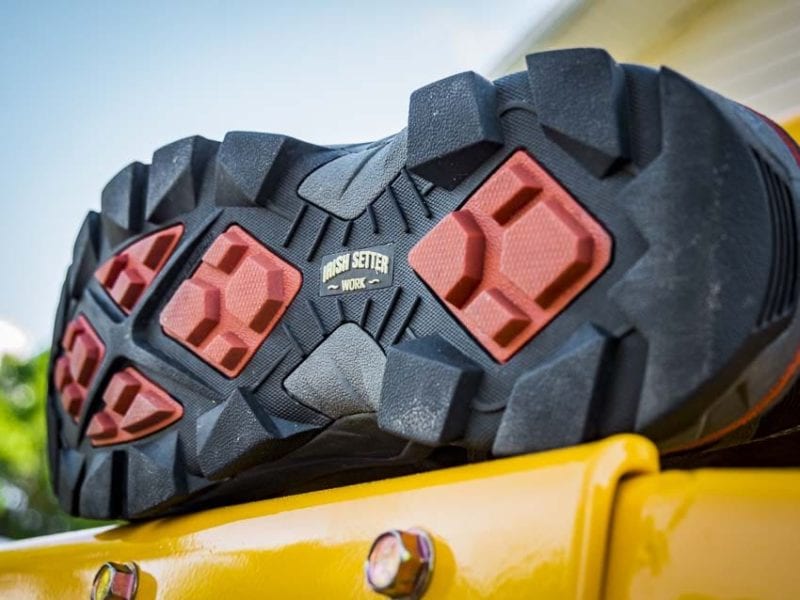
Let’s make a quick note about those wedge boots that I’m in love with thanks to their comfort. They’re great on hard, clean-ish surfaces like concrete and asphalt. However, their tread pattern is shallow, more prone to hold onto mud, and they aren’t great for climbing. They’re not the best choice for varying jobsite conditions. If you’re going to have a pair (and I hope you do!), be very particular about the environments you wear them in.
Did We Mention Comfort is King?
Whether it’s buying your first racing bike or a pair of high-quality works boots, if they aren’t comfortable, you won’t use them. We say that some boots “wear lighter than they are”, meaning that they absorb enough pounding throughout the day that our legs and feet don’t feel as fatigued at the end of the day.
It starts with the proper fit. I’m a 12-1/2 and no one carries that size in work boots. Normally, I wear a 13 but occasionally have to move down to a 12. It’s easy enough to get it right in the store. If you’re ordering online, be sure to check the return policy. Some companies give you 30 days to swap them out. Some even cover the shipping costs if you buy from them directly. It’s better to take the time for a replacement that fits right than hate your boots for the next 6 or 12 months!
There are plenty of other things to look at as well. A flexible boot with a shock absorbing midsole and quality insole that gives you proper arch support goes a long way for comfort. If you’re not blessed with “normal” feet (what the heck is a normal foot, anyway?), the key to comfort might be as simple as swapping the insole for an orthopedic that’s better for your foot.
Look for waterproof, breathable works boots. They wick away sweat and moisture from the inside while repelling water on the outside. They won’t keep your feet perfectly dry if you sweat a lot (guilty!), but they’re great at keeping it to a manageable and comfortable level.
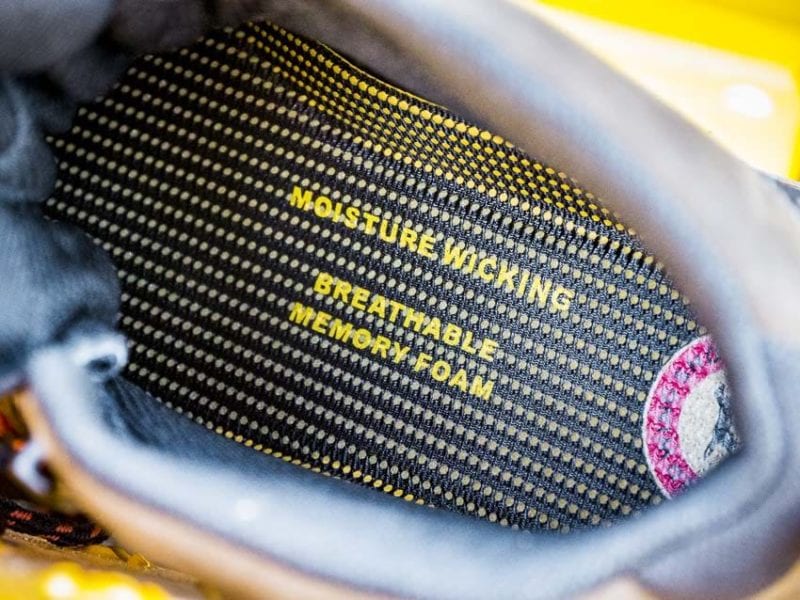
Don’t be afraid to ask about comfort technologies. Even though they have eye-catching names, they’re very real improvements over standard boots construction.
Electricians Should Buy Quality Work Boots
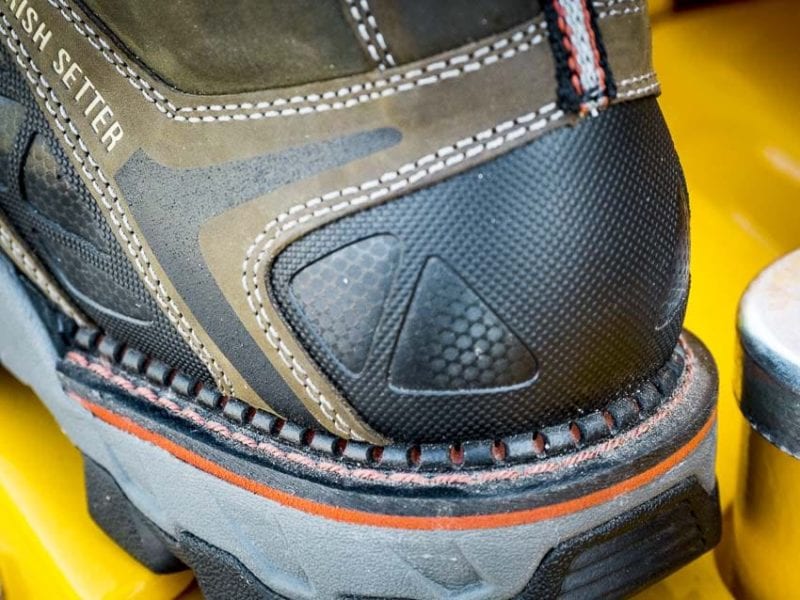
When you’re choosing the best work boots for electricians, there’s a good chance you’re buying a quality boot if you checked off all the boxes above. However, consider the quality of the build itself. Check to see how well the materials are stitched together. Look for double and triple stitching for the best build.
Also, consider how the shoe comes together. Cementing is a glue that has the best flexibility and the lowest durability. Direct attachments use an injection system that creates a bond between the upper and lower. Welting is the strongest of all connections with the trade-off that it’s usually not as flexible.
The combination of all of these ideas and how you prioritize them against the price of the boot should be the deciding factor. Buying a pair of premium boots is nice—just make sure you understand what you’re getting and that it fits your day-to-day work as an electrician.
Hopefully, this guide helped you on your way to buying the best possible boots. In the end, you want boots that fit comfortably, meet your budget, and last a long time. In this case, two out of three simply isn’t good enough.
Why You Can Trust Pro Tool Reviews
We only recommend what we wear, even if we don’t earn a commission from it. It’s all about giving you a legitimate recommendation and our honest opinion of each electrician’s work boot.
We’ve been in business since 2008 covering tools, writing reviews, and reporting on industry news in the construction, automotive, and lawn care industries. Our Pro reviewers work in the trades and have the skills and experience to know whether tools can perform well in the field.
Each year, we bring in and review more than 350 individual products. Our team will put our hands on hundreds of additional tools at media events and trade shows throughout the year.
We consult with innovators in the technology and design of tools to gain a broader grasp of where these products fit and how they work.
We work with more than two dozen professional contractors around the United States who review products for us on real job sites and consult with us on testing methods, categories, and weighting.
We’ll provide more than 500 pieces of new content this year absolutely free for our readers—including objective evaluations of individual tools and products.
The result is information you can trust because of the editorial, scientific, and real-world professional experience we collectively utilize each time we pick up and test a tool.