
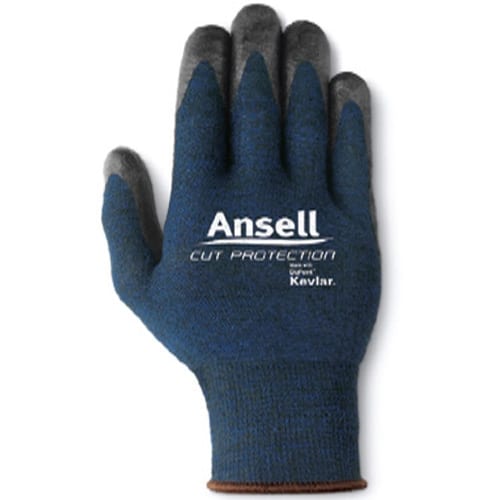
Whether you use gloves or not on the job site is one of those things we leave up to personal preference. At Pro Tool Reviews, most of our staff are full-time construction professionals and the trend seems to favor the wearing of gloves during most jobs involving woodworking, framing, or anything where building materials are being handled. Gloves simply offer protection and even allow faster work when you are handling materials that would, with bare hands, require a bit more caution. Let’s face it, it’s far quicker to grab and throw a piece of plywood when you don’t have to worry about getting splinters. While normal gloves offer protection on the job site, your razor knife can still slice through most. Ansell Cut Protection Kevlar gloves prevent these cuts.
Ansell Cut Protection Kevlar Gloves Features
No one wants a razor knife or a piece of aluminum to slice though your glove and into your hand. With the Ansell Cut Protection Kevlar gloves that fear seems to be somewhat diminished. We used a razor scraper knife and tried our best to slice though the Ansell gloves with no success. The secret to the strength is weaving DuPont Kevlar along with Ansell’s special yarn which makes it is virtually impossible to cut though, giving them an ANSI Level 4 protection. That accidental slip which could have been a trip to the emergency room for stitches (or worse) is now over.
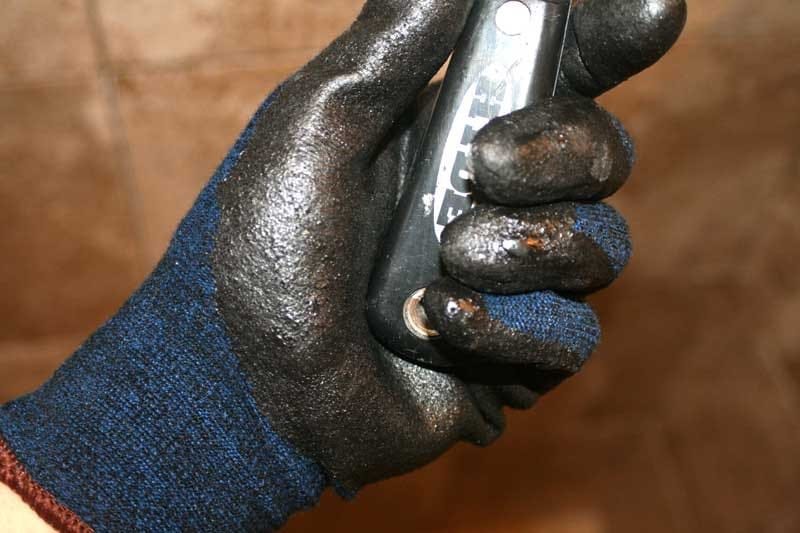
With the Ansell Cut Protection Kevlar gloves (available in sizes 8-10), the small details are what give them the edge over regular work gloves. Though they appear to be standard light weight, woven or knit style gloves, that is where the similarity ends. Using what Ansell calls Intercept Technology Stretch Armor Yarn, the entire body of the glove has the reinforcing materials woven though them.
Nitrile Glove Coating
For great wet and dry grip, the fingers and palms are covered with a foam “nitrile”. It looks as if the gloves were put on, and then someone stuck their palms and the bottoms of their fingers onto a thin rubber compound, absorbing a layer into the gloves themselves. It’s subtle, but offers a nice tactile grip for tools and building materials.
The gloves are comfortable to wear and fit close to the skin so that there is great dexterity and feeling. I even started typing up this review wearing the gloves… and well, they aren’t quite that dexterous! Not only are these handy for the construction pro but also anyone that handles sheet metal, knives, blades, sharpening tools and more. Air conditioning installers (or the people who own the companies) would do well to make these (or something like them) a regular part of their installers’ tool kits. The bottom line is that less injury means less downtime and better productivity.
Check out our article on the difference between nitrile vs latex work gloves.
Ansell Cut Protection Kevlar Gloves Applications
- Handling sharp and/or jagged materials (Stainless/Galvanized Steel, Aluminum)
- Thin Gauge Sheet Metal or Metal Studs
- Broken glass or sharp metal casings
- Applications where Cut/Lacerations/ Wood Splinters are highly probable (Fabrication & Demolition)
- Installation / Cutting / Mending / Demolition of Ductwork & or window frames
- Handling/Installing/cutting/setting ceramic/marble tile
- Handling wet/oily material where grip is important
- Tying Rebar
- Hardscaping or Demanding Landscaping Applications
Testing Kevlar Gloves
We donned a pair of Ansell’s Cut protection gloves and went to work on several renovation projects. We started off with installing some cement board for a tiled shower. Do you want to deliver some abuse to a pair of gloves? Try running them up and down the sides of some cement boards and using a 5-in-1 to chip away the edges of the board to clean up a cut prior to fitting.
What we found was that these Kevlar gloves felt comfortable and took up less “volume” on the hand. This meant that the gloves felt more a part of your hand than our standard $10 work gloves. Whereas our typical work gloves saved us a few bucks, they were far bulkier. Unlike the Ansell gloves, they didn’t allow us to easily use a cell phone or select bits from a tool kit. Earlier, I had actually purchased a pair of leather gloves. They turned out to be bulkier and offer less protection than the Ansell’s. They also cost 50% more!
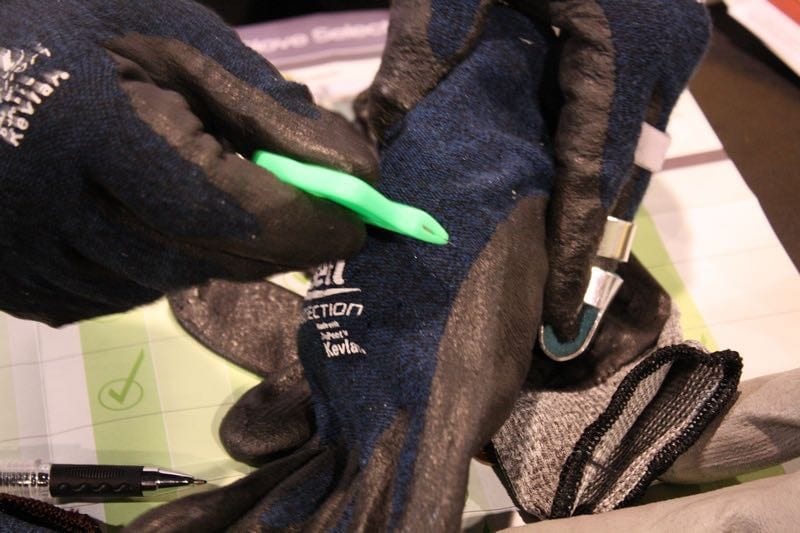
I know you want to hear that we took a razor knife to our gloves while they were on our hands. However, that simply wasn’t the case. No matter how great these gloves are, we’re not about to tempt fate. Instead, we used a plastic insert and cut through to that—or at least we tried to. If you are really determined, you can get a razor knife to penetrate, but it’s not easy. The glove held up pretty nicely when sliding a razor horizontally across its surface. Compared to our leather “reference” glove, the difference was staggering. If you thought simple leather was a good match for a sharp metal edge like a razor or sharp piece of aluminum, think again.
Conclusion
The Ansell Cut Protection Kevlar gloves are a pretty good deal all by themselves. Factor in the case where you might actually save your hands from a brutal cut and you’re looking at a pretty good deal. At the local home improvement store, these gloves sit right in the middle of the pricing spectrum. They also feel much lighter and seem more useful than most others we’ve used. To us, that seems like a pretty good place to sit. It puts these Ansell cut protection kevlar gloves at a tremendous value for professionals and do-it-yourselfers alike. We can highly recommend them.